

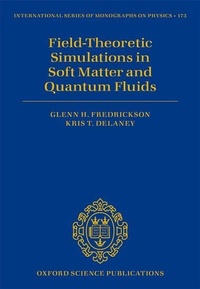
Field Theoretic Simulations in Soft Matter and Quantum Fluids
Published on 28. February 2023
Book
Hardback
400 pages
978-0-19-284748-5 (ISBN)
Description
This monograph provides an introduction to field-theoretic simulations in classical soft matter and Bose quantum fluids. The method represents a new class of molecular computer simulation in which continuous fields, rather than particle coordinates, are sampled and evolved. Field-theoretic simulations are capable of analysing the properties of systems that are challenging for traditional simulation techniques, including dense phases of high molecular weight polymers, self-assembling fluids, and quantum fluids at finite temperature.
The monograph details analytical methods for converting classical and quantum many-body problems to equilibrium field theory models with a molecular basis. Numerical methods are described that enable efficient, accurate, and scalable simulations of such models on modern computer hardware, including graphics processing units (GPUs). Extensions to non-equilibrium systems are discussed, along with an introduction to advanced field-theoretic simulation techniques including free energy estimation, alternative ensembles, coarse-graining, and variable cell methods.
The monograph details analytical methods for converting classical and quantum many-body problems to equilibrium field theory models with a molecular basis. Numerical methods are described that enable efficient, accurate, and scalable simulations of such models on modern computer hardware, including graphics processing units (GPUs). Extensions to non-equilibrium systems are discussed, along with an introduction to advanced field-theoretic simulation techniques including free energy estimation, alternative ensembles, coarse-graining, and variable cell methods.
Reviews / Votes
Field-Theoretic Simulations in Soft Matter and Quantum Fluids is a wonderful text that gives clear guidance for how to develop field theoretic models, including many recent developments, as well as best practices for implementing the most common algorithms. It is an indispensable guide for those working in the field. * Robert Riggleman, Professor, University of Pennsylvania * This book provides a delightfully clear and comprehensive guide to the theory and numerical methods required to perform field-theoretic simulations. Suitable for both the novice and the experienced alike, Fredrickson and Delaney have given us a gem to read and reference for years to come. * Joshua Lequieu, Assistant Professor, Drexel University * The book exhibits the striking parallelisms of statistical and quantum field theories, advocates the coherent states formulation as a natural choice for reactive systems, and dives deeply into the implementation of field theoretical sampling algorithms. It is a delightful surprise for those of us who have benefited from the first book by Prof. Fredrickson, and is a source of inspirations for both ambitious graduate students and seasoned researchers. * Jian Qin, Assistant Professor, Stanford University *More details
Series
Language
English
Place of publication
Oxford
United Kingdom
Target group
Professional and scholarly
Product notice
sewn/stitched
Cloth over boards
Illustrations
58 line drawings and halftones
Dimensions
Height: 250 mm
Width: 174 mm
Thickness: 25 mm
Weight
960 gr
ISBN-13
978-0-19-284748-5 (9780192847485)
Copyright in bibliographic data and cover images is held by Nielsen Book Services Limited or by the publishers or by their respective licensors: all rights reserved.
Schweitzer Classification
Other editions
Additional editions

Glenn Fredrickson | Kris Delaney
Field-Theoretic Simulations in Soft Matter and Quantum Fluids
Book
03/2025
Oxford University Press
€61.00
Shipment within 15-20 days
Glenn Fredrickson | Kris Delaney
Field Theoretic Simulations in Soft Matter and Quantum Fluids
E-Book
02/2023
1st Edition
OUP eBook
€112.99
Available for download
Persons
Glenn H. Fredrickson is a soft matter theorist recognized for his work on self-assembling polymers, especially block copolymers. He pioneered the "field-theoretic simulation" technique that has been widely deployed to assess the structure and phase behavior of complex, multiphase polymer systems. Fredrickson was born in Washington, D.C., and grew up in Indialantic, Florida. He graduated from the University of Florida with a B.S. degree in chemical engineering and received M.S. and Ph.D. degrees in the same discipline from Stanford University. In 1984, he joined AT&T Bell Laboratories as a Member of Technical Staff, and moved to the University of California, Santa Barbara (UCSB) in 1990 as a Professor of Chemical Engineering and Materials. Fredrickson is currently a Distinguished Professor at UCSB. He is a member of the National Academy of Sciences and the National Academy of Engineering of the USA.
Kris T. Delaney is a condensed matter physicist with expertise in polymer physics, quantum many-body theory, magnetism, numerical analysis, and high-performance computing. Delaney was born in Warrington, United Kingdom, and received his M.Phys. and Ph.D. degrees in theoretical physics and physics, respectively, from the University of York. Following postdoctoral work in physics at the University of Illinois at Urbana-Champaign, he joined the Materials Research Laboratory at the University of California, Santa Barbara, in 2006, where he is currently a Project Scientist.
Kris T. Delaney is a condensed matter physicist with expertise in polymer physics, quantum many-body theory, magnetism, numerical analysis, and high-performance computing. Delaney was born in Warrington, United Kingdom, and received his M.Phys. and Ph.D. degrees in theoretical physics and physics, respectively, from the University of York. Following postdoctoral work in physics at the University of Illinois at Urbana-Champaign, he joined the Materials Research Laboratory at the University of California, Santa Barbara, in 2006, where he is currently a Project Scientist.
Content
1: Introduction
2: Classical Equilibrium Theory: Particles to Fields
3: Quantum Equilibrium Theory: Particles to Fields
4: Numerical Methods for Field Operations
5: Numerical Methods for Field-Theoretic Simulations
6: Non-equilibrium Extensions
7: Advanced Simulation Methods
2: Classical Equilibrium Theory: Particles to Fields
3: Quantum Equilibrium Theory: Particles to Fields
4: Numerical Methods for Field Operations
5: Numerical Methods for Field-Theoretic Simulations
6: Non-equilibrium Extensions
7: Advanced Simulation Methods