

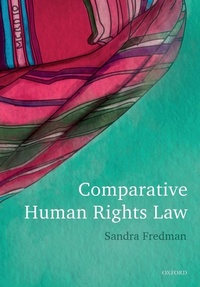
Comparative Human Rights Law
Published on 15. November 2018
Book
Paperback/Softback
512 pages
978-0-19-968941-5 (ISBN)
Description
Courts in different jurisdictions face similar human rights questions. Does the death penalty breach human rights? Does freedom of speech include racist speech? Is there a right to health? This book uses the prism of comparative law to examine the fascinating ways in which these difficult questions are decided. On the one hand, the shared language of human rights suggests that there should be similar solutions to comparable problems. On the other hand, there are important differences. Constitutional texts are worded differently; courts have differing relationships with the legislature; and there are divergences in socio-economic development, politics, and history. Nevertheless, there is a growing transnational conversation between courts, with cases in one jurisdiction being cited in others.
Part I sets out the cross-cutting themes which shape the ways judges respond to challenging human rights issues. It examines when it is legitimate to refer to foreign materials; how universality and cultural relativity are balanced in human rights law; the appropriate role of courts in adjudicating human rights in a democracy; and the principles judges use to interpret human rights texts. The book is unusual in transcending the distinction between socio-economic rights and civil and political rights. Part II applies these cross-cutting themes to comparing human rights law in the US, UK, South Africa, Canada, and India. Its focus is on seven particularly challenging issues: the death penalty, abortion, housing, health, speech, education and religion, with the aim of inspiring further comparative examination of other pressing human rights issues.
Part I sets out the cross-cutting themes which shape the ways judges respond to challenging human rights issues. It examines when it is legitimate to refer to foreign materials; how universality and cultural relativity are balanced in human rights law; the appropriate role of courts in adjudicating human rights in a democracy; and the principles judges use to interpret human rights texts. The book is unusual in transcending the distinction between socio-economic rights and civil and political rights. Part II applies these cross-cutting themes to comparing human rights law in the US, UK, South Africa, Canada, and India. Its focus is on seven particularly challenging issues: the death penalty, abortion, housing, health, speech, education and religion, with the aim of inspiring further comparative examination of other pressing human rights issues.
Reviews / Votes
Fredman brings her experience and knowledge forth to give a concise background on the last 70 years of the study and practice of this area of law ... At the conclusion of the treatise, readers will have a better understanding of the difficulties faced in defining what these rights are and how to judiciously find meaning and application. Fredman allows the reader to reach their own conclusions on these rights while providing a narrative of past judicial interpretation concerning these global issues. * Christine Bowersox, DipLawMatic Dialogues *More details
Language
English
Place of publication
Oxford
United Kingdom
Target group
College/higher education
Professional and scholarly
Dimensions
Height: 244 mm
Width: 170 mm
Thickness: 27 mm
Weight
877 gr
ISBN-13
978-0-19-968941-5 (9780199689415)
Copyright in bibliographic data and cover images is held by Nielsen Book Services Limited or by the publishers or by their respective licensors: all rights reserved.
Schweitzer Classification
Other editions
Additional editions
Sandra Fredman
Comparative Human Rights Law
E-Book
11/2018
1st Edition
OUP eBook
€46.99
Available for download
Sandra Fredman
Comparative Human Rights Law
E-Book
11/2018
1st Edition
OUP eBook
€42.49
Available for download
Person
Sandra Fredman is Rhodes Professor of the Laws of the British Commonwealth and the USA at Oxford University. She was elected a Fellow of the British Academy in 2005 and became a QC (honoris causa) in 2012. She is Honorary Professor of Law at the University of Cape Town and a fellow of Pembroke College Oxford. She has acted as an expert adviser on equality law and labour legislation in the EU, Northern Ireland, the UK, India, South Africa, Canada, and the UN; and is a barrister practising at Old Square Chambers. She founded the Oxford Human Rights Hub in 2012, of which she is the Director.
Content
Part I
1: Foreign Fads or Fashions: The Role of Comparativism in Human Rights Law
2: What is a Human Right? Dealing with Disagreement
3: Challenging the Divide: Socio-economic Rights as Human Rights
4: Allies or Subversives: Adjudication and Democracy
5: Interpreting Human Rights Law
Part II
6: Capital Punishment
7: Abortion
8: The Right to Health
9: The Right to Housing
10: Freedom of Speech
11: The Right to Education
12: Freedom of Religion
13: Conclusion
1: Foreign Fads or Fashions: The Role of Comparativism in Human Rights Law
2: What is a Human Right? Dealing with Disagreement
3: Challenging the Divide: Socio-economic Rights as Human Rights
4: Allies or Subversives: Adjudication and Democracy
5: Interpreting Human Rights Law
Part II
6: Capital Punishment
7: Abortion
8: The Right to Health
9: The Right to Housing
10: Freedom of Speech
11: The Right to Education
12: Freedom of Religion
13: Conclusion