

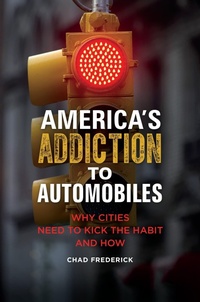
America's Addiction to Automobiles
Why Cities Need to Kick the Habit and How
Published on 21. September 2017
Book
Hardback
256 pages
978-1-4408-5280-0 (ISBN)
Description
A provocative look at our nation's dependency on the automobile and how its potential impact on urban design will either make or break our health, economy, and quality of life.
In this thought-provoking work, author and urban planning expert Chad Frederick scrutinizes the use of automobiles in cities, investigating its role in exacerbating urban inequalities and thwarting sustainability of modern society. Through a comprehensive, thoughtful discussion, Frederick illustrates how the automobile is fundamentally at odds with the very nature of cities. He shows how cars impose huge burdens on our health, equity, environment, local and national economy, and quality of life. Most of all, he shows how automobile dependency has put our entire society at risk.
The book delves into the monumental role of automobiles in the development of cities after the Great Depression, impacting the American identity and affecting the way we produce and manage urban spaces. Frederick provides compelling evidence that cities with more diverse modes of transportation are greener, healthier, more prosperous, and even more enjoyable places to live than automobile-dependent cities. He identifies one institution responsible for our inability to improve our cities: the social sciences, and examines the root cause of our inability to make progress toward more multi-modal cities. In conclusion, the author offers a radical solution for moving beyond the underlying logic that forces us to create automobile-dependent cities.
In this thought-provoking work, author and urban planning expert Chad Frederick scrutinizes the use of automobiles in cities, investigating its role in exacerbating urban inequalities and thwarting sustainability of modern society. Through a comprehensive, thoughtful discussion, Frederick illustrates how the automobile is fundamentally at odds with the very nature of cities. He shows how cars impose huge burdens on our health, equity, environment, local and national economy, and quality of life. Most of all, he shows how automobile dependency has put our entire society at risk.
The book delves into the monumental role of automobiles in the development of cities after the Great Depression, impacting the American identity and affecting the way we produce and manage urban spaces. Frederick provides compelling evidence that cities with more diverse modes of transportation are greener, healthier, more prosperous, and even more enjoyable places to live than automobile-dependent cities. He identifies one institution responsible for our inability to improve our cities: the social sciences, and examines the root cause of our inability to make progress toward more multi-modal cities. In conclusion, the author offers a radical solution for moving beyond the underlying logic that forces us to create automobile-dependent cities.
Reviews / Votes
This is a well-reasoned, clearly organized text that makes its points with scholarly passion. Frederick's point that 'knowing what to do is not enough' sounds like a clear call to action. * Choice *More details
Language
English
Place of publication
United States
Publishing group
Bloomsbury Publishing Plc
Dimensions
Height: 240 mm
Width: 161 mm
Thickness: 18 mm
Weight
552 gr
ISBN-13
978-1-4408-5280-0 (9781440852800)
Copyright in bibliographic data and cover images is held by Nielsen Book Services Limited or by the publishers or by their respective licensors: all rights reserved.
Schweitzer Classification
Other editions
Additional editions
E-Book
09/2017
1st Edition
Praeger Publishers Inc
€55.99
Available for download
E-Book
09/2017
1st Edition
Praeger Publishers Inc
€55.99
Available for download
Person
Chad Frederick, PhD, is an assistant professor of geography and sustainable planning at Grand Valley State University, in Grand Rapids, Michigan, and the senior research associate at the Center for Sustainable Urban Neighborhoods at the University of Louisville.
Content
Series Foreword
Introduction
PART 1: THINKING ABOUT THE PROBLEM
1. Our Addiction
2. Cities: The Immovable Objects
3. Automobiles: The Irresistible Force
4. Social Science
5. Sustainability
PART 2: LOOKING AT THE PROBLEM OF AUTOMOBILE DEPENDENCY
6. A Sketch of the City
7. The Cities in the Sketch
8. Public Health
9. Airborne Emissions
10. Economic Inequality
11. Quality of Life
Summary: An Epiphany for an Automobile-Addicted Country
PART 3: SOLVING THE PROBLEM OF AUTOMOBILE-DEPENDENT CITIES
12. Applying a New Logic
Appendix
Bibliography
Index
About the Author
About the Series and Series Editor
Introduction
PART 1: THINKING ABOUT THE PROBLEM
1. Our Addiction
2. Cities: The Immovable Objects
3. Automobiles: The Irresistible Force
4. Social Science
5. Sustainability
PART 2: LOOKING AT THE PROBLEM OF AUTOMOBILE DEPENDENCY
6. A Sketch of the City
7. The Cities in the Sketch
8. Public Health
9. Airborne Emissions
10. Economic Inequality
11. Quality of Life
Summary: An Epiphany for an Automobile-Addicted Country
PART 3: SOLVING THE PROBLEM OF AUTOMOBILE-DEPENDENT CITIES
12. Applying a New Logic
Appendix
Bibliography
Index
About the Author
About the Series and Series Editor