

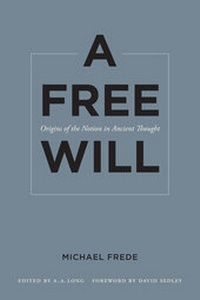
A Free Will
Origins of the Notion in Ancient Thought
1st Edition
Will be published approx. on 1. February 2011
Book
Hardback
224 pages
978-0-520-26848-7 (ISBN)
Description
Where does the notion of free will come from? How and when did it develop, and what did that development involve? In Michael Frede's radically new account of the history of this idea, the notion of a free will emerged from powerful assumptions about the relation between divine providence, correctness of individual choice, and self-enslavement due to incorrect choice. Anchoring his discussion in Stoicism, Frede begins with Aristotle - who, he argues, had no notion of a free will - and ends with Augustine. Frede shows that Augustine, far from originating the idea (as is often claimed), derived most of his thinking about it from the Stoicism developed by Epictetus.
Reviews / Votes
"In this posthumously published volume, comprising lectures delivered in Berkeley in fall 1997, Frede reflects on the concept of a free will in ancient thought." "Summing Up: Highly recommended." -- J Bussanich Choice "...One can only feel awe before the breadth of [Frede's] learning and the depth of his insight." -- Charles Kahn Archiv fur Geschichte der PhilosophieMore details
Series
Edition
First Edition
Language
English
Place of publication
Berkerley
United States
Target group
Professional and scholarly
Product notice
Cloth over boards
Dimensions
Height: 210 mm
Width: 140 mm
Thickness: 23 mm
Weight
408 gr
ISBN-13
978-0-520-26848-7 (9780520268487)
Copyright in bibliographic data and cover images is held by Nielsen Book Services Limited or by the publishers or by their respective licensors: all rights reserved.
Schweitzer Classification
Other editions
Additional editions
E-Book
02/2011
1st Edition
Naval Institute Press
€28.99
Available for download
Persons
Michael Frede, who died in 2007, held positions successively in the departments of philosophy at the University of California, Berkeley, Princeton University, and Oxford University, where he held the Chair of the History of Philosophy. In 1997-1998, he was Sather Professor of Classical Literature at UC Berkeley, where he delivered the lectures that make up this volume. A. A. Long is Professor of Classics, Irving Stone Professor of Literature, and Affiliated Professor of Philosophy at the University of California, Berkeley. He is the author of Epictetus: A Stoic and Socratic Guide to Life and From Epicurus to Epictetus: Studies in Hellenistic and Roman Philosophy. David Sedley is Lawrence Professor of Ancient Philosophy at the University of Cambridge and the author of Creationism and Its Critics in Antiquity (UC Press).
Content
Foreword Editor's Preface Chapter 1. Introduction Chapter 2. Aristotle on Choice without a Will Chapter 3. The Emergence of a Notion of Will in Stoicism Chapter 4. Later Platonist and Peripatetic Contributions Chapter 5. The Emergence of a Notion of a Free Will in Stoicism Chapter 6. Platonist and Peripatetic Criticisms and Responses Chapter 7. An Early Christian View on a Free Will: Origen Chapter 8. Reactions to the Stoic Notion of a Free Will: Plotinus Chapter 9. Augustine: A Radically New Notion of a Free Will? Chapter 10. Conclusion Abbreviations Notes Bibliography Index