

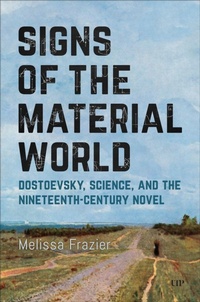
Signs of the Material World
Dostoevsky, Science, and the Nineteenth-Century Novel
Published on 16. April 2025
Book
Hardback
234 pages
978-1-4875-6070-6 (ISBN)
Description
Signs of the Material World traces the literary effects of nineteenth-century materialism that includes the mind and body within a multifaceted "living life." The book examines a range of scientists, from Auguste Comte and the "vulgar" materialists to Charles Darwin, James Clerk Maxwell, George Henry Lewes, Charles Sanders Peirce, and the Russian Nikolai Strakhov.
The book sets Fyodor Dostoevsky in complex opposition to his fellow writers, Lev Tolstoy and Nikolai Chernyshevsky, while also exploring the formal connections that he shares with contemporaries across Europe and the United States, including Wilkie Collins, Charles Dickens, George Eliot, Nathaniel Hawthorne, and Friedrich Schiller. Melissa Frazier argues that Dostoevsky's art serves as his science, both in his reliance on plot and in his recourse to an often-extravagant figurative language.
This combined literary and scientific practice reflects Dostoevsky's transnational and interdisciplinary reading; it also transforms our own. In George Eliot's words, Dostoevsky "changes the lights for us." Once drawn into his orbit, Eliot herself no longer looks quite the same. Finally, Signs of the Material World argues that Eliot and Dostoevsky's particular strain of nineteenth-century materialism lends itself to an ambivalent political stance, as they both confront the certainties of social utopianism with a deliberate embrace of ambiguity.
The book sets Fyodor Dostoevsky in complex opposition to his fellow writers, Lev Tolstoy and Nikolai Chernyshevsky, while also exploring the formal connections that he shares with contemporaries across Europe and the United States, including Wilkie Collins, Charles Dickens, George Eliot, Nathaniel Hawthorne, and Friedrich Schiller. Melissa Frazier argues that Dostoevsky's art serves as his science, both in his reliance on plot and in his recourse to an often-extravagant figurative language.
This combined literary and scientific practice reflects Dostoevsky's transnational and interdisciplinary reading; it also transforms our own. In George Eliot's words, Dostoevsky "changes the lights for us." Once drawn into his orbit, Eliot herself no longer looks quite the same. Finally, Signs of the Material World argues that Eliot and Dostoevsky's particular strain of nineteenth-century materialism lends itself to an ambivalent political stance, as they both confront the certainties of social utopianism with a deliberate embrace of ambiguity.
More details
Language
English
Place of publication
Toronto
Canada
Target group
College/higher education
Professional and scholarly
Product notice
sewn/stitched
Cloth over boards
Dimensions
Height: 229 mm
Width: 152 mm
Thickness: 25 mm
Weight
445 gr
ISBN-13
978-1-4875-6070-6 (9781487560706)
Copyright in bibliographic data and cover images is held by Nielsen Book Services Limited or by the publishers or by their respective licensors: all rights reserved.
Schweitzer Classification
Person
Melissa Frazier is a professor of Russian language and Russian and comparative literature at Sarah Lawrence College.
Content
Acknowledgments
Note on Citation
Dostoevsky, Science, and Nineteenth-Century Novel
1. Nineteenth-Century Materialisms
2. Of Doctors and Detectives, Chemistry and Mathematics
3. Bodies and Plots
4. Metaphor and Allegory
5. Social Physics
Last Words and Open Endings
Notes
Works Cited
Index
Note on Citation
Dostoevsky, Science, and Nineteenth-Century Novel
1. Nineteenth-Century Materialisms
2. Of Doctors and Detectives, Chemistry and Mathematics
3. Bodies and Plots
4. Metaphor and Allegory
5. Social Physics
Last Words and Open Endings
Notes
Works Cited
Index