

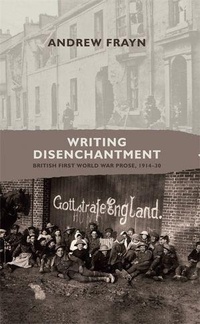
Writing Disenchantment
British First World War Prose, 1914-30
Published on 30. September 2014
Book
Hardback
272 pages
978-0-7190-8922-0 (ISBN)
Description
It has become axiomatic that First World War literature was disenchanted, or disillusioned, and returning combatants were unable to process or communicate that experience. In Writing disenchantment, Andrew Frayn argues that this was not just about the war: non-combatants were just as disenchanted as those who fought, and writers such as D. H. Lawrence and Virginia Woolf produced some of the sharpest criticisms. Its language already existed in contemporary sociological and historical accounts of the problems of mass culture and the modern city, whose structures contained the conflict and were strengthened during it.
Archival material, sales data and reviews are used to chart disenchantment in a wide range of early twentieth-century war literature from novels about fears of invasion and pacifism, through the modernist novels of the 1920s to its dominance in the War Books Boom of 1928-30. This book will appeal to scholars and students of English literature, social and cultural history, and gender studies. -- .
Archival material, sales data and reviews are used to chart disenchantment in a wide range of early twentieth-century war literature from novels about fears of invasion and pacifism, through the modernist novels of the 1920s to its dominance in the War Books Boom of 1928-30. This book will appeal to scholars and students of English literature, social and cultural history, and gender studies. -- .
Reviews / Votes
'A nuanced, sophisticated book that advances its insights through careful readings of works both iconic and very nearly forgotten. The pairing of high modernist with mass-cultural novels is ingenious, and reveals the overarching coherence of British culture in the Great War.'Stephen Ross, University of Victoria
'Andrew Frayn's Writing Disenchantment is a signal achievement - an original, thoughtful book that forces us to think again about both the Great War's legacies, and the relationship between British society, culture, and economy in the widest possible sense. Keenly attentive to the politically charged nature of writing about war and its aftermath, and ranging across ostensibly discrete forms of 'mass' and 'modernist' writing, Frayn shows how disenchantment became a keynote in the formation of British modernities. Vital reading for literary critics and historians working on this period, Writing Disenchantment is also an excellent critical introduction to the contested memories of the Great War for undergraduate and postgraduate students.'
Matt Houlbrook, Professor of Cultural History, University of Birmingham -- .
More details
Edition
UK edition
Language
English
Place of publication
Manchester
United Kingdom
Product notice
sewn/stitched
Cloth over boards
With dust jacket
Illustrations
Illustrations, black & white
Dimensions
Height: 216 mm
Width: 140 mm
Thickness: 23 mm
Weight
454 gr
ISBN-13
978-0-7190-8922-0 (9780719089220)
Copyright in bibliographic data and cover images is held by Nielsen Book Services Limited or by the publishers or by their respective licensors: all rights reserved.
Schweitzer Classification
Other editions
Additional editions
E-Book
11/2015
1st Edition
Manchester University Press
€189.99
Available for download
E-Book
11/2015
1st Edition
Manchester University Press
from
€189.99
Available for download
Person
Andrew Frayn is Lecturer in Twentieth-Century Literature and Culture at Edinburgh Napier University -- .
Content
Introduction
1. Patriotism, propaganda and pacifism, 1914-18
2. Hope to Disenchantment, 1919-22
3. Modernism, conflict and the Home Front, 1922-27
4. Sagas and series, 1924-28
5. Popular disenchantment: the war books boom, 1928-30
Conclusion
Index -- .
1. Patriotism, propaganda and pacifism, 1914-18
2. Hope to Disenchantment, 1919-22
3. Modernism, conflict and the Home Front, 1922-27
4. Sagas and series, 1924-28
5. Popular disenchantment: the war books boom, 1928-30
Conclusion
Index -- .