

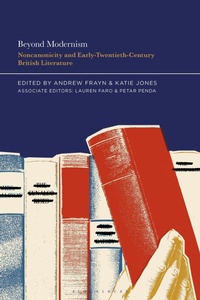
Beyond Modernism
Noncanonicity and Early-Twentieth-Century British Literature
Will be published approx. on 20. August 2026
Book
Hardback
264 pages
978-1-350-53643-2 (ISBN)
Description
Underlining (and undermining) the notion of literary merit, this book focuses on noncanonical works and asks: what happens when we look away from modernism?
Seeking an alternative history of British literature from 1890 to 1945, this book reflects on the processes by which canonicity happens by studying less familiar authors, othered by genre, gender and form. This book deliberately looks away from the British modernist canon of the late nineteenth and early twentieth century, bringing into sharp relief the problematic nature of discussions about literary merit.
Engaging with topics such as politics, nation and identity in bestsellers, work straddling art and literature, the complex relationships between conservatism and progressive movements such as suffragism, and the importance of popular science writing, in authors such as Stella Benson, Dorothy Edwards, Violet Hunt and Hugh Walpole, it brings to bear valuable new perspectives on the cultural history of this period.
Seeking an alternative history of British literature from 1890 to 1945, this book reflects on the processes by which canonicity happens by studying less familiar authors, othered by genre, gender and form. This book deliberately looks away from the British modernist canon of the late nineteenth and early twentieth century, bringing into sharp relief the problematic nature of discussions about literary merit.
Engaging with topics such as politics, nation and identity in bestsellers, work straddling art and literature, the complex relationships between conservatism and progressive movements such as suffragism, and the importance of popular science writing, in authors such as Stella Benson, Dorothy Edwards, Violet Hunt and Hugh Walpole, it brings to bear valuable new perspectives on the cultural history of this period.
Reviews / Votes
Beyond Modernism is a bold, thoroughly researched, collective manifesto about the value of reading noncanonically as a critical practice. Its theoretical framework promises to reshape our research, publishing, and teaching on noncanonical modern British writers, reminding us amid the clatter of the skeptics in the popular press why literary study and literary criticism still matter. * Kristin Bluemel, Monmouth University * Beyond Modernism advocates for reading noncanonically - not to expand the modernist canon but to resist it. These lively, surprising essays reveal the alternative value systems that are articulated through the unserious, the excessive, the mislaid texts of the era. -- Faye Hammill, Professor of English Literature and Canadian Studies, University of Glasgow, UKMore details
Language
English
Place of publication
London
United Kingdom
Publishing group
Bloomsbury Publishing PLC
Target group
Professional and scholarly
Product notice
Laminated cover
Illustrations
3 bw illus
Dimensions
Height: 234 mm
Width: 156 mm
Thickness: 14 mm
Weight
454 gr
ISBN-13
978-1-350-53643-2 (9781350536432)
Copyright in bibliographic data and cover images is held by Nielsen Book Services Limited or by the publishers or by their respective licensors: all rights reserved.
Schweitzer Classification
Other editions
Additional editions
Andrew Frayn | Katie Jones
Beyond Modernism
Noncanonicity and Early-Twentieth-Century British Literature
E-Book
approx. 07/2026
Bloomsbury Academic
€94.49
Available for download
Andrew Frayn | Katie Jones
Beyond Modernism
Noncanonicity and Early-Twentieth-Century British Literature
E-Book
approx. 07/2026
Bloomsbury Academic
€94.49
Available for download
Persons
Andrew Frayn is Associate Professor of Twentieth-Century Literature and Culture at Edinburgh Napier University, UK
Katie Jones is a Post-Doctoral Researcher at Swansea University, UK
Katie Jones is a Post-Doctoral Researcher at Swansea University, UK
Content
List of figures
Notes on contributors
Acknowledgements
Introduction: Beyond Modernism, Andrew Frayn (Edinburgh Napier University, UK) and Katie Jones (Swansea University, UK)
Section 1: Genre
Introduction, Andrew Frayn (Edinburgh Napier University, UK) and Katie Jones (Swansea University, UK)
1. Serious Rivals: Popular Physics Writing as Noncanonical Literature, Michael H. Whitworth (University of Oxford, UK)
2. 'I Hate Practical Englishmen': Hugh Walpole's The Dark Forest (1916), Anglo-Russian Encounter, and the modern-period canon, Nicholas Birns (New York University, USA)
3. 'Salute John Citizen': Forgetting and Remembering Robert Greenwood's People's War Novels (1940-1949)', Chris Hopkins (Sheffield Hallam University, UK)
4. The Anxious Modern Woman: Elizabeth Taylor's Early Fiction, Jessica Gildersleeve (University of Southern Queensland, Australia)
Section 2: Form
Introduction, Andrew Frayn (Edinburgh Napier University, UK) and Katie Jones (Swansea University, UK)
5. 'Civilisation is on the Edge of a Precipice' : interdisciplinarity and next-war fiction in Princess Paul Troubetzkoy and C.R.W. Nevinson's Exodus A.D. (1934), Thomas Bromwell (Paul Mellon Centre for Studies in British Art, UK)
6. 'A Fugal Siege': Sacheverell Sitwell's Canons of Giant Art (1933), Allan Pero (University of Western Ontario, London, Canada)
7. Jessica Dismorr: Vorticism's Forgotten Voice, Lauren Faro (Independent scholar)
8. '[A] writer of murk': reading Oswell Blakeston's obscurity, Polly Hember (Royal Holloway, University of London, UK)
Section 3: Gender
Introduction, Andrew Frayn (Edinburgh Napier University, UK) and Katie Jones (Swansea University, UK)
9. Postcolonial Interactions with British Non-Canonicity: Begum Rokeya Sakhawat Hossain's 'Sultana's Dream' (1905) and 'Padmarag' (1924) as Feminist Utopias, Rehnuma Sazzad (University of London, UK)
10. Forced Independence: The Complicated, Non-Canonical Feminism of Violet Hunt, Melissa Dinsman (York College of the City University of New York, USA) and Heather Robinson (York College of the City University of New York, USA)
11. Mourning the Canon: Exclusivity, Exclusion and Dorothy Edwards's Short Stories, Katie Jones (Swansea University, UK)
12. 'Being at Home in the World': Stella Benson's Goodbye, Stranger (1926), Nicola Darwood (University of Bedfordshire, UK)
13. Minding the gaps: Non canonicity and the cases of Rachel Annand Taylor and Rachel Cusk, Susan Reid (Independent Scholar)
Conclusion: Noncanonical futures... Andrew Frayn (Edinburgh Napier University, UK) and Katie Jones (Swansea University, UK)
Index
Notes on contributors
Acknowledgements
Introduction: Beyond Modernism, Andrew Frayn (Edinburgh Napier University, UK) and Katie Jones (Swansea University, UK)
Section 1: Genre
Introduction, Andrew Frayn (Edinburgh Napier University, UK) and Katie Jones (Swansea University, UK)
1. Serious Rivals: Popular Physics Writing as Noncanonical Literature, Michael H. Whitworth (University of Oxford, UK)
2. 'I Hate Practical Englishmen': Hugh Walpole's The Dark Forest (1916), Anglo-Russian Encounter, and the modern-period canon, Nicholas Birns (New York University, USA)
3. 'Salute John Citizen': Forgetting and Remembering Robert Greenwood's People's War Novels (1940-1949)', Chris Hopkins (Sheffield Hallam University, UK)
4. The Anxious Modern Woman: Elizabeth Taylor's Early Fiction, Jessica Gildersleeve (University of Southern Queensland, Australia)
Section 2: Form
Introduction, Andrew Frayn (Edinburgh Napier University, UK) and Katie Jones (Swansea University, UK)
5. 'Civilisation is on the Edge of a Precipice' : interdisciplinarity and next-war fiction in Princess Paul Troubetzkoy and C.R.W. Nevinson's Exodus A.D. (1934), Thomas Bromwell (Paul Mellon Centre for Studies in British Art, UK)
6. 'A Fugal Siege': Sacheverell Sitwell's Canons of Giant Art (1933), Allan Pero (University of Western Ontario, London, Canada)
7. Jessica Dismorr: Vorticism's Forgotten Voice, Lauren Faro (Independent scholar)
8. '[A] writer of murk': reading Oswell Blakeston's obscurity, Polly Hember (Royal Holloway, University of London, UK)
Section 3: Gender
Introduction, Andrew Frayn (Edinburgh Napier University, UK) and Katie Jones (Swansea University, UK)
9. Postcolonial Interactions with British Non-Canonicity: Begum Rokeya Sakhawat Hossain's 'Sultana's Dream' (1905) and 'Padmarag' (1924) as Feminist Utopias, Rehnuma Sazzad (University of London, UK)
10. Forced Independence: The Complicated, Non-Canonical Feminism of Violet Hunt, Melissa Dinsman (York College of the City University of New York, USA) and Heather Robinson (York College of the City University of New York, USA)
11. Mourning the Canon: Exclusivity, Exclusion and Dorothy Edwards's Short Stories, Katie Jones (Swansea University, UK)
12. 'Being at Home in the World': Stella Benson's Goodbye, Stranger (1926), Nicola Darwood (University of Bedfordshire, UK)
13. Minding the gaps: Non canonicity and the cases of Rachel Annand Taylor and Rachel Cusk, Susan Reid (Independent Scholar)
Conclusion: Noncanonical futures... Andrew Frayn (Edinburgh Napier University, UK) and Katie Jones (Swansea University, UK)
Index