

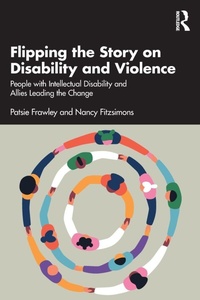
Flipping the Story on Disability and Violence
People with Intellectual Disability and Allies Leading the Change
1st Edition
Published on 30. September 2025
Book
Paperback/Softback
190 pages
978-1-032-91149-6 (ISBN)
Description
Internationally there is a growing awareness that domestic, family, and sexual violence is a social issue that results from social structures and relational contexts that have positioned women as 'less than' men. Alongside this growing awareness has come social action by women and their allies that aim to change these social and relational structures using an intersectional framing of oppression.
People with disabilities, especially people with an intellectual disability, have been largely excluded from this social action. However, for decades they have been challenging the oppressive social and relational structures that frame them as 'of less value' than 'non-disabled' people. Aligned with this self-advocacy are social ecological models that look systemically to understand why interpersonal violence occurs and to prevent violence. This book introduces a unique 'flipped' social ecological model and applies it to approaches from across the world that are working from the societal, community, relationship, and individual levels to challenge the 'vulnerable victim' discourse through positioning people with intellectual and other disabilities as social change agents shaping their safer lives.
Divided into six chapters and providing case-examples from Australia, the United States, New Zealand, the United Kingdom, Norway, Sweden, and the Global South, this book profiles work done by government and community-based anti-violence service sectors in partnership with people with intellectual disability and their allies, as well as work on sexuality rights and disability advocacy that is contributing to the social effort to prevent interpersonal violence against people with an intellectual disability.
It is a must-read resource for anyone doing interpersonal violence prevention research and work and can be used as primary or supplemental reading for students doing coursework and research in disability studies, gender studies, community psychology, sociology, public health, and social work.
People with disabilities, especially people with an intellectual disability, have been largely excluded from this social action. However, for decades they have been challenging the oppressive social and relational structures that frame them as 'of less value' than 'non-disabled' people. Aligned with this self-advocacy are social ecological models that look systemically to understand why interpersonal violence occurs and to prevent violence. This book introduces a unique 'flipped' social ecological model and applies it to approaches from across the world that are working from the societal, community, relationship, and individual levels to challenge the 'vulnerable victim' discourse through positioning people with intellectual and other disabilities as social change agents shaping their safer lives.
Divided into six chapters and providing case-examples from Australia, the United States, New Zealand, the United Kingdom, Norway, Sweden, and the Global South, this book profiles work done by government and community-based anti-violence service sectors in partnership with people with intellectual disability and their allies, as well as work on sexuality rights and disability advocacy that is contributing to the social effort to prevent interpersonal violence against people with an intellectual disability.
It is a must-read resource for anyone doing interpersonal violence prevention research and work and can be used as primary or supplemental reading for students doing coursework and research in disability studies, gender studies, community psychology, sociology, public health, and social work.
Reviews / Votes
Patsie and Nancy's book is a collective celebration of what is possible when people with disability take their place at the centre of their own lives and raise their voice; and what happens when their voices are listened to and a community shares accountability to act together.Sheridan Kerr, PhD, Safer Me Safer You, SHFPACT, Australia
Flipping the Story on Disability and Violence is a must-read for anyone in the violence prevention field who supports the "Nothing About Us Without Us" motto and aims to address the societal root causes of violence against people with developmental disabilities.
Katherine McLaughlin, M.Ed, CSE, Elevatus Training, USA
Globally, people with disabilities experience inequitable and unacceptable levels of violence. This contemporary text explains instructive theory, outlines new and existing evidence, and showcases effective initiatives and approaches to preventing and responding to violence against people with a disability. In doing so, it provides critical guidance to support sustained change.
Brigit Mirfin-Veitch, PhD, Associate Professor and Director Donald Beasley Institute, Aotearoa New Zealand
Patsie Frawley and Nancy Fitzsimons shine a light on prioritizing self-advocacy and person-centered approaches to violence prevention for individuals with intellectual disability. I encourage stakeholders to read their thought-provoking approaches.
Tara Ahern, Illinois,Self-Advocacy Alliance, USA
The account is an insight into the important contribution that is made by people with disabilities, for people with disabilities. We encourage others to use this resource as a tool to consider how lived experience, whether that be people of with intellectual and cognitive disabilities, victim-survivors of sexual harm, or both can inform their work.
Rachael Walters, Peer Educator; Jane Barr, CEO; Alisha Gilliland, Program Manager, Gippsland Centre Against Sexual Assault, Victoria, Australia
Flipping the Story on Disability and Violence by Frawley and Fitzsimons offers a groundbreaking shift in abuse prevention, centering people with intellectual disabilities. It challenges traditional models by prioritizing inclusion and empowerment. A must-read for moving upstream in prevention!
Aafke Scharloo, Clinical Psychologist specializing in intellectual disability, abuse, and trauma, the Netherlands.
More details
Language
English
Place of publication
London
United Kingdom
Publishing group
Taylor & Francis Ltd
Target group
College/higher education
Professional and scholarly
Postgraduate and Professional Reference
Illustrations
14 s/w Abbildungen, 12 s/w Zeichnungen, 2 s/w Tabellen, 2 s/w Photographien bzw. Rasterbilder
2 Tables, black and white; 12 Line drawings, black and white; 2 Halftones, black and white; 14 Illustrations, black and white
Dimensions
Height: 234 mm
Width: 156 mm
Thickness: 12 mm
Weight
327 gr
ISBN-13
978-1-032-91149-6 (9781032911496)
Copyright in bibliographic data and cover images is held by Nielsen Book Services Limited or by the publishers or by their respective licensors: all rights reserved.
Schweitzer Classification
Other editions
Additional editions
Patsie Frawley | Nancy Fitzsimons
Flipping the Story on Disability and Violence
People with Intellectual Disability and Allies Leading the Change
Book
09/2025
1st Edition
Routledge
€206.20
Shipment within 10-20 days
Patsie Frawley | Nancy Fitzsimons
Flipping the Story on Disability and Violence
People with Intellectual Disability and Allies Leading the Change
E-Book
09/2025
Routledge
€55.49
Available for download
Patsie Frawley | Nancy Fitzsimons
Flipping the Story on Disability and Violence
People with Intellectual Disability and Allies Leading the Change
E-Book
09/2025
Routledge
€55.49
Available for download
Persons
Patsie Frawley, PhD, is an Associate Professor at the National Centre of Excellence in Intellectual Disability Health, University of New South Wales. Patsie has worked for almost four decades alongside people with intellectual disability, promoting rights and co-developing approaches to inclusive research.
Nancy Fitzsimons, PhD, MSW, LISW, is Professor of Social Work at Minnesota State University Mankato, teaching courses on policy, advocacy, and community practice. For almost 30 years, she has been writing, developing curricula, delivering presentations, and working on initiatives focused on disability violence prevention.
Nancy Fitzsimons, PhD, MSW, LISW, is Professor of Social Work at Minnesota State University Mankato, teaching courses on policy, advocacy, and community practice. For almost 30 years, she has been writing, developing curricula, delivering presentations, and working on initiatives focused on disability violence prevention.
Content
1.Disability, Vulnerability, and Interpersonal Violence Prevention: A Flipped Social Ecological Approach. 2.The Social Level: Social Change - Rights, Opportunities, Equity, and Disability Justice. 3.The Community Level: It takes a Community. Reimagining Community and Strengthening Community Connections. 4.Relationship Level: Family, Friends, Trusted Supporters - Relational and Relationship-based Violence Prevention. 5.The Individual Level: People with Intellectual Disabilities Leading Change. 6.Creating a Global Space for Sustaining Prevention of Violence 'By' and 'With' People with Disabilities.