

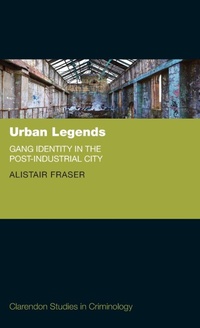
Urban Legends
Gang Identity in the Post-Industrial City
Published on 21. May 2015
Book
Hardback
304 pages
978-0-19-872861-0 (ISBN)
Description
As the youth gang phenomenon becomes an important and sensitive public issue, communities from Los Angeles to Rio, Cape Town to London are facing the reality of what such violent groups mean for their children and young people. Complex dangers and instabilities, as well as high levels of public fear and anger, fuel an amplification of anxious public and political rhetoric in relation to gangs, in which the stereotype of the American street-gang - a ruthless, hierarchical, street-based criminal organisation capable of corrupting youth and fracturing communities - looms large.
Set against this backdrop, Urban Legends: Gang Identity in the Post-Industrial City tells a unique and powerful story of young people, gang identity, and social change in post-industrial Glasgow, challenging the perceptions of gangs as a novel, universal, or pathological phenomenon. Though territorial gangs have been reported in Glasgow for over a century, with striking continuities over this time, there are similarities with street-based groups elsewhere. Using this similarity as the foundation, the book goes on to argue that Glaswegian gangs have a specific historical trajectory that is particular to the city. Drawing on four years of varied ethnographic fieldwork in Langview, a deindustrialised working-class community, the book spotlights the everyday experiences and understandings of gangs for young people growing up in the area, reasoning that - for some - gang identification represents a root of identity and a route to masculinity, in a post-industrial city that has little space for them.
Set against this backdrop, Urban Legends: Gang Identity in the Post-Industrial City tells a unique and powerful story of young people, gang identity, and social change in post-industrial Glasgow, challenging the perceptions of gangs as a novel, universal, or pathological phenomenon. Though territorial gangs have been reported in Glasgow for over a century, with striking continuities over this time, there are similarities with street-based groups elsewhere. Using this similarity as the foundation, the book goes on to argue that Glaswegian gangs have a specific historical trajectory that is particular to the city. Drawing on four years of varied ethnographic fieldwork in Langview, a deindustrialised working-class community, the book spotlights the everyday experiences and understandings of gangs for young people growing up in the area, reasoning that - for some - gang identification represents a root of identity and a route to masculinity, in a post-industrial city that has little space for them.
Reviews / Votes
Urban Legends...can compete with all the classic works. Fraser's book is a fresh start for European street ethnography. We can only hope that more will follow. I recommend it to those interested in Bourdieu, Glasgow, gangs, youth delinquency, post-industrialism, or just anyone interested in a reading a really good ethnography. * Sveinung Sandberg, British Journal of Criminology * Urban Legends is a groundbreaking work transcending classic theory and sharply departing from Eurogang positivism. Fraser applies Bourdieus habitus and other concepts to give us new and powerful theoretical tools with which to understand gangs in the global era. The most insightful study of Glasgow gangs ever written. * John Hagedorn, Department of Criminal Justice, University of Illinois at Chicago * We commend this book as making a significant contribution to the field of criminology, and also to the study of the history and sociology of the city. It is a book to be most warmly welcomed. * Professor Tim Newburn and Professor Jill Peay, London School of Economics (from the Foreword) * The book has profound methodological and theoretical implications to the study of youth gangs in a global context. Understanding gangs from a global and comparative perspective is not an easy task because of the difficulty of data collection, but Alistair Fraser, a young and brilliant criminologist, has made an especially significant contribution to the study. * Peng Wang, Global Crime * Fraser impressively situates his meticulous ethnographic research within historical and theoretical contexts. Urban Legends makes a profoundly important contribution to the international 'gang' literature. Sociological criminology at its very best. * Professor Barry Goldson, Charles Booth Chair of Social Science, Department of Sociology, Social Policy and Criminology, The University of Liverpool. *More details
Series
Language
English
Place of publication
Oxford
United Kingdom
Target group
College/higher education
Professional and scholarly
Dimensions
Height: 222 mm
Width: 145 mm
Thickness: 20 mm
Weight
514 gr
ISBN-13
978-0-19-872861-0 (9780198728610)
Copyright in bibliographic data and cover images is held by Nielsen Book Services Limited or by the publishers or by their respective licensors: all rights reserved.
Schweitzer Classification
Other editions
Additional editions
E-Book
05/2015
1st Edition
OUP eBook
€54.49
Available for download
E-Book
05/2015
1st Edition
OUP eBook
€54.49
Available for download
Person
Alistair Fraser is Lecturer in Criminology and Sociology, University of Glasgow, where he is also Associate Director (Internationalisation) of the Scottish Centre for Crime and Justice Research and Convenor of Postgraduate Criminology. He holds an MSc in Criminology from the University of Oxford, and a PhD in Sociology from the University of Glasgow. His research centres on issues of youth, crime and globalisation, with a particular focus on youth gangs. He has carried out fieldwork in Glasgow, Chicago and Hong Kong.
Content
1. Introduction ; 2. Shifting Definitions ; 3. A Global Sociological Imagination ; 4. City as Lens ; 5. Best Laid Schemes ; 6. Street Habitus ; 7. Redundant Hardmen ; 8. Learning to Leisure ; 9. Generations of Gangs ; 10. Conclusion