

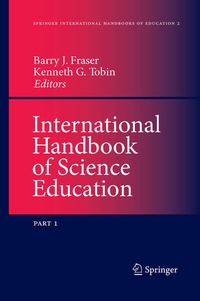
International Handbook of Science Education
Published on 30. June 2003
Book
Paperback/Softback
XXX, 1271 pages
978-1-4020-1551-9 (ISBN)
Description
The field of science education has been developing for over half a century and has flourished especially during the previous few decades. It is timely and fitting now that the International Handbook of Science Education should be assembled to synthesise and reconceptualise past research and theorising in science education, provide practical implications for improving science education, and suggest desir able ways to advance the field in the future. This Handbook provides a detailed and up-to-date overview of advanced international scholarship in science education. This two-volume, 72-chapter, 1,200+-page work is the largest and most comprehensive resource ever produced in science education for use by researchers, teacher educators, policy-makers, advis ers, teachers and graduate students. In structuring the Handbook, we divided the field of science education into the following ten significant areas: Learning Teaching Educational Technology Curriculum Learning Environments Teacher Education Assessment and Evaluation Equity History and Philosophy of Science Research Methods To each section, we appointed a 'section coordinator', who is a leading international scholar in that particular area and who assisted us in identifying authors and top ics for a section and in evaluating drafts of chapters and suggesting improve ments.
More details
Series
Edition
New edition
Language
English
Place of publication
Dordrecht
Netherlands
Target group
Professional and scholarly
Research
Edition type
New edition
Illustrations
11 s/w Abbildungen
XXX, 1271 p. 11 illus. In 2 volumes, not available separately.
Dimensions
Height: 235 mm
Width: 155 mm
Thickness: 70 mm
Weight
1950 gr
ISBN-13
978-1-4020-1551-9 (9781402015519)
DOI
10.1007/978-94-011-4940-2
Schweitzer Classification
Other editions
Additional editions
B. Fraser | Kenneth Tobin
International Handbook of Science Education
Book
04/1998
Kluwer Academic Publishers
€534.99
Article exhausted; check different version
Content
Section 1: Learning. Editors: R. Duit, D.F. Treagust.
1.1. Learning in Science: From Behaviourism Towards Social Constructivism and Beyond; R. Duit, D.F. Treagust. 1.2. New Perspectives on Language in Science; C. Sutton. 1.3. Cultural Aspects of Learning Science; W.W. Cobern, G.S. Aikenhead. 1.4. Learning Science Through Models and Modelling; J.K. Gilbert, C.J. Boulter. 1.5. Learning About Science Teaching: Perspectives From an Action Research Project; P.H. Scott, R.H. Driver. 1.6. Scientific Inquiry Within Reach of Young Children; K.E. Metz. 1.7. Theories of Knowledge Acquisition; C.A. Chinn, W.F. Brewer. 1.8. The Epistemology of Students: The 'Thingified' Nature of Scientific Knowledge; J. Désautels, M. Larochelle.
Section 2: Teaching. Editor: K. Tobin.
2.1. Issues and Trends in the Teaching of Science; K. Tobin. 2.2. A View of Quality in Teaching; J.R. Baird. 2.3. Teaching and Learning as Everyday Activity; W.-M. Roth. 2.4. Teaching for Understanding in Pre-Secondary Science; W. Harlen. 2.5. Teaching for Conceptual Change; P.W. Hewson, et al. 2.6. The Role of Routine Problem Tasks in Science Teaching; P. Hobden. 2.7. The Complexity of Chemistry and Implications for Teaching; D. Gabel. 2.8. The School Science Laboratory: Historical Perspectives and Contexts for Contemporary Teaching; V.N. Lunetta.
Section 3: Educational Technology. Editor: M.C. Linn.
3.1. The Impact of Technology on Science Instruction: HistoricalTrends and Current Opportunities; M.C. Linn. 3.2. Computer Microworlds and Scientific Inquiry: An Alternative Approach to Science Education; B.Y. White. 3.3. Realising Authentic Science Learning through the Adaptation of Scientific Practice; D.C. Edelson. 3.4. Can Technology Bring Students Closer to Science? N. Butler Songer. 3.5. Problem-Based MacroContexts in Science Instruction: Design Issues and Applications; R.D. Sherwood, et al. 3.6. Using Technology to Support Students' Artefact Construction in Science; M. Wisnudel Spitulnik, et al. 3.7. Integration of Experimenting and Modelling by Advanced Educational Technology: Examples from Nuclear Physics; H.P. Schecker. 3.8. Where You Want IT, When You Want IT: The Role of Portable Computers in Science Education; A.E. McFarlane, Y. Friedler.
Section 4: Curriculum. Editor: J. van den Akker.
4.1. The Science Curriculum: Between Ideals and Outcomes; J. van den Akker. 4.2. Cooperative Learning in the Science Curriculum; R. Lazarowitz, R. Hertz-Lazarowitz. 4.3. Curriculum Change in Science: Riding the Waves of Reform; J. Wallace, W. Louden. 4.4. Science Curriculum: Transforming Goals to Practices; R.W. Bybee, N. Ben-Zvi. 4.5. Integrated Science and Mathematics Education: Evolution and Implications of a Theoretical Model; D.F. Berlin, A.L. White. 4.6. The Learning Cycle Approach as a Strategy for Instruction in Science; M.R. Abraham.
Section 5: Learning Environments. Editor: B. Fraser.
5.1. Science Learning Environments: Assessment, Effects and D