

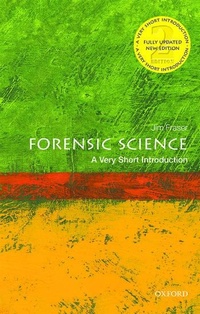
Forensic Science
A Very Short Introduction
2nd Edition
Published on 27. February 2020
Book
Paperback/Softback
160 pages
978-0-19-883441-0 (ISBN)
Description
Forensic science is a subject of wide fascination. What happens at a crime scene? How does DNA profiling work? How can it help solve crimes that happened 20 years ago? In forensic science, a criminal case can often hinge on a piece of evidence such as a hair, a blood trace, half a footprint, or a tyre mark. Complex scientific findings must be considered carefully and dispassionately, and communicated with clarity, simplicity, and precision. High profile cases such as the Stephen Lawrence enquiry and the Madeleine McCann case have attracted enormous media attention and enhanced general interest in this area in recent years.
In this Very Short Introduction, Jim Fraser introduces the concept of forensic science and explains how it is used in the investigation of crime. He begins at the crime scene itself, explaining the principles and processes of crime scene management, and drawing on his own personal experience of high profile cases including, the murder of Rachel Nickell and the unsolved murder of Jill Dando. Fraser explores how forensic scientists work; from the reconstruction of events to laboratory examinations. He considers the techniques they use, such as fingerprinting, and goes on to highlight the immense impact DNA profiling has had. Providing examples from forensic science cases in the UK, US, and other countries, he considers the techniques and challenges faced around the world. This new edition has been fully updated to take into account developments in areas such as DNA analysis and drug analysis, and the growing field of digital forensics. Topical areas explored include the growing significance of cognitive bias in forensic science, and recent research that raises doubts about the validity of some forensic techniques.
ABOUT THE SERIES:
The Very Short Introductions series from Oxford University Press contains hundreds of titles in almost every subject area. These pocket-sized books are the perfect way to get ahead in a new subject quickly. Our expert authors combine facts, analysis, perspective, new ideas, and enthusiasm to make interesting and challenging topics highly readable.
In this Very Short Introduction, Jim Fraser introduces the concept of forensic science and explains how it is used in the investigation of crime. He begins at the crime scene itself, explaining the principles and processes of crime scene management, and drawing on his own personal experience of high profile cases including, the murder of Rachel Nickell and the unsolved murder of Jill Dando. Fraser explores how forensic scientists work; from the reconstruction of events to laboratory examinations. He considers the techniques they use, such as fingerprinting, and goes on to highlight the immense impact DNA profiling has had. Providing examples from forensic science cases in the UK, US, and other countries, he considers the techniques and challenges faced around the world. This new edition has been fully updated to take into account developments in areas such as DNA analysis and drug analysis, and the growing field of digital forensics. Topical areas explored include the growing significance of cognitive bias in forensic science, and recent research that raises doubts about the validity of some forensic techniques.
ABOUT THE SERIES:
The Very Short Introductions series from Oxford University Press contains hundreds of titles in almost every subject area. These pocket-sized books are the perfect way to get ahead in a new subject quickly. Our expert authors combine facts, analysis, perspective, new ideas, and enthusiasm to make interesting and challenging topics highly readable.
Reviews / Votes
Well written and accessible... [and] does not shy away from the various controversies that have come to plague the discipline of forensic science in recent years. * Professor David Wilson, author of My Life With Murderers *More details
Series
Edition
2nd Revised edition
Language
English
Place of publication
Oxford
United Kingdom
Edition type
Revised edition
Illustrations
17 black and white illustrations
Dimensions
Height: 172 mm
Width: 114 mm
Thickness: 12 mm
Weight
121 gr
ISBN-13
978-0-19-883441-0 (9780198834410)
Copyright in bibliographic data and cover images is held by Nielsen Book Services Limited or by the publishers or by their respective licensors: all rights reserved.
Schweitzer Classification
Other editions
Additional editions
E-Book
02/2020
2nd Edition
OUP eBook
€9.49
Available for download
E-Book
02/2020
2nd Edition
OUP eBook
€9.49
Available for download
Previous edition
Book
02/2010
1st Edition
Oxford University Press
€11.13
Article exhausted; check for reprint
Person
Jim Fraser has 40 years' experience in forensic science and has worked on many high profile cases, in various roles, including as an expert witness, case reviewer, senior police manager, policy adviser, and researcher. He has also advised many public agencies including police organisations in the UK and abroad, the Home Office, the Scottish Parliament, and the UK Parliament. He is a Research Professor in Forensic Science at the University of Strathclyde, as well as a member of the Scottish Criminal Cases Review Commission and Independent Chair of the United Kingdom Accreditation Service technical advisory committee on forensic science.
Content
Preface and acknowledgements to second edition 1: What is forensic science 2: Investigating crime 3: Crime scene management and forensic investigation 4: Laboratory examination: search, recovery, and analysis 5: DNA: identity, relationships, and databases 6: Prints and marks: more ways to identify people and things 7: Trace evidence 8: Drugs and toxicology 9: Science and justice - a case study Further reading Index