

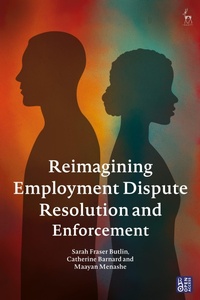
Reimagining Employment Dispute Resolution and Enforcement
Will be published approx. on 25. June 2026
Book
Hardback
384 pages
978-1-5099-9053-5 (ISBN)
Description
This open access book examines the evolution of employment tribunals from a speedy, informal process to a system marked by delays and significant financial and human costs.
Resolving disputes in the workplace is difficult, expensive and emotionally charged. The current system is broken but what is the answer? Using material from a large-scale empirical study, including a survey of over 200 practitioners, the book examines the problems facing the system. It then considers how these problems are addressed in other jurisdictions both in the UK and in other countries.
The book then examines what can be done. It suggests that locating labour law disputes within a contract-tort-human rights frame takes insufficient account of the fundamental emotional and behavioural factors that are in play. The book therefore argues that much can be learnt from the resolution of family law disputes, whether it be in relation to how a relationship that has ended can be satisfactorily concluded, or how a relationship with ongoing ties can be managed going forwards. Utilising this theoretical reframing, the book proposes a blueprint for the future of employment dispute resolution.
This book is for policy makers, practitioners and academics looking for a rigorous empirical and theoretical analysis of what has gone wrong with employment dispute resolution and what can be done about it.
The ebook editions of this book are available open access under a CC BY-NC-ND 4.0 licence on bloomsburycollections.com.
Resolving disputes in the workplace is difficult, expensive and emotionally charged. The current system is broken but what is the answer? Using material from a large-scale empirical study, including a survey of over 200 practitioners, the book examines the problems facing the system. It then considers how these problems are addressed in other jurisdictions both in the UK and in other countries.
The book then examines what can be done. It suggests that locating labour law disputes within a contract-tort-human rights frame takes insufficient account of the fundamental emotional and behavioural factors that are in play. The book therefore argues that much can be learnt from the resolution of family law disputes, whether it be in relation to how a relationship that has ended can be satisfactorily concluded, or how a relationship with ongoing ties can be managed going forwards. Utilising this theoretical reframing, the book proposes a blueprint for the future of employment dispute resolution.
This book is for policy makers, practitioners and academics looking for a rigorous empirical and theoretical analysis of what has gone wrong with employment dispute resolution and what can be done about it.
The ebook editions of this book are available open access under a CC BY-NC-ND 4.0 licence on bloomsburycollections.com.
More details
Language
English
Place of publication
Oxford
United Kingdom
Publishing group
Bloomsbury Publishing PLC
Target group
Professional and scholarly
College/higher education
Product notice
sewn/stitched
Cloth over boards
With dust jacket
Dimensions
Height: 234 mm
Width: 156 mm
Thickness: 25 mm
Weight
454 gr
ISBN-13
978-1-5099-9053-5 (9781509990535)
Copyright in bibliographic data and cover images is held by Nielsen Book Services Limited or by the publishers or by their respective licensors: all rights reserved.
Schweitzer Classification
Persons
Sarah Fraser Butlin is Fellow at Selwyn College Cambridge and Barrister, Cloisters, UK.
Catherine Barnard is Professor of EU and Labour Law, University of Cambridge and Fellow of Trinity College, Cambridge, UK.
Maayan Menashe is Senior Lecturer in Law at City St George's, University of London, UK.
Catherine Barnard is Professor of EU and Labour Law, University of Cambridge and Fellow of Trinity College, Cambridge, UK.
Maayan Menashe is Senior Lecturer in Law at City St George's, University of London, UK.
Content
Part I: Context and Theoretical Underpinnings
1. Evolution of the Employment Tribunal system
2. Other Fora for Employment Claims
3. Theoretical Underpinnings of Employment Law and Dispute Resolution
Part 2: Resolving Disputes Without Litigation
4. Early Resolution of Disputes
5. Looking Across the UK Landscape for Methods Which Might Encourage Early Settlement
6. Looking Internationally: Lessons for Reform of Employment Dispute Resolution from Other Jurisdictions
Part III: The Tribunal Litigation Process
7. The Litigation Process in the Employment Tribunal System
8. Starting Claims and Dealing with Problem Pleadings
9. Exploring the Landscape of the Litigation Process: Tracking, Evidence and Disclosure
10. Alternative Dispute Resolution Once a Claim has been Issued
Part IV: Costs, Fees and Enforcement
11. Costs and Tribunal Fees
12. Enforcement of Awards and Addressing Systemic Issues
Part V: Recommendations and Methodology
13. Recommendations Past and Present
Appendix 1: Methodology
1. Evolution of the Employment Tribunal system
2. Other Fora for Employment Claims
3. Theoretical Underpinnings of Employment Law and Dispute Resolution
Part 2: Resolving Disputes Without Litigation
4. Early Resolution of Disputes
5. Looking Across the UK Landscape for Methods Which Might Encourage Early Settlement
6. Looking Internationally: Lessons for Reform of Employment Dispute Resolution from Other Jurisdictions
Part III: The Tribunal Litigation Process
7. The Litigation Process in the Employment Tribunal System
8. Starting Claims and Dealing with Problem Pleadings
9. Exploring the Landscape of the Litigation Process: Tracking, Evidence and Disclosure
10. Alternative Dispute Resolution Once a Claim has been Issued
Part IV: Costs, Fees and Enforcement
11. Costs and Tribunal Fees
12. Enforcement of Awards and Addressing Systemic Issues
Part V: Recommendations and Methodology
13. Recommendations Past and Present
Appendix 1: Methodology