

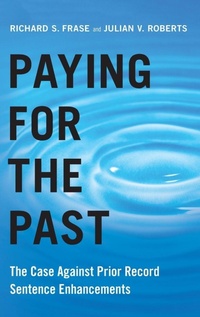
Paying for the Past
The Case Against Prior Record Sentence Enhancements
Published on 10. September 2019
Book
Hardback
336 pages
978-0-19-025400-1 (ISBN)
Description
All modern sentencing systems, in the US and beyond, consider the offender's prior record to be an important determinant of the form and severity of punishment for subsequent offences. Repeat offenders receive harsher punishments than first offenders, and offenders with longer criminal records are punished more severely than those with shorter records. Yet the vast literature on sentencing policy, law, and practice has generally overlooked the issue of prior convictions, even though this is the most important sentencing factor after the seriousness of the crime.
In Paying for the Past, Richard S. Frase and Julian V. Roberts provide a critical and systematic examination of current prior record enhancements under sentencing guidelines across the US. Drawing on empirical data and analyses of guidelines from a number of jurisdictions, they illustrate different approaches to prior record enhancements and the differing outcomes of those approaches. Roberts and Frase demonstrate that most prior record enhancements generate a range of adverse outcomes at sentencing. Further, the pervasive justifications for prior record enhancement, such as the repeat offender's assumed higher risk of reoffending or greater culpability, are uncertain and have rarely been subjected to critical appraisal. The punitive sentencing premiums for repeat offenders prescribed by US guidelines cannot be justified on grounds of prevention or retribution.
Shining a light on a neglected but critically important topic, Paying for the Past examines the costs of prior record enhancements for repeat offenders and offers model guidelines to help reduce racial disparities and reallocate criminal justice resources for jurisdictions who use sentence enhancements.
In Paying for the Past, Richard S. Frase and Julian V. Roberts provide a critical and systematic examination of current prior record enhancements under sentencing guidelines across the US. Drawing on empirical data and analyses of guidelines from a number of jurisdictions, they illustrate different approaches to prior record enhancements and the differing outcomes of those approaches. Roberts and Frase demonstrate that most prior record enhancements generate a range of adverse outcomes at sentencing. Further, the pervasive justifications for prior record enhancement, such as the repeat offender's assumed higher risk of reoffending or greater culpability, are uncertain and have rarely been subjected to critical appraisal. The punitive sentencing premiums for repeat offenders prescribed by US guidelines cannot be justified on grounds of prevention or retribution.
Shining a light on a neglected but critically important topic, Paying for the Past examines the costs of prior record enhancements for repeat offenders and offers model guidelines to help reduce racial disparities and reallocate criminal justice resources for jurisdictions who use sentence enhancements.
More details
Language
English
Place of publication
New York
United States
Target group
Professional and scholarly
Product notice
sewn/stitched
Cloth over boards
Illustrations
3 line drawings; 6 half tones
Dimensions
Height: 236 mm
Width: 163 mm
Thickness: 28 mm
Weight
612 gr
ISBN-13
978-0-19-025400-1 (9780190254001)
Copyright in bibliographic data and cover images is held by Nielsen Book Services Limited or by the publishers or by their respective licensors: all rights reserved.
Schweitzer Classification
Other editions
Additional editions
Richard S. Frase | Julian V. Roberts
Paying for the Past
The Case Against Prior Record Sentence Enhancements
E-Book
07/2019
OUP eBook
€39.49
Available for download
Richard S. Frase | Julian V. Roberts
Paying for the Past
The Case Against Prior Record Sentence Enhancements
E-Book
07/2019
OUP eBook
€30.49
Available for download
Persons
Richard S. Frase is Benjamin N. Berger Professor of Criminal Law at the University of Minnesota. His scholarship examines Minnesota and other state sentencing guidelines, punishment theories, criminal procedure in the U.S. and abroad, and comparison of sentencing law and practice across U.S. states and between the U.S. and other nations.
Julian V. Roberts is Professor of Criminal Justice at the University of Oxford and a member of the Sentencing Council of England and Wales His research focuses on all aspects of sentencing law, policy and practice in common law jurisdictions.
Julian V. Roberts is Professor of Criminal Justice at the University of Oxford and a member of the Sentencing Council of England and Wales His research focuses on all aspects of sentencing law, policy and practice in common law jurisdictions.
Content
Preface
Acknowledgements
Introduction: Prior Record Sentencing Enhancements in Context
Chapter 1: Retributive Perspectives on an Offender's Criminal or Crime-free Past
Chapter 2: Prior Record and the Risk of Recidivism
Chapter 3: What Other Factors Indicate High or Low Recidivism Risk?
Chapter 4: Are Record-based Enhancements a Cost-effective and Fair Way to Reduce Crime?
Chapter 5: The Effects of Prior Convictions on Sentence Severity (Co-author: Rhys Hester)
Chapter 6: Adverse Impacts on Offense-based Proportionality and Prison-use Priorities (Co-author: Rhys Hester)
Chapter 7: Disproportionate Impacts on Minority Offenders (Co-author: Rhys Hester)
Chapter 8: Impacts of Criminal History Enhancements on Prison Bed Needs and Costs (Co-author: Rhys Hester)
Chapter 9: The Long Arm of the Law: Look-back Provisions
Chapter 10: Problematic Components Found in Many Criminal History Formulas
Chapter 11: The Model Regime
Appendix A: Representative Criminal History Provisions in U.S. Guidelines
Appendix B: Representative Provisions from other Common Law Systems
Appendix C: Some Offender Groups That May Require Special Treatment
References
Case Table
Index
Acknowledgements
Introduction: Prior Record Sentencing Enhancements in Context
Chapter 1: Retributive Perspectives on an Offender's Criminal or Crime-free Past
Chapter 2: Prior Record and the Risk of Recidivism
Chapter 3: What Other Factors Indicate High or Low Recidivism Risk?
Chapter 4: Are Record-based Enhancements a Cost-effective and Fair Way to Reduce Crime?
Chapter 5: The Effects of Prior Convictions on Sentence Severity (Co-author: Rhys Hester)
Chapter 6: Adverse Impacts on Offense-based Proportionality and Prison-use Priorities (Co-author: Rhys Hester)
Chapter 7: Disproportionate Impacts on Minority Offenders (Co-author: Rhys Hester)
Chapter 8: Impacts of Criminal History Enhancements on Prison Bed Needs and Costs (Co-author: Rhys Hester)
Chapter 9: The Long Arm of the Law: Look-back Provisions
Chapter 10: Problematic Components Found in Many Criminal History Formulas
Chapter 11: The Model Regime
Appendix A: Representative Criminal History Provisions in U.S. Guidelines
Appendix B: Representative Provisions from other Common Law Systems
Appendix C: Some Offender Groups That May Require Special Treatment
References
Case Table
Index