

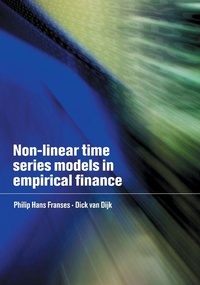
Non-Linear Time Series Models in Empirical Finance
Published on 27. July 2000
Book
Hardback
298 pages
978-0-521-77041-5 (ISBN)
Description
Although many of the models commonly used in empirical finance are linear, the nature of financial data suggests that non-linear models are more appropriate for forecasting and accurately describing returns and volatility. The enormous number of non-linear time series models appropriate for modeling and forecasting economic time series models makes choosing the best model for a particular application daunting. This classroom-tested advanced undergraduate and graduate textbook, first published in 2000, provides a rigorous treatment of recently developed non-linear models, including regime-switching and artificial neural networks. The focus is on the potential applicability for describing and forecasting financial asset returns and their associated volatility. The models are analysed in detail and are not treated as 'black boxes'. Illustrated using a wide range of financial data, drawn from sources including the financial markets of Tokyo, London and Frankfurt.
More details
Language
English
Place of publication
Cambridge
United Kingdom
Target group
Professional and scholarly
College/higher education
Illustrations
51 Tables, unspecified
Dimensions
Height: 260 mm
Width: 183 mm
Thickness: 21 mm
Weight
759 gr
ISBN-13
978-0-521-77041-5 (9780521770415)
Copyright in bibliographic data and cover images is held by Nielsen Book Services Limited or by the publishers or by their respective licensors: all rights reserved.
Schweitzer Classification
Other editions
Additional editions
Philip Hans Franses | Dick Van Dijk
Non-Linear Time Series Models in Empirical Finance
E-Book
01/2005
1st Edition
Cambridge University Press
€54.49
Available for download
Philip Hans Franses | Dick Van Dijk
Non-Linear Time Series Models in Empirical Finance
Book
07/2000
Cambridge University Press
€94.40
Shipment within 15-20 days
Persons
Content
1. Introduction; 2. Some concepts in time series analysis; 3. Regime-switching models for returns; 4. Regime-switching models for volatility; 5. Artificial neural networks for returns; 6. Conclusion.