

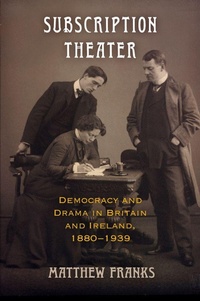
Subscription Theater
Democracy and Drama in Britain and Ireland, 1880-1939
Published on 25. September 2020
Book
Hardback
296 pages
978-0-8122-5247-7 (ISBN)
Description
Subscription Theater asks why turn-of-the-century British and Irish citizens spent so much time, money, and effort adding their names to subscription lists. Shining a spotlight on private play-producing clubs, public repertory theaters, amateur drama groups, and theatrical magazines, Matthew Franks locates subscription theaters in a vast constellation of civic subscription initiatives, ranging from voluntary schools and workers' hospitals to soldiers' memorials and Diamond Jubilee funds. Across these enterprises, Franks argues, subscribers created their own spaces for performing social roles from which they had long been excluded. Whether by undermining the authority of the Lord Chamberlain's Examiner of Plays and London's commercial theater producers, or by extending rights to disenfranchised women and property-less men, a diverse cast of subscribers including typists, plumbers, and maids acted as political representatives for their fellow citizens, both inside the theater and far beyond it. Citizens prized a "democratic" or "representative" subscription list as an end in itself, and such lists set the stage for the eventual public subsidy of subscription endeavors.
Subscription Theater points to the importance of printed ephemera such as programs, tickets, and prospectuses in questioning any assumption that theatrical collectivity is confined to the live performance event. Drawing on new media as well as old, Franks uses a database of over 23,000 stage productions to reveal that subscribers introduced nearly a third of the plays that were most frequently revived between 1890 and the mid-twentieth century, as well as nearly half of all new translations, and they were instrumental in staging the work of such writers as Shaw and Ibsen, whose plays featured subscription lists as a plot point or prop. Although subscribers often are blamed for being a conservative force in theater, Franks demonstrates that they have been responsible for how we value audience and repertoire today, and their history offers a new account of the relationship between ephemera, drama, and democracy.
Subscription Theater points to the importance of printed ephemera such as programs, tickets, and prospectuses in questioning any assumption that theatrical collectivity is confined to the live performance event. Drawing on new media as well as old, Franks uses a database of over 23,000 stage productions to reveal that subscribers introduced nearly a third of the plays that were most frequently revived between 1890 and the mid-twentieth century, as well as nearly half of all new translations, and they were instrumental in staging the work of such writers as Shaw and Ibsen, whose plays featured subscription lists as a plot point or prop. Although subscribers often are blamed for being a conservative force in theater, Franks demonstrates that they have been responsible for how we value audience and repertoire today, and their history offers a new account of the relationship between ephemera, drama, and democracy.
Reviews / Votes
"Drama and theater scholars will find much to admire in Franks's Subscription Theater...The book is bold in its claims, careful in its argumentation, and self-aware in its practice. Even those readers who will perhaps have anticipated the claim that theatrical ephemera are not, in fact, ephemeral will come away with new methods for reading a multimedia archive and new ways to approach performance events through a material apparatus. Readers will also come away with an expanded sense of the literary and of the ways in which Victorian and Edwardian theatergoers made theater-and themselves." (Victorian Studies) "Matthew Franks convincingly argues that subscription underlay the development of theater audience and repertoire in the modern period. His conclusions are original and make a substantial contribution to both theater history and print culture studies." (Elizabeth Carolyn Miller, University of California, Davis) "Matthew Franks offers valuable knowledge about the wider cultural context-social as well as artistic-of British and Irish Edwardian 'new' drama and stagecraft, the regional repertory movement, and the widespread phenomenon of amateur theater. His methodological focus on printed ephemera presents exciting new ways of thinking about documentary evidence in theater history." (Claire Cochrane, University of Worcester)More details
Series
Language
English
Place of publication
Pennsylvania
United States
Target group
College/higher education
Product notice
Paper over boards
Illustrations
7 illus.
Dimensions
Height: 239 mm
Width: 160 mm
Thickness: 38 mm
Weight
680 gr
ISBN-13
978-0-8122-5247-7 (9780812252477)
Copyright in bibliographic data and cover images is held by Nielsen Book Services Limited or by the publishers or by their respective licensors: all rights reserved.
Schweitzer Classification
Other editions
Additional editions

E-Book
08/2020
1st Edition
University of Pennsylvania Press
€88.99
Available for download
Person
Matthew Franks is Assistant Professor of English and Theatre Studies at the University of Warwick.
Content
Introduction. Stages of Subscription
Chapter 1. Private Subscription: The Incorporated Stage Society and Ephemeral Repertoire
Chapter 2. Public Subscription: Audience Impressions in Dublin, Glasgow, and Liverpool##
Chapter 3. Subscription On and Beyond the Stage
Chapter 4. Affiliative Subscription: Paying to Play with Amateur Groups
Chapter 5. Virtual Subscription: The Mask as Readers' Theater
Epilogue. Subscribe Now
Notes
Bibliography
Index
Acknowledgments
Chapter 1. Private Subscription: The Incorporated Stage Society and Ephemeral Repertoire
Chapter 2. Public Subscription: Audience Impressions in Dublin, Glasgow, and Liverpool##
Chapter 3. Subscription On and Beyond the Stage
Chapter 4. Affiliative Subscription: Paying to Play with Amateur Groups
Chapter 5. Virtual Subscription: The Mask as Readers' Theater
Epilogue. Subscribe Now
Notes
Bibliography
Index
Acknowledgments