

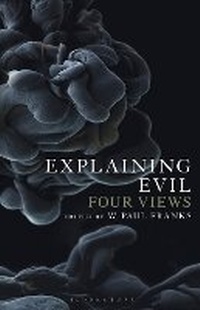
Explaining Evil
Four Views
Published on 21. February 2019
Book
Hardback
192 pages
978-1-5013-3114-5 (ISBN)
Description
In Explaining Evil four prominent philosophers, two theists and two non-theists, present their arguments for why evil exists. Taking a "position and response" format, in which one philosopher offers an account of evil and three others respond, this book guides readers through the advantages and limitations of various philosophical positions on evil, making it ideal for classroom use as well as individual study.
Divided into four chapters, Explaining Evil covers Theistic Libertarianism, Theistic Compatibilism, Atheistic Moral Realism and Atheistic Moral Non-realism. It features topics including free will, theism, atheism, goodness, Calvinism, evolutionary ethics, and pain, and demonstrates some of the dominant models of thinking within contemporary philosophy of religion and ethics.
Written in accessible prose and with an approachable structure, this book provides a clear and useful overview of the central issues of the philosophy of evil.
Divided into four chapters, Explaining Evil covers Theistic Libertarianism, Theistic Compatibilism, Atheistic Moral Realism and Atheistic Moral Non-realism. It features topics including free will, theism, atheism, goodness, Calvinism, evolutionary ethics, and pain, and demonstrates some of the dominant models of thinking within contemporary philosophy of religion and ethics.
Written in accessible prose and with an approachable structure, this book provides a clear and useful overview of the central issues of the philosophy of evil.
Reviews / Votes
The tone is civil, but the critical interactions are lively and uninhibited ... The book is rounded out with an excellent recommended reading section ... and an extensive bibliography emphasizing recent (some of it very recent) literature. Summing Up: Highly recommended. Upper-division undergraduates through faculty. * CHOICE * This an outstanding book on the problem of evil. Instead of addressing the enduring debate over the value of evil as evidence against theism, the contributors to this book consider how evil fits into their theistic or atheistic perspectives. Anyone interested in the problem of evil-even those who feel that they have already read enough about the topic-should find the book intriguing and eye-opening. * Yujin Nagasawa, Professor of Philosophy and Co-Director of the John Hick Centre for Philosophy of Religion, University of Birmingham, UK * Encountering Evil is an interesting volume, and worth a read. The book provides a concise overview of four approaches relevant to discussions of human morality, and relevant to discussions of the problem of evil. The book would provide a useful textbook for an undergraduate seminar on theism and morality, or a seminar on the problem of evil. * International Journal of Philosophical Studies * What a splendid book this is! [A]ll four make many excellent points. Would that all academic debates could be conducted in such a respectful manner. * Theology *More details
Language
English
Place of publication
New York
United States
Publishing group
Bloomsbury Publishing Plc
Target group
College/higher education
Dimensions
Height: 216 mm
Width: 140 mm
Weight
372 gr
ISBN-13
978-1-5013-3114-5 (9781501331145)
Copyright in bibliographic data and cover images is held by Nielsen Book Services Limited or by the publishers or by their respective licensors: all rights reserved.
Schweitzer Classification
Person
W. Paul Franks is Associate Professor of Philosophy at Tyndale University College, Canada. He has published in the Heythrop Journal, Philosophia Christi, Religious Studies and Sophia.
Content
Notes on Contributors
Acknowledgements
Introduction, W. Paul Franks (Tyndale University College, Canada)
1. Evil and Agent-Causal Theism, Richard Brian Davis (Tyndale University College, Canada)
Response to Richard Brian Davis
Paul Helm (Regent College, Canada)
Michael Ruse (Florida State University, USA)
Erik Wielenberg (DePauw University, USA)
Reply to Critics
2. Evil and Christian Classical Theism, Paul Helm (Regent College, Canada)
Response to Paul Helm
Richard Brian Davis (Tyndale University College, Canada)
Michael Ruse (Florida State University, USA)
Erik Wielenberg (DePauw University, USA)
Reply to Critics
3. Evil and Atheistic Moral Skepticism, Michael Ruse (Florida State University, USA)
Response to Michael Ruse
Richard Brian Davis (Tyndale University College, Canada)
Paul Helm (Regent College, Canada)
Erik Wielenberg (DePauw University, USA)
Reply to Critics
4. Evil and Atheistic Moral Realism, Erik J. Wielenberg (DePauw University, USA)
Response to Michael Ruse
Richard Brian Davis (Tyndale University College, Canada)
Paul Helm (Regent College, Canada)
Erik Wielenberg (DePauw University, USA)
Reply to Critics
Recommended Reading
Bibliography
Index
Acknowledgements
Introduction, W. Paul Franks (Tyndale University College, Canada)
1. Evil and Agent-Causal Theism, Richard Brian Davis (Tyndale University College, Canada)
Response to Richard Brian Davis
Paul Helm (Regent College, Canada)
Michael Ruse (Florida State University, USA)
Erik Wielenberg (DePauw University, USA)
Reply to Critics
2. Evil and Christian Classical Theism, Paul Helm (Regent College, Canada)
Response to Paul Helm
Richard Brian Davis (Tyndale University College, Canada)
Michael Ruse (Florida State University, USA)
Erik Wielenberg (DePauw University, USA)
Reply to Critics
3. Evil and Atheistic Moral Skepticism, Michael Ruse (Florida State University, USA)
Response to Michael Ruse
Richard Brian Davis (Tyndale University College, Canada)
Paul Helm (Regent College, Canada)
Erik Wielenberg (DePauw University, USA)
Reply to Critics
4. Evil and Atheistic Moral Realism, Erik J. Wielenberg (DePauw University, USA)
Response to Michael Ruse
Richard Brian Davis (Tyndale University College, Canada)
Paul Helm (Regent College, Canada)
Erik Wielenberg (DePauw University, USA)
Reply to Critics
Recommended Reading
Bibliography
Index