

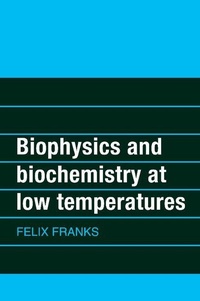
Biophysics and Biochemistry at Low Temperatures
Published on 19. July 2012
Book
Paperback/Softback
222 pages
978-0-521-26932-2 (ISBN)
Description
Cold is the single most important enemy of life, and this book, first published in 1985, discusses the responses of living organisms to low temperatures. Subfreezing temperatures in particular affect the properties of water, which is essential to life, and the book describes the physics and chemistry of water in the context of physiology. Injury from cooling and the way in which organisms respond and survive, as well as the mechanism of cold hardening in micro-organisms, insects and plants are discussed. The laboratory exploitation of low temperatures to preserve life and to protect labile materials against freeze damage is also considered.
More details
Language
English
Place of publication
Cambridge
United Kingdom
Target group
College/higher education
Product notice
Paperback (trade)
Illustrations
Worked examples or Exercises
Dimensions
Height: 229 mm
Width: 152 mm
Thickness: 12 mm
Weight
329 gr
ISBN-13
978-0-521-26932-2 (9780521269322)
Copyright in bibliographic data and cover images is held by Nielsen Book Services Limited or by the publishers or by their respective licensors: all rights reserved.
Schweitzer Classification
Other editions
Additional editions

Felix Franks
Biophysics and Biochemistry at Low Temperatures
Book
06/1985
Cambridge University Press
€55.71
Article exhausted; check for reprint
Previous edition
Felix Franks
Biophysics and Biochemistry at Low Temperatures
Book
06/1985
Cambridge University Press
€55.71
Article exhausted; check for reprint
Content
Acknowledgements; Foreword; 1. Water, temperature and life; 2. The physics of water at subzero temperatures; 3. Physical chemistry of aqueous solutions at subzero temperatures; 4. Cryobiochemistry - responses of proteins to suboptimal temperatures; 5. The single cell: responses to chill and freezing; 6. Freeze avoidance in living organisms; 7. Freeze tolerance in living organisms; 8. Cryobiology: the laboratory preservation of cells, tissues and organs; 9. The technology of metastable water; 10. Matters arising; References; Index.