

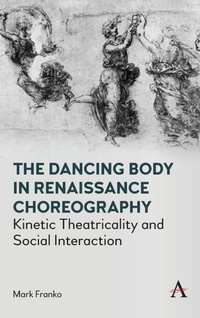
The Dancing Body in Renaissance Choreography
Kinetic Theatricality and Social Interaction
Published on 1. March 2022
Book
Hardback
160 pages
978-1-78527-801-3 (ISBN)
Description
The Dancing Body in Renaissance Choreography problematizes the absence of the dancing body in treatises in order to reconstruct it through a series of intertextual readings triggered by Thoinot Arbeau's definition of dance in his 1589 dance treatise, Orchesographie. The notion of the intertext as elaborated by Michael Riffaterre is used to understand a series of relationships between dance and other activities within which the historical dancing body emerges to the light of day. Arbeau's discussion of dance as a mute rhetoric in the demonstrative genre points to the intertext of Quintilian's The Oratorical Institution where the genus demonstrativum is explained as epideixis, the goal of which is to inspire confidence and charm the audience. The second intertext explored is that of civility as found in courtesy books where the posture of the body and the parameters of movement are outlined, converging in the gesture of the reverence. The categories of pose and movement are then read into the structure of the basse danse, the quintessential courtly social dance of the period. The relation of pose to movement or of stillness to mobility is further theorized through the terms of earlier Italian treatises, specifically in terms of fantasmata as used by Domenico da Piacenza.
Reviews / Votes
"Mark Franko's intellectually challenging study of the history and language of dance treatises exposes a kinetic fashioning of the body. Franko's new preface and judicious close readings offer an indispensable guide to early modern histories and theories of dance and movement, traversing fresh insight on gesture and rhetoric as well as madness and courtesy. From popular practice to preoccupations with movement and theatricality, this work's careful translation of aesthetic terms and values illuminates dance treatises' and manuals' important role in the history and theory of dance embodiment. This book is a compelling introduction to these sources and expert contribution in pre-modern dance and performance research." -V K Preston, Concordia University, Canada "Franko presents dance as a signifying practice akin to literature, that calls for an interdisciplinary interpretation. The dancing body moves through texts, but also becomes itself a text, defying the elusiveness of corporeality in dance notation and constituting itself in the social world characterized by the fashioning of individual identity. It inscribes itself in its cultural context through its performative dimension."-Sidia Fiorato, University of Verona, ItalyMore details
Series
Language
English
Place of publication
London
United Kingdom
Target group
Professional and scholarly
US School Grade: College Graduate Student
Dimensions
Height: 235 mm
Width: 157 mm
Thickness: 13 mm
Weight
392 gr
ISBN-13
978-1-78527-801-3 (9781785278013)
Copyright in bibliographic data and cover images is held by Nielsen Book Services Limited or by the publishers or by their respective licensors: all rights reserved.
Schweitzer Classification
Other editions
Additional editions
Mark Franko
The Dancing Body in Renaissance Choreography
Kinetic Theatricality and Social Interaction
E-Book
03/2022
1st Edition
Anthem Press
€38.99
Available for download
Mark Franko
The Dancing Body in Renaissance Choreography
Kinetic Theatricality and Social Interaction
E-Book
03/2022
1st Edition
Anthem Press
€38.99
Available for download
Person
Mark Franko is Laura H. Carnell Professor of Dance at the Boyer College of Music and Dance, Temple University, USA. He is founding editor of the Oxford Studies in Dance Theory book series.
Content
Preface to the Revised Edition; 1. Introduction; 2. The Mythological Intertext: Language; 3. The Sociological Intertext: Courtesy; 4. The Pedagogical Intertext: Precepts; 5. The Political Intertext: Civil Conversatione (Social Intercourse); Bibliography; Index.