

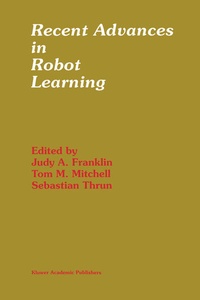
Recent Advances in Robot Learning
Machine Learning
Published on 17. September 2011
Book
Paperback/Softback
IV, 218 pages
978-1-4613-8064-1 (ISBN)
Description
Recent Advances in Robot Learning
contains seven papers on robot learning written by leading researchers in the field. As the selection of papers illustrates, the field of robot learning is both active and diverse. A variety of machine learning methods, ranging from inductive logic programming to reinforcement learning, is being applied to many subproblems in robot perception and control, often with objectives as diverse as parameter calibration and concept formulation.
While no unified robot learning framework has yet emerged to cover the variety of problems and approaches described in these papers and other publications, a clear set of shared issues underlies many robot learning problems.
These characteristics present challenges and constraints to the learning system. Since these characteristics are shared by other important real-world application domains, robotics is a highly attractive area for research on machine learning.
On the other hand, machine learning is also highly attractive to robotics. There is a great variety of open problems in robotics that defy a static, hand-coded solution.
Recent Advances in Robot Learning is an edited volume of peer-reviewed original research comprising seven invited contributions by leading researchers. This research work has also been published as a special issue of Machine Learning (Volume 23, Numbers 2 and 3).
While no unified robot learning framework has yet emerged to cover the variety of problems and approaches described in these papers and other publications, a clear set of shared issues underlies many robot learning problems.
- Machine learning, when applied to robotics, is situated: it is embedded into a real-world system that tightly integrates perception, decision making and execution.
- Since robot learning involves decision making, there is an inherent active learning issue.
- Robotic domains are usually complex, yet the expense of using actual robotic hardware often prohibits the collection of large amounts of training data.
- Most robotic systems are real-time systems. Decisions must be made within critical or practical time constraints.
These characteristics present challenges and constraints to the learning system. Since these characteristics are shared by other important real-world application domains, robotics is a highly attractive area for research on machine learning.
On the other hand, machine learning is also highly attractive to robotics. There is a great variety of open problems in robotics that defy a static, hand-coded solution.
Recent Advances in Robot Learning is an edited volume of peer-reviewed original research comprising seven invited contributions by leading researchers. This research work has also been published as a special issue of Machine Learning (Volume 23, Numbers 2 and 3).
More details
Series
Edition
Softcover reprint of the original 1st ed. 1996
Language
English
Place of publication
New York
United States
Target group
Professional and scholarly
Research
Illustrations
IV, 218 p.
Dimensions
Height: 240 mm
Width: 160 mm
Thickness: 13 mm
Weight
372 gr
ISBN-13
978-1-4613-8064-1 (9781461380641)
DOI
10.1007/978-1-4613-0471-5
Schweitzer Classification
Other editions
Additional editions
Judy A. Franklin | Tom M. Mitchell | Sebastian Thrun
Recent Advances in Robot Learning
Machine Learning
E-Book
12/2012
Springer
€149.79
Available for download
Judy A. Franklin | Tom M. Mitchell | Sebastian Thrun
Recent Advances in Robot Learning
Machine Learning
Book
06/1996
Kluwer Academic Publishers
€164.50
Shipment within 15-20 days
Content
Machine Learning.- Real-World Robotics: Learning, to Plan for Robust Execution.- Robot Programming by Demonstration (RPD): Supporting the Induction by Human Interaction.- Performance Improvement of Robot Continuous-Path Operation through Iterative Learning Using Neural Networks.- Learning Controllers for Industrial Robots.- Active Learning for Vision-Based Robot Grasping.- Purposive Behavior Acquisition for a Real Robot by Vision-Based Reinforcement Learning.- Learning Concepts from Sensor Data of a Mobile Robot.