

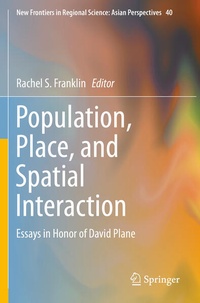
Population, Place, and Spatial Interaction
Essays in Honor of David Plane
Published on 8. January 2021
Book
Paperback/Softback
XIII, 271 pages
978-981-13-9233-7 (ISBN)
Description
This volume is devoted to the geographical-or spatial-aspects of population research in regional science, spanning spatial demographic methods for population composition and migration to studies of internal and international migration to investigations of the role of population in related fields such as climate change and economic growth. If spatial aspects of economic growth and development are the flagship of the regional science discipline, population research is the anchor. People migrate, consume, produce, and demand services. People are the source and beneficiaries of national, regional, and local growth and development. Since the origins of regional science, demographic research has been at the core of the discipline. Contributions in this volume are both retrospective and prospective, offering in their ensemble an authoritative overview of demographic research within the field of regional science.
More details
Series
Edition
2019 ed.
Language
English
Place of publication
Singapore
Singapore
Target group
Professional and scholarly
Illustrations
16 s/w Abbildungen, 36 farbige Abbildungen
XIII, 271 p. 52 illus., 36 illus. in color.
Dimensions
Height: 235 mm
Width: 155 mm
Thickness: 16 mm
Weight
441 gr
ISBN-13
978-981-13-9233-7 (9789811392337)
DOI
10.1007/978-981-13-9231-3
Schweitzer Classification
Other editions
Additional editions
Book
12/2019
Springer
€53.49
Shipment within 15-20 days
Person
Rachel S. Franklin, Newcastle University.
Content
Chapter 1. I Dream of Gini: Measures of Population Concentration and Their Application to U.S. Population Distribution.- Chapter 2. Unraveling David Plane's Tools for Analyzing the Income Impacts of Interregional Migration Flows.- Chapter 3. A Short Exercise to Assess the Effects of Temporal and Spatial Aggregation on the Amounts of Spatial Spillovers.- Chapter 4. Population Characterization in Location Modeling: Alternatives, Impacts, and Insights.- Chapter 5. Interpreting the Geography of Human Capital Stock Variations: When is a Magnet a Magnet?.- Chapter 6. Population and Employment Change in U.S. Metropolitan Areas.- Chapter 7. Confronting Statistical Uncertainty in Rural America: Toward More Certain Data-Driven Policymaking Using American Community Survey (ACS) Data.- Chapter 8. Unpacking the Nature of Long Term Residential Stability.- Chapter 9. Short-Term Relocation versus Long Term Migration: Measuring Income Transfers by Inter-Provincial Employees across Canadian Provinces.- Chapter 10. Age Articulation of Australia's International Migration Flows.- Chapter 11. Modelling Inter-Urban Migration in an Open Population Setting-The Case of New Zealand.- Chapter 12. Baby Boomers' Paths into Retirement.- Chapter 13. The Demography of Water Use: Why the Past is a Poor Predictor of the Future.- Chapter 14. Mapping the Impact of Collaborative Research with David Plane.