

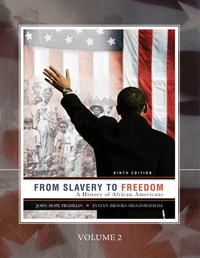
LSC Volume Two From Slavery to Freedom(General Use)
9th Edition
Published on 16. March 2010
Book
Paperback/Softback
528 pages
978-0-07-740752-0 (ISBN)
Description
The preeminent history of African-Americans, this best-selling text charts the journey of African-Americans from their origins in the civilizations of Africa, through slavery in the Western Hemisphere, their struggle for freedom in the West Indies, Latin America, and the United States, to the election of our first African American president. The ninth edition of this best-selling text has been thoroughly rewritten and reorganized to reflect the most current scholarship on African-American history. Beginning with greater coverage of ancestral Africa, the text contains new material on African American migration, notable African American women, popular culture, and the 2008 election. The text also has a fresh new 4-color design with new charts, maps, photographs, paintings, and illustrations. Written by legendary, award-winning authors, From Slavery to Freedom remains the most revered, respected, honored text on the market.
More details
Edition
9th edition
Language
English
Place of publication
United States
Publishing group
McGraw-Hill Education - Europe
Dimensions
Height: 252 mm
Width: 201 mm
Thickness: 18 mm
Weight
891 gr
ISBN-13
978-0-07-740752-0 (9780077407520)
Copyright in bibliographic data and cover images is held by Nielsen Book Services Limited or by the publishers or by their respective licensors: all rights reserved.
Schweitzer Classification
Persons
John Hope Franklin was the James B. Duke Professor Emeritus of History, and for seven years was Professor of Legal History at Duke University Law School. A native of Oklahoma and a graduate of Fisk University (1935), he received the A.M. and Ph.D. degrees in history from Harvard University (1936 and 1941). He taught at a number of institutions, including Fisk, St. Augustines College, and Howard University. In 1956 he went to Brooklyn College as Chair of the Department of History; and in 1964, he joined the faculty of the University of Chicago, serving as Chair of the Department of History from 1967 to 1970. At Chicago, he was the John Matthews Manly Distinguished Service Professor from 1969 to 1982, when he became Professor Emeritus.Among his many published works are The Free Negro in North Carolina (1943), Reconstruction after the Civil War (1961), A Southern Odyssey (1971), and perhaps his best-known book, From Slavery to Freedom: A History of African Americans, now in its ninth edition. In 1990 a collection of essays covering a teaching and writing career of fifty years was published as Race and History: Selected Essays, 1938-1988. At the time of his death in March 2009, he was engaged in research on "Dissidents on the Plantation: Runaway Slaves."During his long career, Professor Franklin was active in numerous professional and educational organizations. For many years he served on the editorial board of the Journal of Negro History. He also served as president of the following organizations:The Southern Historical Association, the United Chapters of Phi Beta Kappa, the Organization of American Historians, and the American Historical Association.Dr. Franklin served on many national commissions and delegations, including the National Council on the Humanities, the President's Advisory Commission on Ambassadorial Appointments, and the United States delegation to the 21st General Conference of UNESCO. He was appointed by President Clinton to chair the President's Advisory Board for the One America initiative in June 1997.He was the recipient of many honors. In 1978 Who's Who in America selected him as one of eight Americans who has made significant contributions to society. In 1995 he received the first W.E.B. DuBois Award from the Fisk University Alumni Association, the Organization of American Historians' Award for Outstanding Achievement, the NAACP's Spingarn medal, and the Presidential Medal of Freedom. In addition to his many awards, Dr. Franklin received honorary degrees from more than one hundred colleges and universities.
Evelyn Brooks Higginbotham is the Victor S. Thomas Professor of History and of African and African American Studies at Harvard University. She is currently chair of the Department of African and African American Studies and has held this position since 2006. Professor Higginbotham earned a Ph.D. from the University of Rochester in American History, an M.A. from Howard University, and her B.A. from the University of Wisconsin-Milwaukee. Before coming to Harvard, she taught on the full-time faculties of Dartmouth, the University of Maryland, and the University of Pennsylvania. In addition, she was a Visiting Professor at Princeton University and New York University.Professor Higginbotham's writings span diverse fields--African American religious history, women's history, civil rights, constructions of racial and gender identity, electoral politics, and the intersection of theory and history. She is co-editor with Henry Louis Gates, Jr., of the African American National Biography (2008)--a multivolume-reference work that presents African American history through the lives of people. Professor Higginbotham is the author of Righteous Discontent: The Women's Movement in the Black Baptist Church: 1880-1920 (1993), which won numerous book prizes and was also included among The New York Times Book Review's Notable Books of the Year in 1993 and 1994. Dr. Higginbotham has received numerous awards. In April 2003 she was chosen by Harvard University to be a Walter Channing Cabot Fellow in recognition of her achievements and scholarly eminence in the field of history. The Association for the Study of African American Life and History awarded her the Carter G. Woodson Scholars Medallion in October 2008, and the Urban League awarded her the Legend Award in August 2008.
Evelyn Brooks Higginbotham is the Victor S. Thomas Professor of History and of African and African American Studies at Harvard University. She is currently chair of the Department of African and African American Studies and has held this position since 2006. Professor Higginbotham earned a Ph.D. from the University of Rochester in American History, an M.A. from Howard University, and her B.A. from the University of Wisconsin-Milwaukee. Before coming to Harvard, she taught on the full-time faculties of Dartmouth, the University of Maryland, and the University of Pennsylvania. In addition, she was a Visiting Professor at Princeton University and New York University.Professor Higginbotham's writings span diverse fields--African American religious history, women's history, civil rights, constructions of racial and gender identity, electoral politics, and the intersection of theory and history. She is co-editor with Henry Louis Gates, Jr., of the African American National Biography (2008)--a multivolume-reference work that presents African American history through the lives of people. Professor Higginbotham is the author of Righteous Discontent: The Women's Movement in the Black Baptist Church: 1880-1920 (1993), which won numerous book prizes and was also included among The New York Times Book Review's Notable Books of the Year in 1993 and 1994. Dr. Higginbotham has received numerous awards. In April 2003 she was chosen by Harvard University to be a Walter Channing Cabot Fellow in recognition of her achievements and scholarly eminence in the field of history. The Association for the Study of African American Life and History awarded her the Carter G. Woodson Scholars Medallion in October 2008, and the Urban League awarded her the Legend Award in August 2008.
Content
Chapter 12 - The Meaning of Freedom: The Promise of Reconstruction, 1865-1868
Chapter 13 - The Meaning of Freedom: The Failure of Reconstruction
PART IV
Searching for Safe Spaces
Chapter 14 - White Supremacy Triumphant: African Americans in the South in the Late Nineteenth Century
Chapter 15 - Black Southerners Challenge White Supremacy
Chapter 16 - Conciliation, Agitation, and Migration: African Americans in the Early Twentieth Century
Chapter 17 - African Americans and the 1920s
PART V
The Great Depression and World War II
Chapter 18 - The Great Depression and The New Deal
Chapter 19 - Black Culture and Society in the 1930s and 1940s
Chapter 20 - The World War II Era and Seeds of a Revolution
PART VI
The Black Revolution
Chapter 21 - The Freedom Movement, 1954-1965
Chapter 22 - The Struggle Continues, 1965-1980
Chapter 23 - Black Politics, White Backlash, 1980 to Present
Chapter 24 - African Americans in the New Millenium
Epilogue: "A Nation Within a Nation"
Chapter 13 - The Meaning of Freedom: The Failure of Reconstruction
PART IV
Searching for Safe Spaces
Chapter 14 - White Supremacy Triumphant: African Americans in the South in the Late Nineteenth Century
Chapter 15 - Black Southerners Challenge White Supremacy
Chapter 16 - Conciliation, Agitation, and Migration: African Americans in the Early Twentieth Century
Chapter 17 - African Americans and the 1920s
PART V
The Great Depression and World War II
Chapter 18 - The Great Depression and The New Deal
Chapter 19 - Black Culture and Society in the 1930s and 1940s
Chapter 20 - The World War II Era and Seeds of a Revolution
PART VI
The Black Revolution
Chapter 21 - The Freedom Movement, 1954-1965
Chapter 22 - The Struggle Continues, 1965-1980
Chapter 23 - Black Politics, White Backlash, 1980 to Present
Chapter 24 - African Americans in the New Millenium
Epilogue: "A Nation Within a Nation"