

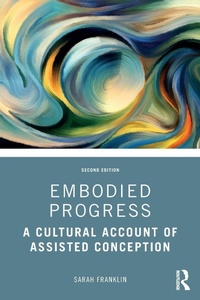
Embodied Progress
A Cultural Account of Assisted Conception
2nd Edition
Published on 12. October 2022
Book
Paperback/Softback
244 pages
978-1-032-25667-2 (ISBN)
Description
This new edition of Sarah Franklin's classic monograph on the development of in vitro fertilisation (IVF) includes two entirely new chapters reflecting on the relevance of the book's findings in the context of the past two decades and providing a 'state-of-the-art' review of the field today.
Over the past 25 years, both the assisted conception industry and the academic field of reproductive studies have grown enormously. IVF, in particular, is belatedly becoming recognised as one of the most influential technologies of the twentieth and twenty-first centuries, with a far-reaching set of implications that have to date been underestimated, understudied and under-reported. This pioneering text was the first to explore the emergence of commercial IVF in the United Kingdom, where the technique was originally developed. During the 1980s, the British Parliament devised a unique system of comprehensive national regulation of assisted reproduction amidst fractious public and media debate over IVF and embryo research. Franklin chronicles these developments and explores their significance in relation to classic anthropological debates about the meanings of kinship, gender and the 'biological facts' of parenthood. Drawing on extensive personal interviews with women and couples undergoing IVF, as well as ethnographic fieldword in early IVF clinics, the book explores the unique demands of the IVF technique. In richly detailed chapters, it documents the 'topsy-turvy' world of IVF, and how the experience of undergoing IVF changes its users in ways they had not anticipated. Franklin argues that such experiences reveal a crucial feature of translational biomedical procedures more widely - namely, that these are 'hope technologies' that paradoxically generate new uncertainties and risks in the very space of their supposed resolution. The final chapter closely engages with the 'hope technology' concept, as well as the idea of 'having to try' and uses these frames to link contemporary reproductive studies to core sociological and anthropological arguments about economy, society and technology.
In the context of rapid fertility decline and huge growth in the fertility industry, this volume is even more relevant today than when it was first published at the dawn of what Franklin calls the era of 'iFertility'. Embodied Progress is an essential read for all social science academics and students with an interested in the burgeoning new field of reproductive studies. It is also a valuable resource for practitioners working in the fields of reproductive health, biomedicine and policy.
Over the past 25 years, both the assisted conception industry and the academic field of reproductive studies have grown enormously. IVF, in particular, is belatedly becoming recognised as one of the most influential technologies of the twentieth and twenty-first centuries, with a far-reaching set of implications that have to date been underestimated, understudied and under-reported. This pioneering text was the first to explore the emergence of commercial IVF in the United Kingdom, where the technique was originally developed. During the 1980s, the British Parliament devised a unique system of comprehensive national regulation of assisted reproduction amidst fractious public and media debate over IVF and embryo research. Franklin chronicles these developments and explores their significance in relation to classic anthropological debates about the meanings of kinship, gender and the 'biological facts' of parenthood. Drawing on extensive personal interviews with women and couples undergoing IVF, as well as ethnographic fieldword in early IVF clinics, the book explores the unique demands of the IVF technique. In richly detailed chapters, it documents the 'topsy-turvy' world of IVF, and how the experience of undergoing IVF changes its users in ways they had not anticipated. Franklin argues that such experiences reveal a crucial feature of translational biomedical procedures more widely - namely, that these are 'hope technologies' that paradoxically generate new uncertainties and risks in the very space of their supposed resolution. The final chapter closely engages with the 'hope technology' concept, as well as the idea of 'having to try' and uses these frames to link contemporary reproductive studies to core sociological and anthropological arguments about economy, society and technology.
In the context of rapid fertility decline and huge growth in the fertility industry, this volume is even more relevant today than when it was first published at the dawn of what Franklin calls the era of 'iFertility'. Embodied Progress is an essential read for all social science academics and students with an interested in the burgeoning new field of reproductive studies. It is also a valuable resource for practitioners working in the fields of reproductive health, biomedicine and policy.
More details
Edition
2nd edition
Language
English
Place of publication
London
United Kingdom
Publishing group
Taylor & Francis Ltd
Target group
College/higher education
Postgraduate and Undergraduate Advanced
Dimensions
Height: 234 mm
Width: 156 mm
Thickness: 14 mm
Weight
404 gr
ISBN-13
978-1-032-25667-2 (9781032256672)
Copyright in bibliographic data and cover images is held by Nielsen Book Services Limited or by the publishers or by their respective licensors: all rights reserved.
Schweitzer Classification
Other editions
Additional editions
E-Book
10/2022
2nd Edition
Routledge
€59.49
Available for download
Konstantinos Papadikis | Chee Chin | Isaac Galobardes
Embodied Progress
A Cultural Account of Assisted Conception
E-Book
10/2022
2nd Edition
Routledge
€59.49
Available for download

Book
10/2022
2nd Edition
Routledge
€186.20
Shipment within 10-20 days
Previous edition
Book
02/1997
1st Edition
Routledge
€73.22
Article exhausted; check for reprint
Person
Sarah Franklin is the Chair of Sociology and Director of the Reproductive Sociology Research Group (ReproSoc) at the University of Cambridge, where she is also a Fellow of Christ's College.
Content
Introduction to the 1st edition. Introduction to the second edition. 1.Conception among the anthropologists. 2.Contested conceptions in the enterprise culture. 3.The 'obstacle course': the reproductive work of IVF. 4.'It just takes over': IVF as a 'way of life'. 5.Hhaving to try 'and 'having to choose': how IVF 'makes sense'. 6.The embodiment of progress. Afterword