

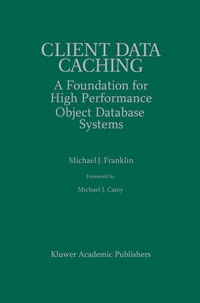
Client Data Caching
A Foundation for High Performance Object Database Systems
Published on 26. September 2011
Book
Paperback/Softback
XIV, 216 pages
978-1-4612-8588-5 (ISBN)
Description
Despite the significant ongoing work in the development of new database systems, many of the basic architectural and performance tradeoffs involved in their design have not previously been explored in a systematic manner. The designers of the various systems have adopted a wide range of strategies in areas such as process structure, client-server interaction, concurrency control, transaction management, and memory management.
This monograph investigates several fundamental aspects of the emerging generation of database systems. It describes and investigates implementation techniques to provide high performance and scalability while maintaining the transaction semantics, reliability, and availability associated with more traditional database architectures. The common theme of the techniques developed here is the exploitation of client resources through caching-based data replication.
Client Data Caching: A Foundation for High Performance Object Database Systems should be a value to anyone interested in the performance and architecture of distributed information systems in general and Object-based Database Management Systems in particular. It provides useful information for designers of such systems, as well as for practitioners who need to understand the inherent tradeoffs among the architectural alternatives in order to evaluate existing systems. Furthermore, many of the issues addressed in this book are relevant to other systems beyond the ODBMS domain. Such systems include shared-disk parallel database systems, distributed file systems, and distributed virtual memory systems. The presentation is suitable for practitioners and advanced students in all of these areas, although a basic understanding of database transaction semantics and techniques is assumed.
This monograph investigates several fundamental aspects of the emerging generation of database systems. It describes and investigates implementation techniques to provide high performance and scalability while maintaining the transaction semantics, reliability, and availability associated with more traditional database architectures. The common theme of the techniques developed here is the exploitation of client resources through caching-based data replication.
Client Data Caching: A Foundation for High Performance Object Database Systems should be a value to anyone interested in the performance and architecture of distributed information systems in general and Object-based Database Management Systems in particular. It provides useful information for designers of such systems, as well as for practitioners who need to understand the inherent tradeoffs among the architectural alternatives in order to evaluate existing systems. Furthermore, many of the issues addressed in this book are relevant to other systems beyond the ODBMS domain. Such systems include shared-disk parallel database systems, distributed file systems, and distributed virtual memory systems. The presentation is suitable for practitioners and advanced students in all of these areas, although a basic understanding of database transaction semantics and techniques is assumed.
More details
Series
Edition
Softcover reprint of the original 1st ed. 1996
Language
English
Place of publication
New York
United States
Target group
Professional and scholarly
Research
Illustrations
XIV, 216 p.
Dimensions
Height: 235 mm
Width: 155 mm
Thickness: 13 mm
Weight
365 gr
ISBN-13
978-1-4612-8588-5 (9781461285885)
DOI
10.1007/978-1-4613-1363-2
Schweitzer Classification
Other editions
Additional editions
Book
03/1996
Kluwer Academic Publishers
€160.49
Shipment within 15-20 days
Content
1 Introduction.- 1.1 Background and Motivation.- 1.2 Overview.- 1.3 Organization.- 2 Client-Server Database Systems.- 2.1 Architectural Alternatives.- 2.2 Reference Architecture.- 2.3 Utilizing Client Resources.- 2.4 Related Systems.- 3 Modeling a Page Server DBMS.- 3.1 Model Overview.- 3.2 Client-Server Execution Model.- 3.3 Database and Physical Resource Model.- 3.4 Workload Models.- 3.5 Experimental Methodology.- 4 Client Cache Consistency.- 4.1 The Consistency Maintenance Problem.- 4.2 A Taxonomy of Consistency Protocols.- 4.3 Cache Consistency Maintenance Algorithms.- 5 Performance of Cache Consistency Algorithms.- 5.1 System Configuration and Workloads.- 5.2 Server-based 2PL and Optimistic 2PL.- 5.3 Callback Locking.- 5.4 Related Work.- 5.5 Chapter Summary.- 6 Global Memory Management.- 6.1 Introduction.- 6.2 Algorithms for Global Memory Management.- 6.3 Experiments and Results.- 6.4 Related Work.- 6.5 Chapter Summary.- 7 Local Disk Caching.- 7.1 Utilizing Client Disks.- 7.2 Designing an Extended Cache.- 7.3 Extended Cache Performance.- 7.4 Algorithm Extensions.- 7.5 Chapter Summary.- 8 Towards a Flexible Distributed DBMS Architecture.- 8.1 Data Granularity.- 8.2 Peer-to-Peer Architecture.- 8.3 Integrating Data-shipping and Query-shipping.- 9 Conclusions.- 9.1 Summary of Results.- 9.2 Future Work.- References.