

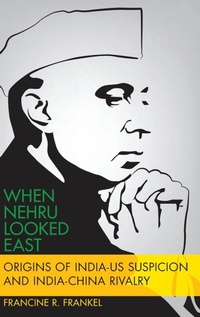
When Nehru Looked East
Origins of India-US Suspicion and India-China Rivalry
Published on 31. January 2020
Book
Hardback
364 pages
978-0-19-006434-1 (ISBN)
Description
Jawaharlal Nehru, India's first Prime Minister and Minister of External Affairs from 1947 to 1964, set the framework of foreign policy which has remained India's reference point until the present. One of the most significant leaders of the twentieth century, Nehru came to power in the early years of the Cold War, determined to assert independent India's influence and interests in Asia and beyond. Drawing on the Nehru Papers, Francine Frankel's When Nehru Looked East reinterprets the doctrine of non-alignment with which Nehru is most closely identified to reveal its strategic purpose.
Analyzing India-US and India-China relations during this period, Frankel explains how these parties came to distrust each other. From the outset, Nehru's vision of India's destiny as a great power collided with that of the US as leader and protector of the free world. He considered the US a rival in South and Southeast Asia and the Middle East and carried out an active diplomacy to dissuade newly independent nations from joining US-led anti-communist mutual security alliances and instead follow India's example of non-alignment. He did not see a threat from the Soviet Union and believed, despite the dispute with China over the northern border, that India's approach would bring India and China together as advocates of Asianism to counter American penetration in the region. This historic miscalculation, manifested in the 1962 China-India War, overthrew the pillars of Nehru's foreign policy.
Frankel provides the most authoritative account yet of the origins of India-US suspicions and India-China rivalries. Outlasting the Cold War, Nehru's worldview lived on in the mindset of successor generations, making it difficult for the US and India to form a strategic partnership and establish a natural balance in Asia.
Analyzing India-US and India-China relations during this period, Frankel explains how these parties came to distrust each other. From the outset, Nehru's vision of India's destiny as a great power collided with that of the US as leader and protector of the free world. He considered the US a rival in South and Southeast Asia and the Middle East and carried out an active diplomacy to dissuade newly independent nations from joining US-led anti-communist mutual security alliances and instead follow India's example of non-alignment. He did not see a threat from the Soviet Union and believed, despite the dispute with China over the northern border, that India's approach would bring India and China together as advocates of Asianism to counter American penetration in the region. This historic miscalculation, manifested in the 1962 China-India War, overthrew the pillars of Nehru's foreign policy.
Frankel provides the most authoritative account yet of the origins of India-US suspicions and India-China rivalries. Outlasting the Cold War, Nehru's worldview lived on in the mindset of successor generations, making it difficult for the US and India to form a strategic partnership and establish a natural balance in Asia.
Reviews / Votes
When Nehru Looked East is interpretative history at its best. It is a sobering tale of how discordant worldviews, unequal capabilities, incompatible strategies and sometimes, plain shortsightedness, conspired to subvert the construction of a U.S.-Indian partnership that could have made a real difference to Asia's evolution during the early Cold War-problems that unfortunately have not disappeared even today. This book is essential reading for scholars and policymakers in both countries. * Ashley Tellis, Carnegie Endowment for International Peace * Drawing on a vast array of documents-including rare access to the Nehru papers-Frankel provides an authoritative account of how the seeds of mistrust in India-U.S. relations were planted when the guiding principles of India's foreign policy were being formulated, in a fertile soil of competing national interests and priorities, fueling mutual suspicion that would last half a century. * Devesh Kapur, Johns Hopkins University *More details
Series
Language
English
Place of publication
New York
United States
Target group
Professional and scholarly
Dimensions
Height: 240 mm
Width: 161 mm
Thickness: 24 mm
Weight
710 gr
ISBN-13
978-0-19-006434-1 (9780190064341)
Copyright in bibliographic data and cover images is held by Nielsen Book Services Limited or by the publishers or by their respective licensors: all rights reserved.
Schweitzer Classification
Other editions
Additional editions
E-Book
12/2019
OUP eBook
€27.49
Available for download
E-Book
12/2019
OUP eBook
€27.49
Available for download
Person
Francine R. Frankel is Professor Emeritus of Political Science and Founding Director of the Center for the Advanced Study of India (CASI) at the University of Pennsylvania. She is a Founding Member of the University of Pennsylvania Institute for the Advanced Study of India (UPIASI), New Delhi, the counterpart institution of CASI. She is the author, or co-editor of eight books, including India's Political Economy, 1947-1977, and India's Political Economy, 1947-2004, second edition.
Content
Preface
Acknowledgments
Abbreviations
Chapter 1: First Encounters
Chapter 2: Partition: Anglo-U.S. Origins of Strategic Parity between India and Pakistan
Chapter 3: Kashmir: Onset of India's Suspicion of the United States
Chapter 4: Different Worlds: U.S. and Indian Policies toward Nationalist Movements in Asia, Communist Victory in China, and the Chinese Claim to Tibet
Chapter 5: Korea: India's "Un-Neutral" China Policy Stokes U.S. Suspicions
Chapter 6: U.S. and Indian Policies in Direct Conflict, Part I: Collective Security in the Middle East and Pakistan
Chapter 7: U.S. and Indian Policies in Direct Conflict, Part II: India's "Area of Peace" as a Strategy to Contain U.S. Intervention in Indi-China and Southeast Asia
Chapter 8: India-China War, 1962
Epilogue
Bibliography
Acknowledgments
Abbreviations
Chapter 1: First Encounters
Chapter 2: Partition: Anglo-U.S. Origins of Strategic Parity between India and Pakistan
Chapter 3: Kashmir: Onset of India's Suspicion of the United States
Chapter 4: Different Worlds: U.S. and Indian Policies toward Nationalist Movements in Asia, Communist Victory in China, and the Chinese Claim to Tibet
Chapter 5: Korea: India's "Un-Neutral" China Policy Stokes U.S. Suspicions
Chapter 6: U.S. and Indian Policies in Direct Conflict, Part I: Collective Security in the Middle East and Pakistan
Chapter 7: U.S. and Indian Policies in Direct Conflict, Part II: India's "Area of Peace" as a Strategy to Contain U.S. Intervention in Indi-China and Southeast Asia
Chapter 8: India-China War, 1962
Epilogue
Bibliography