

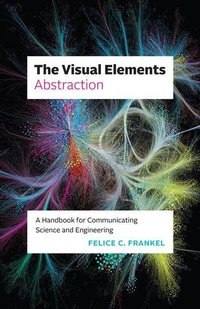
The Visual Elements-Abstraction
A Handbook for Communicating Science and Engineering
Will be published approx. on 16. July 2026
Book
Paperback/Softback
208 pages
978-0-226-84828-0 (ISBN)
Description
For anyone interested in visual communication, a training guide for evaluating and developing visual representations for the big ideas in science and technology, essential skills for journal submissions, grant applications, and public understanding.
As a scientist, engineer, or other researcher, you may have written an abstract. In a paragraph, you explain the purpose of your research, your approach, the questions you have asked and answered, and your work's impact. The abstract is a summary and an invitation-to read the paper, attend your talk, and join you in your thinking. You may even have been asked to create a visual abstract-a single image-to achieve the same goals. As a designer or public information officer, you may have had a similar brief-to explain a compelling subject with a visual for a journal cover or press release. And yet, this important skill-devising visual metaphors-isn't typically taught. With her decades of experience creating compelling images and instructing MIT researchers, award-winning photographer and science communicator Felice C. Frankel helps readers evaluate and create their own visual abstractions.
Like in her other books in the Visual Elements series, on photography and design, Frankel asks readers to evaluate different choices-for example, in conveying the uncertainty of a hurricane's path or the organization of the Standard Model for elementary particles. But in Abstraction, she offers more. With examples from science, engineering, and beyond, the book helps readers consider and evaluate the visuals around them and determine how they work and when they fail: Is this representation the best for communication? Will these abstractions encourage others to engage with my work? Will they mislead? Will they help my ideas evolve? Frankel invites researchers to think about the many meanings behind their images-and, in turn, to think more deeply about their research.
As a scientist, engineer, or other researcher, you may have written an abstract. In a paragraph, you explain the purpose of your research, your approach, the questions you have asked and answered, and your work's impact. The abstract is a summary and an invitation-to read the paper, attend your talk, and join you in your thinking. You may even have been asked to create a visual abstract-a single image-to achieve the same goals. As a designer or public information officer, you may have had a similar brief-to explain a compelling subject with a visual for a journal cover or press release. And yet, this important skill-devising visual metaphors-isn't typically taught. With her decades of experience creating compelling images and instructing MIT researchers, award-winning photographer and science communicator Felice C. Frankel helps readers evaluate and create their own visual abstractions.
Like in her other books in the Visual Elements series, on photography and design, Frankel asks readers to evaluate different choices-for example, in conveying the uncertainty of a hurricane's path or the organization of the Standard Model for elementary particles. But in Abstraction, she offers more. With examples from science, engineering, and beyond, the book helps readers consider and evaluate the visuals around them and determine how they work and when they fail: Is this representation the best for communication? Will these abstractions encourage others to engage with my work? Will they mislead? Will they help my ideas evolve? Frankel invites researchers to think about the many meanings behind their images-and, in turn, to think more deeply about their research.
Reviews / Votes
"Frankel is a pioneer in her field who has helped many scientists visualize their work in interesting and effective ways. This latest book in her series highlights a region of unexplored territory. It is not so much a 'how-to' for accomplishing certain effects (or avoiding common blunders) but rather an invitation to think more broadly about what the visual abstract should convey and how to do it in simple terms. An exciting addition." -- Sidney R. Nagel, Stein-Freiler Distinguished Service Professor, Department of Physics, University of ChicagoMore details
Series
Language
English
Place of publication
Chicago
United States
Publishing group
The University of Chicago Press
Target group
Professional and scholarly
Illustrations
186 color plates, 28 halftones
Dimensions
Height: 216 mm
Width: 140 mm
Weight
454 gr
ISBN-13
978-0-226-84828-0 (9780226848280)
Copyright in bibliographic data and cover images is held by Nielsen Book Services Limited or by the publishers or by their respective licensors: all rights reserved.
Schweitzer Classification
Person
Felice C. Frankel is an award-winning science photographer and research scientist in the Department of Chemical Engineering, with support from Mechanical Engineering, at the Massachusetts Institute of Technology. Working in collaboration with scientists and engineers, Frankel has had images appear in Nature, Science, Cell, TheNew York Times, National Geographic, PNAS, Newsweek, Scientific American, Discover, Popular Science, and New Scientist, among others. She is the coauthor of Visual Strategies and author of Picturing Science and Engineering; The Visual Elements-Photography and The Visual Elements-Design, both also published by the University of Chicago Press; and most recently, Phenomenal Moments: Revealing the Hidden Science Around Us.
Content
Introduction
1. Illustrations
2. Notations
3. Systems
4. Uncertainty
5. Metaphors
6. Picturing the Future
Acknowledgments
Notes
Credits
1. Illustrations
2. Notations
3. Systems
4. Uncertainty
5. Metaphors
6. Picturing the Future
Acknowledgments
Notes
Credits