

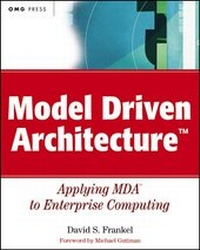
Model Driven Architecture
Applying MDA to Enterprise Computing
Published on 17. January 2003
Book
Paperback/Softback
XXII, 330 pages
978-0-471-31920-7 (ISBN)
Description
* Model Driven Architecture (MDA) is a new methodologyf rom OMG that uses modeling languages like UML along with programming languages like Java to build software architectures
* PriceWatersCoopers' prestigious Technology Center just predicted that MDA will be one of the most important methodologies in the next two years
* Written by the lead architect of the specification who provides inside information on how MDA has worked in the real world
* Describes MDA in detail and demonstrates how it can work with existing methodologies and technologies such as UML,MOF, CWM, and Web services
* PriceWatersCoopers' prestigious Technology Center just predicted that MDA will be one of the most important methodologies in the next two years
* Written by the lead architect of the specification who provides inside information on how MDA has worked in the real world
* Describes MDA in detail and demonstrates how it can work with existing methodologies and technologies such as UML,MOF, CWM, and Web services
More details
Series
Edition
1. Auflage
Language
English
Place of publication
New York
United States
Publishing group
John Wiley and Sons Ltd
Target group
College/higher education
Professional and scholarly
Dimensions
Height: 23.5 cm
Width: 19.9 cm
Thickness: 1.9 cm
Weight
614 gr
ISBN-13
978-0-471-31920-7 (9780471319207)
Schweitzer Classification
Person
DAVID S. FRANKEL is Chief Scientist for QuarterSoft, Inc., and previously held senior positions at IONA Tech-nologies and Genesis Development Corporation. He is a renowned expert in the architecture and development of complex, large-scale distributed computing systems. Frankel has served several terms on the OMG Architecture Board.
Content
Preface.
Foreword.
PART ONE: INTRODUCING MDA.
Pressure and Progress: How We Arrived at This Point.
Model Driven Enterprise Computing.
PART TWO: THE BASE MDA TECHNOLOGIES.
The Role of UML in MDA.
Beyond Basic Class Modeling.
The Meta Object Facility (MOF).
Extending and Creating Modeling Languages.
Building Compilable Class Models.
Modeling at Different Abstraction Levels.
PART THREE: ADVANCED TOPICS.
Modeling Transformations with CWM.
Additional Advanced Topics.
Epilogue: A Reality Check.
Appendix A: Sample Transaction Metamodel.
Appendix B: Options Trading Concepts.
References.
Glossary.
Index.
Foreword.
PART ONE: INTRODUCING MDA.
Pressure and Progress: How We Arrived at This Point.
Model Driven Enterprise Computing.
PART TWO: THE BASE MDA TECHNOLOGIES.
The Role of UML in MDA.
Beyond Basic Class Modeling.
The Meta Object Facility (MOF).
Extending and Creating Modeling Languages.
Building Compilable Class Models.
Modeling at Different Abstraction Levels.
PART THREE: ADVANCED TOPICS.
Modeling Transformations with CWM.
Additional Advanced Topics.
Epilogue: A Reality Check.
Appendix A: Sample Transaction Metamodel.
Appendix B: Options Trading Concepts.
References.
Glossary.
Index.