

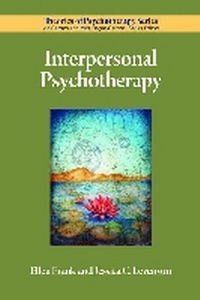
Interpersonal Psychotherapy
Published on 15. August 2010
Book
Paperback/Softback
154 pages
978-1-4338-0851-7 (ISBN)
Description
Interpersonal Psychotherapy provides an introduction to the theory, history, research, and practice of this effective, empirically validated approach.
Gerald L. Klerman and Myrna M. Weissman initially created interpersonal psychotherapy (IPT) as a brief approach for treating depression, but it has since been adapted for use with a wide variety of client presenting problems and in longer-term situations. This approach focuses on the interaction between interpersonal dysfunction and psychological symptoms. IPT is founded on the idea that humans are social beings, thus client personal relationships lie at the center of presenting problems and psychological states.
Although grounded in a medical model, which is used to conceptualize the client's presenting problem, the primary basis for this approach lies in an interpersonal modification of psychodynamic psychotherapy. Therapy is present-focused, but aspects of attachment theory are used to analyze how past relationships affect current relationships. Therapists applying IPT take an active stance, continually and supportively guiding the sessions to maintain focus on one of four interpersonal problem areas: unresolved grief, role transitions, role disputes, or interpersonal deficits.
In this book, Frank and Levenson present and explore this versatile and useful approach, its theory, history, therapy process, primary change mechanisms, the empirical basis for its effectiveness, and contemporary developments that have refined the theory and expanded how it may be practiced. This essential primer, amply illustrated with case examples featuring diverse clients, is perfect for graduate students studying theories of therapy and counseling, as well as for seasoned practitioners interested in understanding how this approach has evolved and how it might be used in their practice.
Gerald L. Klerman and Myrna M. Weissman initially created interpersonal psychotherapy (IPT) as a brief approach for treating depression, but it has since been adapted for use with a wide variety of client presenting problems and in longer-term situations. This approach focuses on the interaction between interpersonal dysfunction and psychological symptoms. IPT is founded on the idea that humans are social beings, thus client personal relationships lie at the center of presenting problems and psychological states.
Although grounded in a medical model, which is used to conceptualize the client's presenting problem, the primary basis for this approach lies in an interpersonal modification of psychodynamic psychotherapy. Therapy is present-focused, but aspects of attachment theory are used to analyze how past relationships affect current relationships. Therapists applying IPT take an active stance, continually and supportively guiding the sessions to maintain focus on one of four interpersonal problem areas: unresolved grief, role transitions, role disputes, or interpersonal deficits.
In this book, Frank and Levenson present and explore this versatile and useful approach, its theory, history, therapy process, primary change mechanisms, the empirical basis for its effectiveness, and contemporary developments that have refined the theory and expanded how it may be practiced. This essential primer, amply illustrated with case examples featuring diverse clients, is perfect for graduate students studying theories of therapy and counseling, as well as for seasoned practitioners interested in understanding how this approach has evolved and how it might be used in their practice.
More details
Series
Language
English
Place of publication
Washington DC
United States
Target group
Professional and scholarly
Product notice
Paperback (trade)
Dimensions
Height: 229 mm
Width: 152 mm
ISBN-13
978-1-4338-0851-7 (9781433808517)
Copyright in bibliographic data and cover images is held by Nielsen Book Services Limited or by the publishers or by their respective licensors: all rights reserved.
Schweitzer Classification
Persons
Ellen Frank, PhD, is a distinguished professor of psychiatry and a professor of psychology at the University of Pittsburgh School of Medicine and director of the Depression and Manic-Depression Prevention Program at the Western Psychiatric Institute and Clinic of the University of Pittsburgh Medical Center. She completed her undergraduate work in drama at Vassar College in Poughkeepsie, New York, completed a master's degree in English at Carnegie-Mellon University in Pittsburgh, Pennsylvania, and obtained her PhD in psychology at the University of Pittsburgh. She received her training in interpersonal psychotherapy (IPT) from Drs. Gerald Klerman, Myrna Weissman, and Bruce Rounsaville in the early 1980s. Since that time, Dr. Frank and her colleagues have developed a series of adaptations of IPT, including those for preventative maintenance treatment of unipolar depression and for the acute and maintenance treatment of bipolar disorder, each of which they have subsequently validated in empirical studies.
Jessica C. Levenson, MS, is a PhD candidate in clinical psychology at the University of Pittsburgh. She received a BA from Brandeis University in Waltham, Massachusetts, and an MS from the University of Pittsburgh. Ms. Levenson's work focuses on the mechanistic understanding and treatment of mood disorders. Her recent work has focused on identifying the patient and treatment characteristics that may differentiate those patients who benefit most from interpersonal psychotherapy.
Jessica C. Levenson, MS, is a PhD candidate in clinical psychology at the University of Pittsburgh. She received a BA from Brandeis University in Waltham, Massachusetts, and an MS from the University of Pittsburgh. Ms. Levenson's work focuses on the mechanistic understanding and treatment of mood disorders. Her recent work has focused on identifying the patient and treatment characteristics that may differentiate those patients who benefit most from interpersonal psychotherapy.
Content
Series Preface
How to Use This Book With APA Psychotherapy Videos
Acknowledgments
Introduction
History
Theory
The Therapy Process
Evaluation
Future Developments
Summary
Glossary of Key Terms
Suggested Readings
References
Index
About the Authors
About the Series Editors
How to Use This Book With APA Psychotherapy Videos
Acknowledgments
Introduction
History
Theory
The Therapy Process
Evaluation
Future Developments
Summary
Glossary of Key Terms
Suggested Readings
References
Index
About the Authors
About the Series Editors