

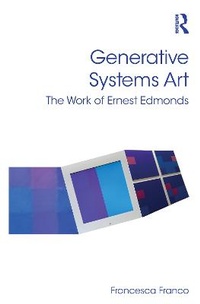
Generative Systems Art
The Work of Ernest Edmonds
1st Edition
Published on 10. October 2017
Book
Hardback
158 pages
978-1-4724-3600-9 (ISBN)
Description
In this unique book the author explores the history of pioneering computer art and its contribution to art history by way of examining Ernest Edmonds' art from the late 1960s to the present day. Edmonds' inventions of new concepts, tools and forms of art, along with his close involvement with the communities of computer artists, constructive artists and computer technologists, provides the context for discussion of the origins and implications of the relationship between art and technology. Drawing on interviews with Edmonds and primary research in archives of his work, the book offers a new contribution to the history of the development of digital art and places Edmonds' work in the context of contemporary art history.
Reviews / Votes
"I consider this book to be an important contribution to the field of media art history and in particular to that of generative and interactive art."Frank Popper, Professor Emeritus of Aesthetics and the Science of Art, University of Paris VIII, Paris
"This book provides a long overdue in-depth study of the work of one of the pioneers of digital art. Drawing upon Edmonds' original projects, his notes and statements, as well as documentation and exhibition catalogues, Francesca Franco traces the work's evolution from figurative art to colour abstraction and computer-based experimentation. The author's detailed analysis not only creates a deeper understanding of Edmonds' body of work but also functions as media archaeology, referencing exhibition histories that are often overlooked and outlining intersections between Constructivism, Systems Art and the digital art of the 21st century, as well as their concepts, tools, and forms."
Christiane Paul, Associate Professor, School of Media Studies, The New School, New York
"Of all those who signposted the road of interaction, systems, colocation and the new geometries of space and communication, from Fluxus to ubiquitous networks, Ernest Edmonds has been among the most connected, prolific and influential. Francesca Franco elaborates his rich, diverse and endlessly invigorating practice in relation to art movements and institutional evolutions in an imaginative and immaculate work of art historical scholarship. Still perplexing even in the digital era, this story of digital art's origins and trajectories will inspire new generations of artists, scholars and thinkers in the dense interweavings of art, science and technology."
Sean Cubitt, Professor of Film and Television and co-Head of Department of Media and Communications Goldsmiths, University of London.
"An insightful and rich source of information about Ernest Edmonds' art practice; this book offers multifaceted observations about the context, connections and development of his generative art."
Melanie Lenz, Curator, Digital Art, Victoria and Albert Museum, London
More details
Series
Language
English
Place of publication
London
United Kingdom
Publishing group
Taylor & Francis Ltd
Target group
College/higher education
Illustrations
57 farbige Abbildungen, 57 Farbfotos bzw. farbige Rasterbilder
57 Halftones, color; 57 Illustrations, color
Dimensions
Height: 234 mm
Width: 156 mm
Weight
430 gr
ISBN-13
978-1-4724-3600-9 (9781472436009)
Copyright in bibliographic data and cover images is held by Nielsen Book Services Limited or by the publishers or by their respective licensors: all rights reserved.
Schweitzer Classification
Other editions
Additional editions
Book
12/2019
1st Edition
Routledge
€53.22
Shipment within 15-20 days
E-Book
10/2017
Routledge
€60.49
Available for download
E-Book
10/2017
Routledge
€60.49
Available for download
Person
Francesca Franco is a Venetian-born art historian based in the UK. The central theme of Francesca's research is the history of art and technology and the pioneers of Computer art. It concerns issues of Generative and interactive art and the connections between Constructivism and Systems art in early Computational art. A major focus has been the history of the Venice Biennale, culminating in a series of publications in books, academic journals and art magazines, which have been translated into various languages.
Content
Introduction 1. The 1960s: from Figurative Art to Colour Abstraction Introduction 1.1 "Art or Mathematics?" 1.2 From Figurative Art to Black and White Abstraction (1960-1962) 1.3 From Black and White to Colour Abstraction (1962-1966) 1.4 Consolidating a Constructivist Approach: Nineteen (1967-69) 2. The 1970s - Logic, Computers and Communication Introduction 2.1 The Systems Group 2.2 Art, Technology and Participation in the United Kingdom 2.2.1 Malcom Hughes 2.2.2 Edward Ihnatowicz 2.2.3 Roy Ascott 2.2.4 Stephen Willats 2.3 Ernest Edmonds' Early Interactive Art 2.3.1 1970: Computer Graphics'70 -*DATAPACK and Jigsaw 2.3.2 1971: Invention of Problems II - The Communications Game 2.3.3 1972: Cognition and Control - The Communications Game 2 2.4 1974-78: Systems Approaches in Edmonds' Paintings and Drawings 3. The 1980s: Constructivism and Systems Introduction 3.1 Personal Networks and Connections 3.2 Ernest Edmonds' Themes 3.2.1 Structure 3.2.2 Time 3.2.3 Colour 3.3 Exhibiting Space, Duality and Co-existence 3.4 Null Dimension (1988) 3.5 Constructivism: Man versus Environment (1989) 4. The 1990s - Correspondences and Intersections Introduction 4.1 A Busy 1990 4.2 A Key Collaboration: Correspondences 4.3 Residencies and Exhibitions in the 1990s 5. Interactive Generative Art: 2000-2015 Introduction 5.1 The Years 2000 to 2005 5.1.1 Expanding and Evolving Video Constructs (2000-2003) 5.1.2 Audio-Visual Artworks: Ernest Edmonds with Mark Fell (2003-2004) 5.1.3 New Interactive Generative Works (2004-2005) 5.2 2005-2010 5.2.1. Tango Tangle (2006) 5.2.2 Shaping Form (from 2007) 5.2.3 Cities Tango: Between Belfast and Sydney (2009) 5.3 2010-2015 5.3.1 Automatic Art, London 2014 5.3.2 Primary Codes, Rio de Janeiro 2015 6. Structure and Systems Introduction 6.1 Structure and Interaction 6.2 Fifty Two (1980) 6.3 Four Shaped Forms (2014) 7. New Media, New Technologies and New Systems Introduction 7.1 Technical Innovations 7.1.1 Iterative Software Design Methods 7.1.2 Adaptable User Interfaces 7.1.3 User Interface Architectures 7.1.4 Creativity Support Tools 7.2 Art and Technology Crossovers 7.2.1 Creativity and Cognition 7.2.2 Living Laboratories for Interactive Art 7.2.3 Logic, Constructive Mathematics and Generative Art 7.2.4 Logic Programming for Time-based Generative Art Conclusions Bibliography Endorsements