

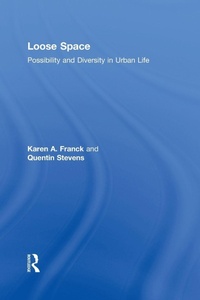
Loose Space
Possibility and Diversity in Urban Life
1st Edition
Published on 6. November 2006
Book
Hardback
318 pages
978-0-415-70116-7 (ISBN)
Description
In cities around the world people use a variety of public spaces to relax, to protest, to buy and sell, to experiment and to celebrate. Loose Space explores the many ways that urban residents, with creativity and determination, appropriate public space to meet their own needs and desires. Familiar or unexpected, spontaneous or planned, momentary or long-lasting, the activities that make urban space loose continue to give cities life and vitality.
The book examines physical spaces and how people use them. Contributors discuss a wide range of recreational, commercial and political activities; some are conventional, others are more experimental. Some of the activities occur alongside the intended uses of planned public spaces, such as sidewalks and plazas; other activities replace former uses, as in abandoned warehouses and industrial sites. The thirteen case studies, international in scope, demonstrate the continuing richness of urban public life that is created and sustained by urbanites themselves
Presents a fresh way of looking at urban public space, focusing on its positive uses and aspects.
Comprises 13 detailed, well-illustrated case studies based on sustained observation and research by social scientists, architects and urban designers.
Looks at a range of activities, both everyday occurrences and more unusual uses, in a variety of public spaces -- planned, leftover and abandoned.
Explores the spatial and the behavioral; considers the wider historical and social context.
Addresses issues of urban research, architecture, urban design and planning.
Takes a broad international perspective with cases from New York, London, Berlin, Amsterdam, Rome, Guadalajara, Athens, Tel Aviv, Melbourne, Bangkok, Kandy, Buffalo, and the North of England.
The book examines physical spaces and how people use them. Contributors discuss a wide range of recreational, commercial and political activities; some are conventional, others are more experimental. Some of the activities occur alongside the intended uses of planned public spaces, such as sidewalks and plazas; other activities replace former uses, as in abandoned warehouses and industrial sites. The thirteen case studies, international in scope, demonstrate the continuing richness of urban public life that is created and sustained by urbanites themselves
Presents a fresh way of looking at urban public space, focusing on its positive uses and aspects.
Comprises 13 detailed, well-illustrated case studies based on sustained observation and research by social scientists, architects and urban designers.
Looks at a range of activities, both everyday occurrences and more unusual uses, in a variety of public spaces -- planned, leftover and abandoned.
Explores the spatial and the behavioral; considers the wider historical and social context.
Addresses issues of urban research, architecture, urban design and planning.
Takes a broad international perspective with cases from New York, London, Berlin, Amsterdam, Rome, Guadalajara, Athens, Tel Aviv, Melbourne, Bangkok, Kandy, Buffalo, and the North of England.
Reviews / Votes
'What the collection draws attention to is the growing interest in the cultural importance of urban fringes and terrains ... there are challenging ideas in these essays, and the issues raised are timely and indeed urgent.' - Green Places'A fascinating book ... contrasts with more traditional urban design texts.' - Urban Design 'What the collection draws attention to is the growing interest in the cultural importance of urban fringes and terrains ... there are challenging ideas in these essays, and the issues raised are timely and indeed urgent.' - Green Places
'A fascinating book ... contrasts with more traditional urban design texts.' - Urban Design
'[T]heroetically and empirically innovative... Certainly a worthwhile read for people interested in critical and emancipatory interpretations of the deployment of urban space." Harold A. Perkins, Ohio University, Annals of the Association of American Geographers
More details
Language
English
Place of publication
London
United Kingdom
Publishing group
Taylor & Francis Ltd
Target group
Adult education
Illustrations
102 s/w Photographien bzw. Rasterbilder
102 Halftones, black and white
Dimensions
Height: 260 mm
Width: 183 mm
Thickness: 22 mm
Weight
796 gr
ISBN-13
978-0-415-70116-7 (9780415701167)
Copyright in bibliographic data and cover images is held by Nielsen Book Services Limited or by the publishers or by their respective licensors: all rights reserved.
Schweitzer Classification
Other editions
Additional editions
Book
10/2006
1st Edition
Routledge
€86.10
Shipment within 15-20 days
E-Book
10/2006
1st Edition
Routledge
€78.99
Available for download
E-Book
10/2006
1st Edition
Routledge
€78.99
Available for download
Persons
Karen A. Franck is a Professor in the School of Architecture and the Department of Humanities at the New Jersey Institute of Technology.
Quentin Stevens is a Lecturer in urban design at the Bartlett School of Planning, University College London.
Quentin Stevens is a Lecturer in urban design at the Bartlett School of Planning, University College London.
Content
Tying Down Loose Space Appropriation Found Spaces: Freedom of Choice in Public Life. Open-Ended Space: Urban Streets in Two Cultural Contexts. Betwixt and Between: Building Thresholds, Liminality and Public Space Tension Urban Appropriation and Loose Spaces in the Guadalajara Cityscape. Urban Slippage: Smooth and Striated Streetscapes in Bangkok. Transforming Public Space into Sites of Mourning and Free Expression. Central Park: The Aesthetics of Order and the Appearance of Looseness Resistance Heterotopias and the Experience of Porous Space. Stalker on Location. Dead Zones, Outdoor Rooms and the Architecture of Transgression Discovery Social Practices, Sensual Excess and Aesthetic Transgression in Industrial Ruins. Unruly and Robust: An Abandoned Industrial River. Patterns of the Unplanned. Annotated Bibliography