

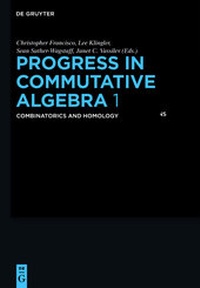
Progress in Commutative Algebra 1
Combinatorics and Homology
1st Edition
Published on 26. April 2012
Book
Mixed media product
XI, 361 pages
978-3-11-219020-3 (ISBN)
Description
This is the first of two volumes of a state-of-the-art survey article collection which originates from three commutative algebra sessions at the 2009 Fall Southeastern American Mathematical Society Meeting at Florida Atlantic University. The articles reach into diverse areas of commutative algebra and build a bridge between Noetherian and non-Noetherian commutative algebra. These volumes present current trends in two of the most active areas of commutative algebra: non-noetherian rings (factorization, ideal theory, integrality), and noetherian rings (the local theory, graded situation, and interactions with combinatorics and geometry). This volume contains combinatorial and homological surveys. The combinatorial papers document some of the increasing focus in commutative algebra recently on the interaction between algebra and combinatorics. Specifically, one can use combinatorial techniques to investigate resolutions and other algebraic structures as with the papers of Fløystad on Boij-Söderburg theory, of Geramita, Harbourne and Migliore, and of Cooper on Hilbert functions, of Clark on minimal poset resolutions and of Mermin on simplicial resolutions. One can also utilize algebraic invariants to understand combinatorial structures like graphs, hypergraphs, and simplicial complexes such as in the paper of Morey and Villarreal on edge ideals. Homological techniques have become indispensable tools for the study of noetherian rings. These ideas have yielded amazing levels of interaction with other fields like algebraic topology (via differential graded techniques as well as the foundations of homological algebra), analysis (via the study of D-modules), and combinatorics (as described in the previous paragraph). The homological articles the editors have included in this volume relate mostly to how homological techniques help us better understand rings and singularities both noetherian and non-noetherian such as in the papers by Roberts, Yao, Hummel and Leuschke.
More details
Series
Language
English
Place of publication
Berlin/Boston
Germany
Target group
Professional and scholarly
US School Grade: College Graduate Student
Illustrations
Includes a print version and an ebook
Dimensions
Height: 24 cm
Width: 17 cm
ISBN-13
978-3-11-219020-3 (9783112190203)
Schweitzer Classification
Other editions
Additional editions
Christopher Francisco | Lee C. Klingler | Sean Sather-Wagstaff
Progress in Commutative Algebra 1
Combinatorics and Homology
E-Book
04/2012
1st Edition
De Gruyter
€0.00
Available for download
Christopher Francisco | Lee C. Klingler | Sean Sather-Wagstaff
Progress in Commutative Algebra 1
Combinatorics and Homology
Book
04/2012
1st Edition
De Gruyter
€250.00
Shipment within 7-9 days
Persons
Christopher Francisco, Oklahoma State University, Stillwater, Oklahoma, USA; Lee C. Klingler, Florida Atlantic University, Boca Raton, Florida, USA; Sean M. Sather-Wagstaff, North Dakota State University, Fargo, North Dakota, USA; Janet Vassilev, University of New Mexico, Albuquerque, New Mexico, USA.
Content
Preface 1Boij-Soederberg Theory: Introduction and SurveyGunnar Fløystad1.1Introduction1.2The Boij-Söderberg Conjectures1.2.1Resolutions and Betti Diagrams1.2.2The Positive Cone of Betti Diagrams1.2.3Herzog-Kühl Equations1.2.4Pure Resolutions1.2.5Linear Combinations of Pure Diagrams1.2.6The Boij-Söderberg Conjectures1.2.7Algorithmic Interpretation1.2.8Geometric Interpretation1.3The Exterior Facets of the Boij-Söderberg Fan and their Supporting Hyperplanes1.3.1The Exterior Facets1.3.2The Supporting Hyperplanes1.3.3Pairings of vector Bundles and Resolutions1.4 The Existence of Pure Free Resolutions and of Vector Bundles with Supernatural Cohomology1.4.1The Equivariant Pure Free Resolution1.4.2Equivariant Supernatural Bundles1.4.3Characteristic Free Supernatural Bundles1.4.4The Characteristic Free Pure Resolution1.4.5Pure Resolutions Constructed from Generic Matrices1.5Cohomology of Vector Bundles on Projective Spaces1.5.1Cohomology Tables1.5.2The Fan of Cohomology Tables of Vector Bundles1.5.3Facet Equations1.6Extensions to Non-Cohen-Macaulay Modules and to Coherent Sheaves1.6.1Betti Diagrams of Graded Modules in General1.6.2Cohomology of Coherent Sheaves1.7Further Topics1.7.1The Semigroup of Betti Diagrams of Modules1.7.2Variants on the Grading1.7.3Poset Structures1.7.4Computer Packages1.7.5Three Basic Problems 2Hilbert Functions of Fat Point Subschemes of the Plane: the Two-fold WayAnthony V. Geramita, Brian Harbourne, and Juan Migliore2.1Introduction2.2Approach I: Nine Double Points2.3Approach I: Points on Cubics2.4Approach II: Points on Cubics 3Edge Ideals: Algebraic and Combinatorial PropertiesSusan Morey and Rafael H. Villarreal3.1Introduction3.2Algebraic and Combinatorial Properties of Edge Ideals3.3Invariants of Edge Ideals: Regularity, Projective Dimension, Depth3.4Stability of Associated Primes 4Three Simplicial ResolutionsJeff Mermin4.1Introduction4.2Background and Notation4.2.1Algebra4.2.2Combinatorics4.3The Taylor Resolution4.4Simplicial Resolutions4.5The Scarf Complex4.6The Lyubeznik Resolutions4.7Intersections4.8Questions 5A Minimal Poset Resolution of Stable IdealsTimothy B. P. Clark5.1Introduction5.2Poset Resolutions and Stable Ideals5.3The Shallability of PN5.4The Topology of PN and Properties of D(PN)5.5Proof of Theorem 2.45.6A Minimal Cellular Resolution of R/N 6Subsets of Complete Intersections and the EGH ConjectureSusan M. Cooper6.1Introduction6.2Preliminary Definitions and Results6.2.1The Eisenbud-Green-Harris Conjecture and Complete Intersections6.3Rectangular Complete Intersections6.4Some Key Tools6.4.1Pairs of Hilbert Functions and Maximal Growth6.4.2Ideals Containing Regular Sequences6.5Subsets of Complete Intersections in P26.6Subsets of C.I.(2, d2, d3) with d2 = d36.7Subsets of C.I.(3, d2, d3) with d3 = d26.8An Application: The Cayley-Bacharach Property 7The Homological ConjecturesPaul C. Roberts7.1Introduction7.2The Serre Multiplicity Conjectures7.2.1The Vanishing Conjecture7.2.2Gabber's Proof of the Nonnegativity Conjecture7.2.3The Positivity Conjecture7.3The Peskine-Szpiro Intersection Conjecture7.3.1Hochester's Metatheorem7.4Generalizations of the Multiplicity Conjectures7.4.1The Graded Case7.4.2The Generalized Rigidity Conjecture7.5The Monomial, Direct Summand, and Canonical Element Conjectures7.6Cohen-Macaulay Modules and Algebras7.6.1Weakly Functorial Big Cohen-Macaulay Algebras7.7The Syzygy Conjecture and the Improved New Intersection Conjecture7.8Tight Closure Theory7.9The Strong Direct Summand Conjecture7.10Almost Cohen-Macaulay Algebras7.11A Summary of Open Questions7.11.1The Serre Positivity Conjecture7.11.2Partial Euler Characteristics7.11.3Strong Multiplicity Conjectures7.11.4Cohen-Macaulay Modules and Related Conjectures7.11.5Almost Cohen-Macaulay Algebras 8The Compatibility, Independence, and Linear Growth PropertiesYongwei Yao8.1Introduction8.2Primary Decomposition8.3Compatibility of Primary Components8.4Maximal Primary Components, Independence8.5Linear Growth of Primary Components8.6Linear growth of {?Tor?_c^R (?(M/(I^m M )),?(N/(J^n N)))}8.7Secondary Representation8.8Compatibility of Secondary Components8.9Applying a Result of Sharp on Artinian Modules8.10Independence8.11Minimal Secondary Components8.12Linear Growth of Secondary Components 9Recent Progress in Coherent Rings: A Homological PerspectiveLivia Hummel9.1Introduction9.2Coherent Rings and Grade9.2.1Coherent Rings and ?(FP)?_?^R Modules9.2.2Non-Noetherian Grade9.3Cohen-Macaulay Rings9.4Gorenstein Dimensions and the Auslander-Bridger Property9.4.1Gorenstein Dimenstions9.4.2The Auslander-Bridger Formula9.5Gorenstein Rings and Injective Dimensions9.6Foundations for Coherent Complete Intersections 10Non-commutative Crepant Resolutions: Scenes from Categorical GeometryGraham J. Leuschke10.1Introduction10.2Morita Equivalence10.3(Quasi)coherent Sheaves10.4Derived Categories of Modules10.5Derived Categories of Sheaves10.6Example: Tilting on Projective Space10.7The Non-existence of Non-commutative Spaces10.8Resolutions of Singularities10.9The Minimal Model Program10.10.Categorical Desingularizations10.11Example: the McKay Correspondence10.12 Non-commutative Crepant Resolutions10.13Example: Normalization10.14 MCM Endomorphism Rings10.15Global Dimension of Endomorphism Rings10.16Rational Singularities10.17Examples: Finite Representation Type10.18Example: the Generic Determinant10.19Non-commutative Blowups10.20Omissions and Open Questions