

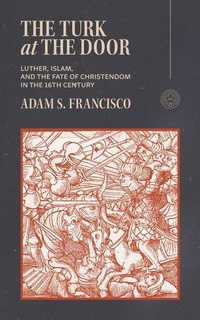
Martin Luther and the Turkish Jihad
Description
In the first half of the 16th century, Western Christendom stood at a crossroads. The Ottoman Empire, led by sultans who claimed the mantle of the caliphate, pressed deep into Europe, while within its own borders the unity of the church and society in general fractured in the wake of the Reformation. The Turk at the Door explores this convergence of empires, ideas, and fears through the eyes of Martin Luther, who viewed the Turks not merely as a geopolitical and religious force but as both the rod of God's anger and the Devil's last great assault against Christ's church. In sermons, tracts, and books Luther offered an interpretation of the times and advice for the future--one that rejected crusade, refined the concept of just war, and rooted Christian endurance in faith rather than violence. Historian and theologian Adam S. Francisco brings to life the world Luther inhabited. Bridging the gap between academic scholarship and accessible narrative, The Turk at the Door reveals a reformer who, amid the terrors of his time, articulated a theology that continues to speak to ours.
More details
Person
Adam S. Francisco, DPhil (Oxford) is Director of Academics at 1517. He is author of a number of books and articles on the subjects of Islam and Christian apologetics and translator of a number of Luther's Latin and German works on the Turks, Islam, and the Qur'an.