

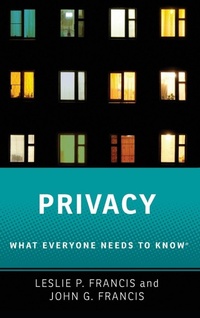
Privacy
What Everyone Needs to Know (R)
Published on 21. September 2017
Book
Hardback
352 pages
978-0-19-061226-9 (ISBN)
Description
We live more and more of our lives online; we rely on the internet as we work, correspond with friends and loved ones, and go through a multitude of mundane activities like paying bills, streaming videos, reading the news, and listening to music. Without thinking twice, we operate with the understanding that the data that traces these activities will not be abused now or in the future. There is an abstract idea of privacy that we invoke, and, concrete rules about our privacy that we can point to if we are pressed. Nonetheless, too often we are uneasily reminded that our privacy is not invulnerable-the data tracks we leave through our health information, the internet and social media, financial and credit information, personal relationships, and public lives make us continuously prey to identity theft, hacking, and even government surveillance.
A great deal is at stake for individuals, groups, and societies if privacy is misunderstood, misdirected, or misused. Popular understanding of privacy doesn't match the heat the concept generates, though understandably. With a host of cultural differences as to how privacy is understood globally and in different religions, and with ceaseless technological advancements, it is an increasingly slippery and complex topic. In this clear and accessible book, Leslie and John G. Francis guide us to an understanding of what privacy can mean and why it is so important. Drawing upon their extensive joint expertise in law, philosophy, political science, regulatory policy, and bioethics, they parse the consequences of the forfeiture, however great or small, of one's privacy.
A great deal is at stake for individuals, groups, and societies if privacy is misunderstood, misdirected, or misused. Popular understanding of privacy doesn't match the heat the concept generates, though understandably. With a host of cultural differences as to how privacy is understood globally and in different religions, and with ceaseless technological advancements, it is an increasingly slippery and complex topic. In this clear and accessible book, Leslie and John G. Francis guide us to an understanding of what privacy can mean and why it is so important. Drawing upon their extensive joint expertise in law, philosophy, political science, regulatory policy, and bioethics, they parse the consequences of the forfeiture, however great or small, of one's privacy.
Reviews / Votes
A fascinating and useful read... This is a well-written and thought-provoking book which will have readers considering the myriad ways in which privacy affects modern life and the courses of action available to those whose privacy has been compromised. * The Law Society Gazette *More details
Series
Language
English
Place of publication
New York
United States
Dimensions
Height: 235 mm
Width: 157 mm
Thickness: 23 mm
Weight
661 gr
ISBN-13
978-0-19-061226-9 (9780190612269)
Copyright in bibliographic data and cover images is held by Nielsen Book Services Limited or by the publishers or by their respective licensors: all rights reserved.
Schweitzer Classification
Other editions
Additional editions
Book
09/2017
Oxford University Press Inc
€16.60
Shipment within 15-20 days
E-Book
06/2017
1st Edition
OUP eBook
€6.99
Available for download
E-Book
06/2017
1st Edition
OUP eBook
€6.99
Available for download
Persons
Leslie Francis is Distinguished Professor of Philosophy and Distinguished Alfred C. Emery Professor of Law at the University of Utah, where she also serves as director of the Center for Law and Biomedical Sciences.
John G. Francis is Professor of Political Science at the University of Utah.
Together, they have co-authored a number of articles on the use of health information with an especial emphasis on transparency and non-discrimination.
John G. Francis is Professor of Political Science at the University of Utah.
Together, they have co-authored a number of articles on the use of health information with an especial emphasis on transparency and non-discrimination.
Content
1. What are the principal ways in which privacy has been understood?
2. What is your own position with respect to privacy? How do privacy's protections and importance vary depending on your social context?
3. What are different attitudes concerning privacy and why has it been valued?
4. How much or how little is privacy currently protected?
5. Why does it matter if personal and private information is shared? What are the limits to acceptable privacy?
6. What are the two primary emerging social images of privacy? Where are we headed?
2. What is your own position with respect to privacy? How do privacy's protections and importance vary depending on your social context?
3. What are different attitudes concerning privacy and why has it been valued?
4. How much or how little is privacy currently protected?
5. Why does it matter if personal and private information is shared? What are the limits to acceptable privacy?
6. What are the two primary emerging social images of privacy? Where are we headed?