

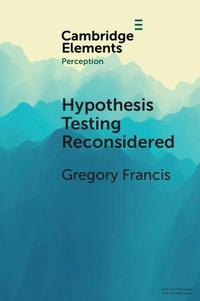
Hypothesis Testing Reconsidered
Published on 23. May 2019
Book
Paperback/Softback
66 pages
978-1-108-73071-6 (ISBN)
Description
Hypothesis testing is a common statistical analysis for empirical data generated by studies of perception, but its properties and limitations are widely misunderstood. This Element describes several properties of hypothesis testing, with special emphasis on analyses common to studies of perception. The author also describes the challenges and difficulties with using hypothesis testing to interpret empirical data. Many common applications of hypothesis testing inflate the intended Type I error rate. Other aspects of hypothesis tests have important implications for experimental design. Solutions are available for some of these difficulties, but many issues are difficult to deal with.
More details
Series
Language
English
Place of publication
Cambridge
United Kingdom
Target group
Professional and scholarly
Product notice
Paperback (trade)
Illustrations
Worked examples or Exercises; 6 Tables, black and white; 14 Line drawings, black and white
Dimensions
Height: 229 mm
Width: 152 mm
Thickness: 4 mm
Weight
108 gr
ISBN-13
978-1-108-73071-6 (9781108730716)
Copyright in bibliographic data and cover images is held by Nielsen Book Services Limited or by the publishers or by their respective licensors: all rights reserved.
Schweitzer Classification
Other editions
Additional editions
Gregory Francis
Hypothesis Testing Reconsidered
E-Book
06/2019
Cambridge University Press
€17.49
Available for download
Gregory Francis
Hypothesis Testing Reconsidered
E-Book
05/2019
Cambridge University Press
€14.49
Available for download
Person
Content
1. Introduction; 2. The basics of hypothesis testing; 3. Robustness of the Two-sample t-test; 4. Adding data increases the Type I error rate: optional stopping; 5. ANOVA can be extremely conservative; 6. ANOVA handles only one type of multiple testing problem; 7. Power analyses should consider all relevant tests; 8. The only p-value you can plan for is zero; 9. Subjects and trials do not trade off evenly; 10. Replication is a poor way to control Type I error; 11. Identifying improper methods through excess success; 12. Preregistration may be useful but is not necessary for good science; 13. Hypothesis testing is a variation of signal detection theory; 14. Using signal detection theory to analyze reported results of hypothesis testing; 15. Conclusions.