

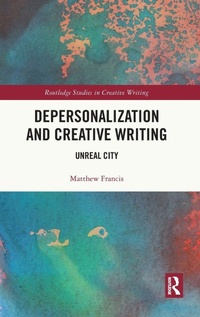
Depersonalization and Creative Writing
Unreal City
1st Edition
Published on 18. July 2022
Book
Hardback
176 pages
978-0-367-53068-6 (ISBN)
Description
Depersonalization and Creative Writing: Unreal City explores the common psychological symptom of depersonalization, its influence on literature and the insights it can provide into the writing process.
Depersonalization is a distressing symptom in which sufferers feel detached from their own selves and the world. Often associated with psychological disorders, it can also affect healthy people at times of stress. Beginning with a first-hand account of the experience, the book goes on to argue that many well-known literary texts, including Camus's The Outsider and Sartre's Nausea, evoke a similar psychological state. It shows how a concept of depersonalized writing can be found in the work of literary theorists from widely different traditions, including T.S. Eliot, Roland Barthes and Viktor Shklovsky. Finally, it maintains that creative writers can make use of the lessons learned from a study of depersonalization to arrive at a deeper understanding of writing.
Given this knowledge, the controversial writing teacher's maxim show, don't tell, so often misapplied or misunderstood, can be repurposed as a practical instruction for taking students' writing to a new level of sophistication and wisdom.
Depersonalization is a distressing symptom in which sufferers feel detached from their own selves and the world. Often associated with psychological disorders, it can also affect healthy people at times of stress. Beginning with a first-hand account of the experience, the book goes on to argue that many well-known literary texts, including Camus's The Outsider and Sartre's Nausea, evoke a similar psychological state. It shows how a concept of depersonalized writing can be found in the work of literary theorists from widely different traditions, including T.S. Eliot, Roland Barthes and Viktor Shklovsky. Finally, it maintains that creative writers can make use of the lessons learned from a study of depersonalization to arrive at a deeper understanding of writing.
Given this knowledge, the controversial writing teacher's maxim show, don't tell, so often misapplied or misunderstood, can be repurposed as a practical instruction for taking students' writing to a new level of sophistication and wisdom.
More details
Series
Language
English
Place of publication
London
United Kingdom
Publishing group
Taylor & Francis Ltd
Target group
College/higher education
Postgraduate
Dimensions
Height: 240 mm
Width: 161 mm
Thickness: 15 mm
Weight
455 gr
ISBN-13
978-0-367-53068-6 (9780367530686)
Copyright in bibliographic data and cover images is held by Nielsen Book Services Limited or by the publishers or by their respective licensors: all rights reserved.
Schweitzer Classification
Other editions
Additional editions
Book
05/2024
1st Edition
Routledge
€66.70
Shipment within 15-20 days
E-Book
07/2022
1st Edition
Routledge
€60.49
Available for download
E-Book
07/2022
1st Edition
Routledge
€60.49
Available for download
Person
Matthew Francis is Professor of Creative Writing at Aberystwyth University, UK. He has published six poetry collections with Faber & Faber, most recently Wing (2020). He is also the author of two novels, WHOM (Bloomsbury, 1989) and The Book of the Needle (Cinnamon Press, 2014), and a collection of short stories, Singing a Man to Death (Cinnamon Press, 2012). He has edited the poems of W.S. Graham for Faber and published a study of Graham, Where the People Are (Salt Publishing, 2005).
Content
Part 1
Autobiographical
Chapter 1
Land Without Feelings: A Depersonalization Memoir
Part 2
Psychological
Chapter 2
Like Looking in Fairyland: The History and Pathology of Depersonalization
Chapter 3
The Sound a Noise Makes when it Ceases: The Literature of Depersonalization
Chapter 4
Making the Stone Stony: Depersonalization in Literary Theory
Part 3
Practical
Chapter 5
A Moonlit Interval: Showing and Telling in Fiction
Chapter 6
The Odour of a Rose: Showing and Telling in Poetry
Chapter 7
Crossing the Threshold: Quests, Epiphanies, Liminality
Autobiographical
Chapter 1
Land Without Feelings: A Depersonalization Memoir
Part 2
Psychological
Chapter 2
Like Looking in Fairyland: The History and Pathology of Depersonalization
Chapter 3
The Sound a Noise Makes when it Ceases: The Literature of Depersonalization
Chapter 4
Making the Stone Stony: Depersonalization in Literary Theory
Part 3
Practical
Chapter 5
A Moonlit Interval: Showing and Telling in Fiction
Chapter 6
The Odour of a Rose: Showing and Telling in Poetry
Chapter 7
Crossing the Threshold: Quests, Epiphanies, Liminality