

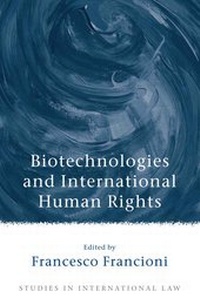
Biotechnologies and International Human Rights
Published on 22. February 2007
Book
Hardback
438 pages
978-1-84113-703-2 (ISBN)
Description
This book follows and complements the previous volume Biotechnology and International Law (Hart 2006) bringing a specific focus on human rights. It is the result of a collaborative effort which brings together the contributions of a select group of experts from academia and from international organisations with the purpose of discussing the extent to which current activities in the field of biotechnology can be regulated by existing human rights principles and standards, and what gaps, if any, need to be identified and filled with new legislative initiatives. Instruments such as the UNESCO Declaration on the Human Genome (1997) and on Bioethics and Human Rights (2005) are having an impact on customary international law. But what is the relevance of these instruments with respect to traditional concepts of state responsibility and the functioning of domestic remedies against misuse of biotechnologies? Are new legislative initiatives needed, and what are the pros and cons of a race toward the adoption of new ad hoc instruments in an area of such rapid technological development?
Are there risks of normative and institutional fragmentation as a consequence of the proliferation of different regulatory regimes? Can we identify a core of human rights principles that define the boundaries of legitimate uses of biotechnology, the legal status of human genetic material, as well as the implications of the definition of the human genome as 'common heritage of humanity' for the purpose of patenting of genetic inventions? These and other questions are the focus of a fascinating collection of essays which, together, help to map this emerging field of inquiry.
Are there risks of normative and institutional fragmentation as a consequence of the proliferation of different regulatory regimes? Can we identify a core of human rights principles that define the boundaries of legitimate uses of biotechnology, the legal status of human genetic material, as well as the implications of the definition of the human genome as 'common heritage of humanity' for the purpose of patenting of genetic inventions? These and other questions are the focus of a fascinating collection of essays which, together, help to map this emerging field of inquiry.
Reviews / Votes
...important and useful collection of essays...this volume makes a singular contribution towards...transformation of the conventional ways of doing jurisprudence and political theory. Upendra Baxi Law and Politics Book Review Vol 18, No 2 Although, the book covers a number of diverse topics, it can be read either article by article or from cover to cover depending on the reader's interests...offers a valuable insight for newcomers to the biotech debate but also appeals to those well versed in the area as it offers a human rights approach to biotechnology in much greater depth than most other books on the market...it can be said that there is something for everyone in this book. It is a stimulating read which provides some guiding principle for further studies and research and can warmly be recommended to anyone interested in the subject. Amina Agovic SCRIPTed 5:2, Aug 08 the volume in general is highly valuable as an overview of debates on the interface between human rights and biotechnology. Also, the tables on diverse legislations and international instruments and the index included by the editors, are extremely helpful. Marcus Duwell Netherlands Research School for Practical Philosophy, Utrecht University Netherlands Quarterly of Human Rights Vol. 27/3More details
Series
Language
English
Place of publication
Oxford
United Kingdom
Publishing group
Bloomsbury Publishing PLC
Target group
Professional and scholarly
Dimensions
Height: 234 mm
Width: 156 mm
Thickness: 34 mm
Weight
0 gr
ISBN-13
978-1-84113-703-2 (9781841137032)
Copyright in bibliographic data and cover images is held by Nielsen Book Services Limited or by the publishers or by their respective licensors: all rights reserved.
Schweitzer Classification
Other editions
Additional editions
Francesco Francioni
Biotechnologies and International Human Rights
E-Book
02/2007
1st Edition
Hart Publishing
€144.99
Available for download
Person
Francesco Francioni is Professor of International Law at the EUI, Florence and the University of Siena.
Content
Part I. Overview and Cross-cutting Issues 1. Genetic Resources, Biotechnology and Human Rights: The International Legal Framework F Francioni 2. State Responsibility for Violations of Basic Principles of Bioethics P-M Dupuy Part II. Bioethics and Human Genetics 3. Ethical Pluralism and the Regulation of Modern Biotechnology R Brownsword 4. Consolidating Bio-rights in Europe S Millns 5. UNESCO Standard-setting Activities on Bioethics: Speak Softly and Carry a Big Stick A Yusuf 6. The Normative Spectrum of an Ethically-inspired Legal Instrument : The 2005 Universal Declaration on Bioethics and Human Rights H Boussard Part III. Economic, Social and Cultural Rights 7. Agricultural Biotechnology and the Right to Food K Mechlem and T Raney 8. A Case Study of the European Union's Regulation of GMOs: Environment, Health, Consumer Rights and Economic Freedom E Righini 9. Biogenetic Resources and Indigenous Peoples' Rights F Lenzerini Part IV. Intellectual Property Rights and Trade Issues 10. Biotechnology, Human Rights and International Economic Law E-U Petersmann 11. Genetic Engineering, Trade and Human Rights T Cottier 12. Patents, Biotechnology and Human Rights: The Preservation of Biodiverse Resources for Future Generations F Abbott Part V. Participatory Rights and Remedies 13. Citizens' Rights and Participation in the Regulation of Biotechnology D Galligan Part VI. International Humanitarian Law 14. Offensive Military Applications of Biotechnologies: Loopholes in the Law? L Vierucci