

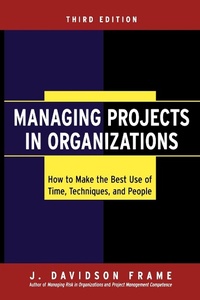
Managing Projects in Organizations
How to Make the Best Use of Time, Techniques, and People
3rd Edition
Published on 29. December 2009
Book
Paperback/Softback
282 pages
978-0-470-63138-6 (ISBN)
Description
In this third edition of Managing Projects in Organizations, J. Davidson Frame updates and expands on his classic book to provide an accessible introduction to the field of project management. Drawing on more than twenty-five years of consulting and training experience, Frame's most current edition of his landmark book includes a wealth of new topics, including:
Managing virtual teams
The evolving concept of the project manager's role
Comanaged project teams
The project office
Project portfolios
Web-based project management
International project management
Managing virtual teams
The evolving concept of the project manager's role
Comanaged project teams
The project office
Project portfolios
Web-based project management
International project management
More details
Edition
3rd edition
Language
English
Place of publication
New York
United States
Publishing group
John Wiley & Sons Inc
Target group
Professional and scholarly
Edition type
Annotated edition
Product notice
Paperback (trade)
Unsewn / adhesive bound
Dimensions
Height: 234 mm
Width: 156 mm
Thickness: 15 mm
Weight
433 gr
ISBN-13
978-0-470-63138-6 (9780470631386)
Copyright in bibliographic data and cover images is held by Nielsen Book Services Limited or by the publishers or by their respective licensors: all rights reserved.
Schweitzer Classification
Person
J. Davidson Frame is Dean of Academic Affairs at the University of Management and Technology (UMT) in Arlington, Virginia. Prior to joining UMT, he established the project management program at George Washington University. He also served as director of the Project Management Certification Program at the Project Management Institute (PMI) and has served on PMI's board of directors. Frame has authored more than forty articles and seven books, including The New Project Management (2nd edition) and Managing Risk in Organizations.
Content
Preface.
The Author.
1. The New Business Environment and the Need for a New Project Management.
PART ONE: MANAGING IN THE NEW BUSINESS ENVIRONMENT.
2. Managing Complexity: Techniques for Fashioning Order Out of Chaos.
3. Engaging Change: Knowing When to Embrace, Accept, or Challenge.
4. Managing Risk: Identifying, Analyzing, and Planning Responses.
5. Satisfying Customers: Knowing Who They Are, What They Want, and When They are Right or Wrong.
6. Defining Requirements that Bridge the Customer-Developer Gap.
PART TWO: TOOLS FOR THE NEW PROJECT MANAGEMENT.
7. Acquiring Political Skills and Building Influence.
8. Building Teams with Borrowed Resources.
9. Selecting Projects That Will Lead to Success.
10. Estimating Realistic Costs, Schedules, and Specifications to Ensure Project Success.
11. Scheduling Projects with New Tools: The Time-boxed and Critical Chain Scheduling Techniques.
12. Outsourcing to Control Costs, Focus on Core Work, and Expand Resources.
13. Integrating Cost and Schedule Control to Measure Work Performance.
14. Evaluating Projects to Maintain Goals, Strengthen Accountability, and Achieve Objectives.
15. Understanding and Using Performance Metrics; or, Measuring the Right Stuff.
16. Establishing and Maintaining a Project Support Office to Strengthen Project Management Capabilities.
17. Carpe Diem: Seize the Day!
Appendix: An Annotated Reading List for the New Project Management.
References.
Index.
The Author.
1. The New Business Environment and the Need for a New Project Management.
PART ONE: MANAGING IN THE NEW BUSINESS ENVIRONMENT.
2. Managing Complexity: Techniques for Fashioning Order Out of Chaos.
3. Engaging Change: Knowing When to Embrace, Accept, or Challenge.
4. Managing Risk: Identifying, Analyzing, and Planning Responses.
5. Satisfying Customers: Knowing Who They Are, What They Want, and When They are Right or Wrong.
6. Defining Requirements that Bridge the Customer-Developer Gap.
PART TWO: TOOLS FOR THE NEW PROJECT MANAGEMENT.
7. Acquiring Political Skills and Building Influence.
8. Building Teams with Borrowed Resources.
9. Selecting Projects That Will Lead to Success.
10. Estimating Realistic Costs, Schedules, and Specifications to Ensure Project Success.
11. Scheduling Projects with New Tools: The Time-boxed and Critical Chain Scheduling Techniques.
12. Outsourcing to Control Costs, Focus on Core Work, and Expand Resources.
13. Integrating Cost and Schedule Control to Measure Work Performance.
14. Evaluating Projects to Maintain Goals, Strengthen Accountability, and Achieve Objectives.
15. Understanding and Using Performance Metrics; or, Measuring the Right Stuff.
16. Establishing and Maintaining a Project Support Office to Strengthen Project Management Capabilities.
17. Carpe Diem: Seize the Day!
Appendix: An Annotated Reading List for the New Project Management.
References.
Index.