

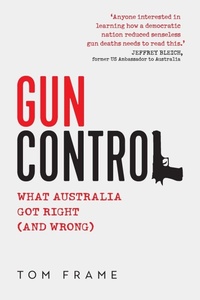
Gun Control
What Australia Got Right (and Wrong)
Published on 1. September 2019
Book
Paperback/Softback
240 pages
978-1-74223-634-6 (ISBN)
Description
In the aftermath of the Port Arthur massacre on 28 April 1996 - when a gunman killed 35 people and seriously wounded another 21 in a quiet town in Tasmania - John Howard, a conservative prime minister who had been in office for just six weeks, moved swiftly to revolutionise Australia's gun control laws. The National Firearms Agreement, produced just twelve days after the massacre, with support from all levels of government and across the Australian political divide, but derided by Howard's natural political allies in the US, is now held up around the world as a model for gun control.
Gun Control draws on interviews with those who supported and opposed the new laws, and asks whether the aftermath of the tragedy might have been a lost opportunity to achieve much more than simply preventing a repeat of Port Arthur - vitally important though that was. Tom Frame argues that the mechanisms for amending national firearms agreement are in need of substantial revision alongside the agreement itself. Frame analyses whether the Australian Government achieved its intention, and what it might have done in response to the massacre, and didn't. The book also traces the history of Australian gun usage and control, and compares this with the US experience.
Gun Control draws on interviews with those who supported and opposed the new laws, and asks whether the aftermath of the tragedy might have been a lost opportunity to achieve much more than simply preventing a repeat of Port Arthur - vitally important though that was. Tom Frame argues that the mechanisms for amending national firearms agreement are in need of substantial revision alongside the agreement itself. Frame analyses whether the Australian Government achieved its intention, and what it might have done in response to the massacre, and didn't. The book also traces the history of Australian gun usage and control, and compares this with the US experience.
Reviews / Votes
Anyone interested in learning how a democratic nation reduced senseless gun deaths needs to read this."" - Jeffrey Bleich, former US Ambassador to AustraliaMore details
Language
English
Place of publication
Sydney
Australia
Target group
Professional and scholarly
Dimensions
Height: 234 mm
Width: 156 mm
Thickness: 14 mm
Weight
415 gr
ISBN-13
978-1-74223-634-6 (9781742236346)
Copyright in bibliographic data and cover images is held by Nielsen Book Services Limited or by the publishers or by their respective licensors: all rights reserved.
Schweitzer Classification
Other editions
Additional editions
E-Book
12/2019
University of New South Wales Press
€18.49
Available for download
Person
Tom Frame has been a naval officer, Anglican Bishop to the Defence Force, a member of the Australian War Memorial Council, a theological college principal and a cattle farmer. He is a graduate of UNSW with an Honours degree and a doctorate in history. He became Professor of History at UNSW Canberra in July 2014 and was appointed Director of the Public Leadership Research Group in July 2017 with responsibility for the establishment of the Howard Library at Old Parliament House. He is the author or editor of more than 45 books, including two volumes of critical essays on the Howard Government.
Content
Introduction
A word to readers
Glossary
1 A day like no other
2 Penalising the law-abiding?
3 A nation divided
4 Restricting freedoms, saving lives
5 A problem in the making
6 Elusive solutions
7 A deadly debate
8 A strange alliance
9 The best thing he ever did
10 Conflict without
Conclusion
Further reading
Notes
Index
A word to readers
Glossary
1 A day like no other
2 Penalising the law-abiding?
3 A nation divided
4 Restricting freedoms, saving lives
5 A problem in the making
6 Elusive solutions
7 A deadly debate
8 A strange alliance
9 The best thing he ever did
10 Conflict without
Conclusion
Further reading
Notes
Index