

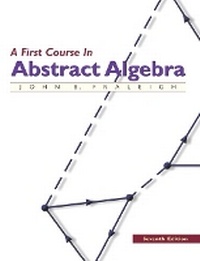
First Course in Abstract Algebra, A
7th Edition
Published on 16. December 2002
Book
Hardback
544 pages
978-0-201-76390-4 (ISBN)
Description
This is an in-depth introduction to abstract algebra. Focused on groups, rings and fields, it should give students a firm foundation for more specialized work by emphasizing an understanding of the nature of algebraic structures. Features include: a classical approach to abstract algebra focussing on applications; an accessible pedagogy including historical notes written by Victor Katz; and a study of group theory.
More details
Edition
7th edition
Language
English
Place of publication
United States
Publishing group
Pearson Education (US)
Target group
Professional and scholarly
Dimensions
Height: 241 mm
Width: 197 mm
Thickness: 25 mm
Weight
1010 gr
ISBN-13
978-0-201-76390-4 (9780201763904)
Copyright in bibliographic data and cover images is held by Nielsen Book Services Limited or by the publishers or by their respective licensors: all rights reserved.
Schweitzer Classification
Other editions
Previous edition
Fraleigh
A First Course in Abstract Algebra
Book
01/1999
6th Edition
Pearson
€54.46
Article exhausted; check for reprint
Content
(*) Not required for the remainder of the text. (**) This section is required only for Chapters 17 and 36.).
0. Sets and Relations.
I. GROUPS AND SUBGROUPS.
1. Introduction and Examples.
2. Binary Operations.
3. Isomorphic Binary Structures.
4. Groups.
5. Subgroups.
6. Cyclic Groups.
7. Generators and Cayley Digraphs.
II. PERMUTATIONS, COSETS, AND DIRECT PRODUCTS.
8. Groups of Permutations.
9. Orbits, Cycles, and the Alternating Groups.
10. Cosets and the Theorem of Lagrange.
11. Direct Products and Finitely Generated Abelian Groups.
12. *Plane Isometries.
III. HOMOMORPHISMS AND FACTOR GROUPS.
13. Homomorphisms.
14. Factor Groups.
15. Factor-Group Computations and Simple Groups.
16. **Group Action on a Set.
17. *Applications of G-Sets to Counting.
IV. RINGS AND FIELDS.
18. Rings and Fields.
19. Integral Domains.
20. Fermat's and Euler's Theorems.
21. The Field of Quotients of an Integral Domain.
22. Rings of Polynomials.
23. Factorization of Polynomials over a Field.
24. *Noncommutative Examples.
25. *Ordered Rings and Fields.
V. IDEALS AND FACTOR RINGS.
26. Homomorphisms and Factor Rings.
27. Prime and Maximal Ideas.
28. *Groebner Bases for Ideals.
VI. EXTENSION FIELDS.
29. Introduction to Extension Fields.
30. Vector Spaces.
31. Algebraic Extensions.
32. *Geometric Constructions.
33. Finite Fields.
VII. ADVANCED GROUP THEORY.
34. Isomorphism Theorems.
35. Series of Groups.
36. Sylow Theorems.
37. Applications of the Sylow Theory.
38. Free Abelian Groups.
39. Free Groups.
40. Group Presentations.
VIII. *GROUPS IN TOPOLOGY.
41. Simplicial Complexes and Homology Groups.
42. Computations of Homology Groups.
43. More Homology Computations and Applications.
44. Homological Algebra.
IX. Factorization.
45. Unique Factorization Domains.
46. Euclidean Domains.
47. Gaussian Integers and Multiplicative Norms.
X. AUTOMORPHISMS AND GALOIS THEORY.
48. Automorphisms of Fields.
49. The Isomorphism Extension Theorem.
50. Splitting Fields.
51. Separable Extensions.
52. *Totally Inseparable Extensions.
53. Galois Theory.
54. Illustrations of Galois Theory.
55. Cyclotomic Extensions.
56. Insolvability of the Quintic.
Appendix: Matrix Algebra.
Notations.
Answers to odd-numbered exercises not asking for definitions or proofs.
Index.
0. Sets and Relations.
I. GROUPS AND SUBGROUPS.
1. Introduction and Examples.
2. Binary Operations.
3. Isomorphic Binary Structures.
4. Groups.
5. Subgroups.
6. Cyclic Groups.
7. Generators and Cayley Digraphs.
II. PERMUTATIONS, COSETS, AND DIRECT PRODUCTS.
8. Groups of Permutations.
9. Orbits, Cycles, and the Alternating Groups.
10. Cosets and the Theorem of Lagrange.
11. Direct Products and Finitely Generated Abelian Groups.
12. *Plane Isometries.
III. HOMOMORPHISMS AND FACTOR GROUPS.
13. Homomorphisms.
14. Factor Groups.
15. Factor-Group Computations and Simple Groups.
16. **Group Action on a Set.
17. *Applications of G-Sets to Counting.
IV. RINGS AND FIELDS.
18. Rings and Fields.
19. Integral Domains.
20. Fermat's and Euler's Theorems.
21. The Field of Quotients of an Integral Domain.
22. Rings of Polynomials.
23. Factorization of Polynomials over a Field.
24. *Noncommutative Examples.
25. *Ordered Rings and Fields.
V. IDEALS AND FACTOR RINGS.
26. Homomorphisms and Factor Rings.
27. Prime and Maximal Ideas.
28. *Groebner Bases for Ideals.
VI. EXTENSION FIELDS.
29. Introduction to Extension Fields.
30. Vector Spaces.
31. Algebraic Extensions.
32. *Geometric Constructions.
33. Finite Fields.
VII. ADVANCED GROUP THEORY.
34. Isomorphism Theorems.
35. Series of Groups.
36. Sylow Theorems.
37. Applications of the Sylow Theory.
38. Free Abelian Groups.
39. Free Groups.
40. Group Presentations.
VIII. *GROUPS IN TOPOLOGY.
41. Simplicial Complexes and Homology Groups.
42. Computations of Homology Groups.
43. More Homology Computations and Applications.
44. Homological Algebra.
IX. Factorization.
45. Unique Factorization Domains.
46. Euclidean Domains.
47. Gaussian Integers and Multiplicative Norms.
X. AUTOMORPHISMS AND GALOIS THEORY.
48. Automorphisms of Fields.
49. The Isomorphism Extension Theorem.
50. Splitting Fields.
51. Separable Extensions.
52. *Totally Inseparable Extensions.
53. Galois Theory.
54. Illustrations of Galois Theory.
55. Cyclotomic Extensions.
56. Insolvability of the Quintic.
Appendix: Matrix Algebra.
Notations.
Answers to odd-numbered exercises not asking for definitions or proofs.
Index.