

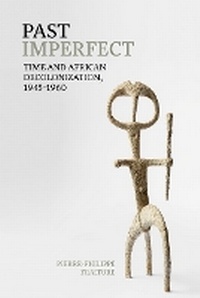
Past Imperfect
Time and African Decolonization, 1945-1960
Published on 1. March 2024
Book
Paperback/Softback
328 pages
978-1-80207-536-6 (ISBN)
Description
This book proposes to examine French and Francophone intellectual history in the period leading to the decolonization of sub-Saharan Africa (1945-1960). The analysis favours the epistemological links between ethnology, museology, sociology, and (art) history. In this discussion, a specific focus is placed on temporality and the role ascribed by these different disciplines to African pasts, presents, and futures. It is argued here that the post-war context, characterized, inter alia, by the creation of UNESCO, the birth of Presence Africaine and the prevalence of existentialism, bore witness to the development of new regimes of historicity and to the partial refutation of a progress-based modernity. This investigation is predicated on case studies from West and Central Africa (AOF, AEF and Belgian Congo) and, whilst adopting a postcolonial methodology, it explores African and French authors such as Georges Balandier, Cheikh Anta Diop, Frantz Fanon, Chris Marker, Joseph Ki-Zerbo, Claude Levi-Strauss, Alain Resnais, Jean-Paul Sartre and Placide Tempels. This study explores the intellectual legacy of the 'long nineteenth century' and the difficulty encountered by these authors to articulate their anti-colonial agenda away from the modern methodologies of the 'colonial library'. By focussing on issues of intellectual alienation, this book also demonstrates that the post-WW2 period foreshadowed twenty-first century debates on extroversion, racial inequalities, the decolonization of history, and cultural (mis)appropriation.
Reviews / Votes
"This is a thoroughgoing and scholarly study of African culture, anthropology and history during the lead-up to decolonization, using the notion of temporality as a lens through which to assess this complex transitional period. It is a high quality piece of research, offering a wealth of new insight on a complex question."Jane Hiddleston, University of Oxford 'Fraiture's intervention in the debate is monumental. He helps the English-speaking world see the part of the debate that, until now, lacked visibility, i.e. the de-colonialists who challenged the French colonial system. And he does it in superb English -a gift to be savoured. The reader gulps with curiosity as Fraiture opens the vaults of history for our benefit. He educates in a very dazzling way. [...] This book is a labour of love; the scholarship is a pure bravura. No one concerned about decolonization can be without this book. It is first-rate.' Paul Okojie, Africa International Network 'Pierre-Philippe Fraiture's opus is an astute book that breaks new ground in the study of decolonization in the twentieth century. An erudite tour de force that deconstructs complex and oftentimes demanding texts, Past Imperfect succeeds in bringing to the fore the intertextual dialogues among African, Antillean, and French intellectuals in their effort to unmake colonialism and the epistemologies that informed its implementation. This makes it a must-read for any scholar interested in the decolonial turn in African studies.'
B. Bamba, African Studies Review
More details
Series
Language
English
Place of publication
Liverpool
United Kingdom
Dimensions
Height: 234 mm
Width: 156 mm
ISBN-13
978-1-80207-536-6 (9781802075366)
Copyright in bibliographic data and cover images is held by Nielsen Book Services Limited or by the publishers or by their respective licensors: all rights reserved.
Schweitzer Classification
Person
Pierre-Philippe Fraiture is a Professor of French in the School of Modern Languages and Cultures at the University of Warwick.
Content
Acknowledgements
Prelude
Introduction
Chapter I: 'Pasts and Futures'
Chapter II 'Things'
Chapter III: 'Words'
Chapter IV: 'Customs'
Conclusion: 'Decolonization: a Work in Progress'
Bibliography
Prelude
Introduction
Chapter I: 'Pasts and Futures'
Chapter II 'Things'
Chapter III: 'Words'
Chapter IV: 'Customs'
Conclusion: 'Decolonization: a Work in Progress'
Bibliography