

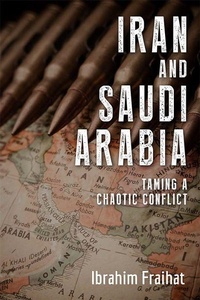
Resolving the Rivalry Between Iran and Saudi Arabia
Taming a Chaotic Conflict
Published on 28. February 2020
Book
Hardback
224 pages
978-1-4744-6618-9 (ISBN)
Description
Hostile relations between Iran and Saudi Arabia are partially responsible for the political instability plaguing the Middle East. This book argues that rapprochement between Tehran and Riyadh is possible and it sets out a realistic agenda for managing their intractable conflict. Ibrahim Fraihat interviewed over sixty scholars, policy makers, think-tank experts and activists to gain an clear, all-round view of Iran-Saudi relations since the invasion of Iraq by US troops in 2003. His research shows that effective peacebuilding would be achievable if the participating countries integrated their diplomatic efforts on three levels: government, Track Two and grassroots.
The result is a fresh perspective on a dangerous and unpredictable rift that affects not only its primary parties - Iran and Saudi Arabia - but also the future of the wider Middle East.
The result is a fresh perspective on a dangerous and unpredictable rift that affects not only its primary parties - Iran and Saudi Arabia - but also the future of the wider Middle East.
Reviews / Votes
This is a thorough account of one of the most important interstate rivalries in recent decades, one that has done much damage in the wider Middle East and Islamic World. This book stands out for not only providing a lucid analysis of the drivers of conflict between Saudi Arabia and Iran, but also for offering concrete suggestions for reducing tensions between those two regional powers. - Toby Matthiesen, University of Oxford; In this eminently fair and balanced assessment of the intractable conflict between Iran and Saudi Arabia, Ibrahim Fraihat is in the unenviable position of trying to make sense of a nonsensical hostility between two ruling regimes that are wasting their respective nations' resources and endangering an entire volatile region. By modestly subtitling his deeply informed and balanced intervention just 'Taming a Chaotic Conflict', Fraihat signals the working of a judicious mind that has wisely abandoned the search for 'root causes' and gently teaches us to be humble and human in our expectations. A superb strategic intervention on how to prevent a colossal calamity from happening.- Hamid Dabashi, Columbia University; This is exactly the book we need right now! Whereas much has been already been written about the causes and developments of the Iran-Saudi Arabia rivalry, we have precious little knowledge about how this conflict can be peacefully managed and ultimately resolved. Fraihat combines his own personal experiences of participation in dialogue efforts over the years with the scholarly insights of the large body of research on conflict resolution, in order to shed light on this. The book gives us a solid basis for analysing the prospects and challenges for how to transform the current destructive relationship between these two regional powers into more constructive interactions, a transformation that would radically change the Middle East region, and thereby the world. - Isak Svensson, Department of Peace and Conflict Research, Uppsala UniversityMore details
Language
English
Place of publication
Edinburgh
United Kingdom
Product notice
sewn/stitched
Cloth over boards
Dimensions
Height: 234 mm
Width: 157 mm
Thickness: 20 mm
Weight
499 gr
ISBN-13
978-1-4744-6618-9 (9781474466189)
Copyright in bibliographic data and cover images is held by Nielsen Book Services Limited or by the publishers or by their respective licensors: all rights reserved.
Schweitzer Classification
Other editions
Additional editions
E-Book
02/2020
Edinburgh University Press
€0.00
Available for download
Person
Ibrahim Fraihat is an associate professor in international conflict resolution at the Doha Institute for Graduate Studies. He previously served as senior foreign policy scholar at the Brookings Institution and taught conflict resolution at Georgetown University. He is the author of Unfinished Revolutions: Yemen, Libya, and Tunisia after the Arab Spring (Yale UP, 2016) and co-author of Libya's Displacement Crisis: Uprooted by Revolution and Civil War (Georgetown UP, 2015). His analysis on Middle East politics has also appeared in Foreign Affairs, Foreign Policy, the New York Times, Huffington Post, Newsweek, and Al Jazeera. Graduate of George Mason University in 2006, he is the recipient of the University's Distinguished Alumni Award (2014) for his achievements in the field of conflict resolution in the Middle East. Fraihat is a non-resident fellow at the Middle East Studies Forum at Deakin University in Australia. He consulted for numerous international organization on Middle East affairs like conflict resolution, national reconciliation, national dialogue, mediation, post-conflict reconstruction, and political transitions.
Content
Acknowledgments
1. Introduction
2. History of Iran-Saudi Arabian Rivalry and Peacemaking efforts
3. Conflict Issues
Security
Sectarianism
Geopolitics and leadership
The external factor
4. Conflict Management
Crisis management system
Confidence building measures
Dialogue
Peace zones
5. Conflict Resolution
Restoring the Regional Order's Balance of Power
Reforming conflict strategies
Formal Track 1 Government Mediation
Track two
Other approaches
Bottom-up rapprochement
Peace plans - Gestures of conciliation
Shia Arab role
6. Conclusion
Bibliography
Index
1. Introduction
2. History of Iran-Saudi Arabian Rivalry and Peacemaking efforts
3. Conflict Issues
Security
Sectarianism
Geopolitics and leadership
The external factor
4. Conflict Management
Crisis management system
Confidence building measures
Dialogue
Peace zones
5. Conflict Resolution
Restoring the Regional Order's Balance of Power
Reforming conflict strategies
Formal Track 1 Government Mediation
Track two
Other approaches
Bottom-up rapprochement
Peace plans - Gestures of conciliation
Shia Arab role
6. Conclusion
Bibliography
Index