

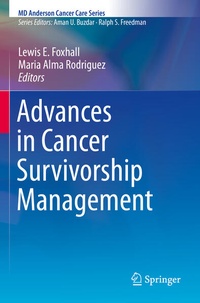
Advances in Cancer Survivorship Management
Description
Reviews / Votes
From the book reviews:
"The book is written for community oncologists, primary care providers, and medical staff involved in the care of cancer survivors. . The information is accurate, concise, and well reported, and it espouses comprehensive care including integrative medicine and preventive medicine. . It is also very useful for the instruction of training residents and fellows in family practice, internal medicine, and emergency medicine. Pediatric and adult oncologists in training could benefit from this review as well." (Linda Jane Butros, Doody's Book Reviews, January, 2015)More details
Other editions
Additional editions
Persons
Lewis E. Foxhall, MD Vice President, Health Policy; Professor, Department of Clinical Cancer Prevention, Division of Cancer Prevention and Population Sciences, The University of Texas MD Anderson Cancer Center, Houston, TX, USA.
Maria Alma Rodriguez, MD Vice President, Medical Affairs, The University of Texas MD Anderson Cancer Center, Houston, TX, USA.
Content
1. Introduction.- Part I. Clinical Care Delivery.- 2. Models of Survivorship Care.- 3. Community Care Integration.- Part II. Surveillance.- 4. Adult Survivorship of Pediatric Cancers.- 5. Breast Cancer Survivorship Management.- 6. Colorectal Cancer Survivorship Management.- 7.Genitourinary Cancer Survivorship Management.- 8. Gynecologic Cancer Survivorship Management.- 9. Head and Neck Cancer Survivorship Management.- 10. Hematologic Cancer Survivorship Management: Transplantation.- 11. Hematologic Cancer Survivorship Management: Leukemia.- 12. Hematologic Cancer Survivorship Management: Lymphoma.- 13. Melanoma Survivorship Management.- 14. Thyroid Cancer Survivorship Management.- Part III. Cancer Prevention and Screening.- 15. Tobacco Cessation.- 16. Obesity and Exercise.- 17. Nutrition.- 18. Screening for Second Primary Cancers.- Part IV. Long-Term and Late Effects.- 19. Cardiovascular Issues.- 20. Cognitive Function.- 21. Endocrinologic Issues.- 22. Fatigue.- 23. Immunologic Issues.- 24. Rehabilitation.- 25. Sexuality.- Part V. Other Crosscutting Issues.- 26. Legal Issues.- 27. Communication between Patients and Health Care Providers.- 28. Integrative Oncology.