

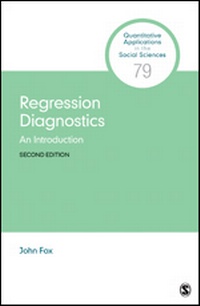
Regression Diagnostics
An Introduction
2nd Edition
Published on 7. May 2020
Book
Paperback/Softback
168 pages
978-1-5443-7522-9 (ISBN)
Description
Regression diagnostics are methods for determining whether a regression model that has been fit to data adequately represents the structure of the data. For example, if the model assumes a linear (straight-line) relationship between the response and an explanatory variable, is the assumption of linearity warranted? Regression diagnostics not only reveal deficiencies in a regression model that has been fit to data but in many instances may suggest how the model can be improved. The Second Edition of this bestselling volume by John Fox considers two important classes of regression models: the normal linear regression model (LM), in which the response variable is quantitative and assumed to have a normal distribution conditional on the values of the explanatory variables; and generalized linear models (GLMs) in which the conditional distribution of the response variable is a member of an exponential family. R code and data sets for examples within the text can be found on an accompanying website.
Reviews / Votes
The work of a master who knows how to make regression come alive with engaging language and catchy graphics. -- Helmut Norpoth * Review * This monograph provides very clear and quite comprehensive treatment of many tools and strategies for dealing with the various issues and situations that might arise to compromise the extent to which a regression model accurately represents the structure that exists within a dataset. As such, I would recommend this work to both beginners and experienced researchers in the social sciences. -- William G. Jacoby * Reviewer * John Fox has substantially updated his authoritative, compact, and accessible presentation on diagnosing and correcting problems in regression models. New sections on graphical inspection and transformation prior to analysis, and on diagnostics for generalized linear models enhance its utility. I recommend it strongly to instructors and practitioners alike. -- Peter Marsden * Review *More details
Series
Edition
2nd Revised edition
Language
English
Place of publication
Thousand Oaks
United States
Target group
College/higher education
Edition type
Revised edition
Dimensions
Height: 216 mm
Width: 140 mm
Weight
201 gr
ISBN-13
978-1-5443-7522-9 (9781544375229)
Copyright in bibliographic data and cover images is held by Nielsen Book Services Limited or by the publishers or by their respective licensors: all rights reserved.
Schweitzer Classification
Other editions
Previous edition
Book
10/1991
1st Edition
SAGE Publications Inc
€48.46
Article exhausted; check for reprint
Person
John Fox received a BA from the City College of New York and a PhD from the University of Michigan, both in Sociology. He is Professor Emeritus of Sociology at McMaster University in Hamilton, Ontario, Canada, where he was previously the Senator William McMaster Professor of Social Statistics. Prior to coming to McMaster, he was Professor of Sociology, Professor of Mathematics and Statistics, and Coordinator of the Statistical Consulting Service at York University in Toronto. Professor Fox is the author of many articles and books on applied statistics, including \emph{Applied Regression Analysis and Generalized Linear Models, Third Edition} (Sage, 2016). He is an elected member of the R Foundation, an associate editor of the Journal of Statistical Software, a prior editor of R News and its successor the R Journal, and a prior editor of the Sage Quantitative Applications in the Social Sciences monograph series.
Content
Series Editors Introduction
About the Author
Acknowledgements
Chapter 1. Introduction
Chapter 2. The Linear Regression Model: Review
The Normal Linear Regression Models
Least-Squares Estimation
Statistical Inference for Regression Coefficients
The Linear Regression Model in Matrix Forms
Chapter 3. Examining and Transforming Regression Data
Univariate Displays
Transformations for Symmetry
Transformations for Linearity
Transforming Nonconstant Variation
Interpreting Results When Variables are Transformed
Chapter 4. Unusual data
Measuring Leverage: Hatvalues
Detecting Outliers: Studentized Residuals
Measuring Influence: Cook's Distance and Other Case-Deletion Diagnostics
Numerical Cutoffs for Noteworthy Case Diagnostics
Jointly Influential Cases: Added-Variable Plots
Should Unusual Data Be Discarded?
Unusual Data: Details
Chapter 5. Non-Normality and Nonconstant Error Variance
Detecting and Correcting Non-Normality
Detecting and Dealing With Nonconstant Error Variance
Robust Coefficient Standard Errors
Bootstrapping
Weighted Least Squares
Robust Standard Errors and Weighted Least Squares: Details
Chapter 6. Nonlinearity
Component-Plus-Residual Plots
Marginal Model Plots
Testing for Nonlinearity
Modeling Nonlinear Relationships with Regression Splines
Chapter 7. Collinearity
Collinearity and Variance Inflation
Visualizing Collinearity
Generalized Variance Inflation
Dealing With Collinearity
*Collinearity: Some Details
Chapter 8. Diagnostics for Generalized Linear Models
Generalized Linear Models: Review
Detecting Unusual Data in GLMs
Nonlinearity Diagnostics for GLMs
Diagnosing Collinearity in GLMs
Quasi-Likelihood Estimation of GLMs
*GLMs: Further Background
Chapter 9. Concluding Remarks
Complementary Reading
References
Index
About the Author
Acknowledgements
Chapter 1. Introduction
Chapter 2. The Linear Regression Model: Review
The Normal Linear Regression Models
Least-Squares Estimation
Statistical Inference for Regression Coefficients
The Linear Regression Model in Matrix Forms
Chapter 3. Examining and Transforming Regression Data
Univariate Displays
Transformations for Symmetry
Transformations for Linearity
Transforming Nonconstant Variation
Interpreting Results When Variables are Transformed
Chapter 4. Unusual data
Measuring Leverage: Hatvalues
Detecting Outliers: Studentized Residuals
Measuring Influence: Cook's Distance and Other Case-Deletion Diagnostics
Numerical Cutoffs for Noteworthy Case Diagnostics
Jointly Influential Cases: Added-Variable Plots
Should Unusual Data Be Discarded?
Unusual Data: Details
Chapter 5. Non-Normality and Nonconstant Error Variance
Detecting and Correcting Non-Normality
Detecting and Dealing With Nonconstant Error Variance
Robust Coefficient Standard Errors
Bootstrapping
Weighted Least Squares
Robust Standard Errors and Weighted Least Squares: Details
Chapter 6. Nonlinearity
Component-Plus-Residual Plots
Marginal Model Plots
Testing for Nonlinearity
Modeling Nonlinear Relationships with Regression Splines
Chapter 7. Collinearity
Collinearity and Variance Inflation
Visualizing Collinearity
Generalized Variance Inflation
Dealing With Collinearity
*Collinearity: Some Details
Chapter 8. Diagnostics for Generalized Linear Models
Generalized Linear Models: Review
Detecting Unusual Data in GLMs
Nonlinearity Diagnostics for GLMs
Diagnosing Collinearity in GLMs
Quasi-Likelihood Estimation of GLMs
*GLMs: Further Background
Chapter 9. Concluding Remarks
Complementary Reading
References
Index