


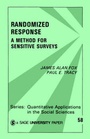
Randomized Response and Related Methods
Surveying Sensitive Data
2nd Edition
Published on 22. October 2015
Book
Paperback/Softback
144 pages
978-1-4833-8103-9 (ISBN)
Description
Randomized response is a data collection strategy specifically designed for surveys of a sensitive nature. By establishing a probabilistic connection between question and answer, randomized response and related methods protect respondents who are asked to disclose personal information. Covering a half century of theoretical and applied research, the Second Edition significantly updates and expands what was, at the time, the first comprehensive and practical guide to randomized response.
Reviews / Votes
Randomized Reponse and Related Methods is a comprehensive how-to guide for any researcher interested in designing, implementing, and analyzing data from an RRT. -- Allyson HolbrookMore details
Series
Edition
2nd Revised edition
Language
English
Place of publication
Thousand Oaks
United States
Target group
College/higher education
Edition type
Revised edition
Dimensions
Height: 216 mm
Width: 140 mm
Weight
176 gr
ISBN-13
978-1-4833-8103-9 (9781483381039)
Copyright in bibliographic data and cover images is held by Nielsen Book Services Limited or by the publishers or by their respective licensors: all rights reserved.
Schweitzer Classification
Other editions
Previous edition
Book
07/1986
1st Edition
SAGE Publications Inc
€39.80
Article exhausted; check for reprint
Person
James Alan Fox is the Lipman Family Professor of Criminology, Law, and Public Policy at Northeastern University. He has published 18 books, dozens of journal and magazine articles, as well as hundreds of freelance columns in newspapers around the country, primarily in the areas of multiple murder, youth crime, school and campus violence, workplace violence, and capital punishment. As a member of its Board of Contributors, his opinion column appears frequently in USAToday. Fox led the investigation of Seattle's Capitol Hill mass shooting and was part of the task force investigating the serial murder of college students in Gainesville, Florida. He also served on President Clinton's advisory committee on school shootings, and a Department of Education Expert Panel on Safe, Disciplined and Drug-Free Schools. In addition, he has been retained as an expert witness/consultant in several mass shooting cases, including the recent massacres at the First Baptist Church of Sutherland Springs, Texas, and the Marjory Stoneman Douglas High School in Parkland, Florida. Fox is one of the principals in maintaining the Associated Press/USA Today/Northeastern University Mass Killing Database. Finally, he has received several awards and honors for his work, including the Hugo Adam Bedau Award for excellence in capital punishment scholarship.
Content
1. Surveying Sensitive Topics
Asking Sensitive Questions
Types of Errors in Surveys
Ethical Issues in Surveys
Legal Means of Privacy Protections
Privacy Protection Through Anonymity
Confidentiality and Privacy Protection
Need for an Alternative Strategy
2. The Randomized Response Technique
Warner's Randomized Response Design
Unrelated Question Approach
Forced Alternative Response
Repeat Randomization
3. Design Considerations in Randomized Response
Alternative Question Content
Randomizing Devise and Question Selection Probability
Distribution of Alternative Questions
Reconciling Respondent Hazards and Efficiency
4. Alternatives to Randomized Response
Non-Randomized Response
Use of Lists and Counts
5. Extensions of Randomized Response
Generalization to Polychotomous Measures
Untruthful Respondents as a Special Group
Extension to Quantitative Measures
6. Analyzing Randomized Response Data
Measures of Association
Randomized Response as Disclosure Control
An Alternative Formulation
Randomized Response Software
7. Applications of Randomized Response Methods
Substantive Applications
Comparison Studies
Validation Research
8. Epilogue
Asking Sensitive Questions
Types of Errors in Surveys
Ethical Issues in Surveys
Legal Means of Privacy Protections
Privacy Protection Through Anonymity
Confidentiality and Privacy Protection
Need for an Alternative Strategy
2. The Randomized Response Technique
Warner's Randomized Response Design
Unrelated Question Approach
Forced Alternative Response
Repeat Randomization
3. Design Considerations in Randomized Response
Alternative Question Content
Randomizing Devise and Question Selection Probability
Distribution of Alternative Questions
Reconciling Respondent Hazards and Efficiency
4. Alternatives to Randomized Response
Non-Randomized Response
Use of Lists and Counts
5. Extensions of Randomized Response
Generalization to Polychotomous Measures
Untruthful Respondents as a Special Group
Extension to Quantitative Measures
6. Analyzing Randomized Response Data
Measures of Association
Randomized Response as Disclosure Control
An Alternative Formulation
Randomized Response Software
7. Applications of Randomized Response Methods
Substantive Applications
Comparison Studies
Validation Research
8. Epilogue