

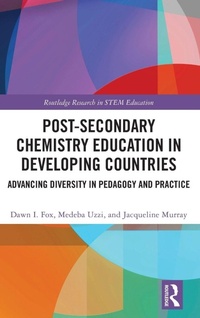
Post-Secondary Chemistry Education in Developing Countries
Advancing Diversity in Pedagogy and Practice
1st Edition
Published on 25. March 2024
Book
Hardback
204 pages
978-1-032-39579-1 (ISBN)
Description
This book considers how post-secondary chemistry education can be advanced in developing countries, in order to respond to emerging global, regional, and local needs.
Taking Guyana as a case study, it pays particular attention to local challenges facing such territories, including human and financial resource shortages, tension between quality and quantity of graduates, cultural inequalities, unequal access to increasingly important Information and Communication Technology or Technologies (ICTs), and increasing competition from international universities in the developed world. Written by a team with over 70 years in combined teaching experience, it asks whether these challenges can be met and overcome and considers how tertiary chemistry education can better meet the rapidly changing needs of society. The authors examine the status quo of tertiary chemistry education in Guyana against the introductory backdrop of the internal and external stresses on the education system, before exploring selected best practices grounded in a three-pronged model focused on pedagogy, programming, and people. Advancing diversity on each of these levels, the book ultimately shows how this framework can support better learning and teaching, and the development of a better equipped and more diverse Science, Technology, Engineering and Mathematics (STEM) workforce.
It will appeal to scholars, researchers, graduate students, and tertiary level curriculum developers in chemistry education, interested in an innovative, holistic approach for transforming chemistry teaching that focuses on pedagogical diversity, strategic co-curricular programming, and accommodating diversity and diverse learning styles in the classroom.
Taking Guyana as a case study, it pays particular attention to local challenges facing such territories, including human and financial resource shortages, tension between quality and quantity of graduates, cultural inequalities, unequal access to increasingly important Information and Communication Technology or Technologies (ICTs), and increasing competition from international universities in the developed world. Written by a team with over 70 years in combined teaching experience, it asks whether these challenges can be met and overcome and considers how tertiary chemistry education can better meet the rapidly changing needs of society. The authors examine the status quo of tertiary chemistry education in Guyana against the introductory backdrop of the internal and external stresses on the education system, before exploring selected best practices grounded in a three-pronged model focused on pedagogy, programming, and people. Advancing diversity on each of these levels, the book ultimately shows how this framework can support better learning and teaching, and the development of a better equipped and more diverse Science, Technology, Engineering and Mathematics (STEM) workforce.
It will appeal to scholars, researchers, graduate students, and tertiary level curriculum developers in chemistry education, interested in an innovative, holistic approach for transforming chemistry teaching that focuses on pedagogical diversity, strategic co-curricular programming, and accommodating diversity and diverse learning styles in the classroom.
More details
Series
Language
English
Place of publication
London
United Kingdom
Publishing group
Taylor & Francis Ltd
Target group
College/higher education
Professional and scholarly
Postgraduate
Illustrations
2 s/w Abbildungen, 2 s/w Zeichnungen, 9 s/w Tabellen
9 Tables, black and white; 2 Line drawings, black and white; 2 Illustrations, black and white
Dimensions
Height: 235 mm
Width: 157 mm
Thickness: 17 mm
Weight
479 gr
ISBN-13
978-1-032-39579-1 (9781032395791)
Copyright in bibliographic data and cover images is held by Nielsen Book Services Limited or by the publishers or by their respective licensors: all rights reserved.
Schweitzer Classification
Other editions
Additional editions
Dawn I. Fox | Medeba Uzzi | Jacqueline Murray
Post-Secondary Chemistry Education in Developing Countries
Advancing Diversity in Pedagogy and Practice
Book
07/2025
1st Edition
Routledge
€65.10
Shipment within 10-20 days
Dawn I. Fox | Medeba Uzzi | Jacqueline Murray
Post-Secondary Chemistry Education in Developing Countries
Advancing Diversity in Pedagogy and Practice
E-Book
03/2024
1st Edition
Routledge
€59.49
Available for download
Dawn I. Fox | Medeba Uzzi | Jacqueline Murray
Post-Secondary Chemistry Education in Developing Countries
Advancing Diversity in Pedagogy and Practice
E-Book
03/2024
1st Edition
Routledge
€59.49
Available for download
Persons
Dawn I. Fox is Senior Lecturer in the Department of Chemistry at the University of Guyana.
Medeba Uzzi is General Chemist and Chemistry Educator within the Department of Chemistry, University of Guyana.
Jacqueline Murray is the Director of the Institute of Distance and Continuing Education, University of Guyana.
Medeba Uzzi is General Chemist and Chemistry Educator within the Department of Chemistry, University of Guyana.
Jacqueline Murray is the Director of the Institute of Distance and Continuing Education, University of Guyana.
Content
Introduction 1. Contemporary Forces Reshaping the Landscape of Chemistry Education 2. Introducing the 3P Approach: Diversifying Pedagogy, Programming, and People for Transformative Chemistry Education Section One: Diversifying Pedagogy in Post-Secondary Chemistry Education 3. Active Teaching and Learning Methods in Chemistry Education 4. Effective Teaching Strategies for a Large, Diverse Class of Tertiary Students 5. Transforming the Chemistry Classroom with Flipped Teaching 6. Transforming the Chemistry Practical: From Recipe to Inquiry Section Two: Diversifying Programming in Post-Secondary Chemistry Education 7. Outside the Classroom: Authentic and Strategic Experiences to Build Transferable Soft Skills 8. Making Connections: Diversifying Disciplinarity and Embracing Emerging Paradigms Section Three: Supporting Diverse People in Post-Secondary Chemistry Education 9. Towards a more Inclusive Chemistry Classroom: Embracing our Students 10. Towards a more Inclusive Chemistry Classroom: Supporting our Teachers Conclusion 11. A Look Ahead: Charting the Future