

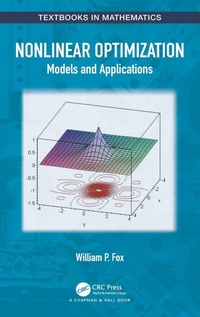
Nonlinear Optimization
Models and Applications
1st Edition
Published on 24. December 2020
Book
Hardback
394 pages
978-0-367-44415-0 (ISBN)
Description
Optimization is the act of obtaining the "best" result under given circumstances. In design, construction, and maintenance of any engineering system, engineers must make technological and managerial decisions to minimize either the effort or cost required or to maximize benefits. There is no single method available for solving all optimization problems efficiently. Several optimization methods have been developed for different types of problems. The optimum-seeking methods are mathematical programming techniques (specifically, nonlinear programming techniques).
Nonlinear Optimization: Models and Applications presents the concepts in several ways to foster understanding. Geometric interpretation: is used to re-enforce the concepts and to foster understanding of the mathematical procedures. The student sees that many problems can be analyzed, and approximate solutions found before analytical solutions techniques are applied. Numerical approximations: early on, the student is exposed to numerical techniques. These numerical procedures are algorithmic and iterative. Worksheets are provided in Excel, MATLAB (R), and Maple (TM) to facilitate the procedure. Algorithms: all algorithms are provided with a step-by-step format. Examples follow the summary to illustrate its use and application.
Nonlinear Optimization: Models and Applications:
Emphasizes process and interpretation throughout
Presents a general classification of optimization problems
Addresses situations that lead to models illustrating many types of optimization problems
Emphasizes model formulations
Addresses a special class of problems that can be solved using only elementary calculus
Emphasizes model solution and model sensitivity analysis
About the author:
William P. Fox is an emeritus professor in the Department of Defense Analysis at the Naval Postgraduate School. He received his Ph.D. at Clemson University and has taught at the United States Military Academy and at Francis Marion University where he was the chair of mathematics. He has written many publications, including over 20 books and over 150 journal articles. Currently, he is an adjunct professor in the Department of Mathematics at the College of William and Mary. He is the emeritus director of both the High School Mathematical Contest in Modeling and the Mathematical Contest in Modeling.
Nonlinear Optimization: Models and Applications presents the concepts in several ways to foster understanding. Geometric interpretation: is used to re-enforce the concepts and to foster understanding of the mathematical procedures. The student sees that many problems can be analyzed, and approximate solutions found before analytical solutions techniques are applied. Numerical approximations: early on, the student is exposed to numerical techniques. These numerical procedures are algorithmic and iterative. Worksheets are provided in Excel, MATLAB (R), and Maple (TM) to facilitate the procedure. Algorithms: all algorithms are provided with a step-by-step format. Examples follow the summary to illustrate its use and application.
Nonlinear Optimization: Models and Applications:
Emphasizes process and interpretation throughout
Presents a general classification of optimization problems
Addresses situations that lead to models illustrating many types of optimization problems
Emphasizes model formulations
Addresses a special class of problems that can be solved using only elementary calculus
Emphasizes model solution and model sensitivity analysis
About the author:
William P. Fox is an emeritus professor in the Department of Defense Analysis at the Naval Postgraduate School. He received his Ph.D. at Clemson University and has taught at the United States Military Academy and at Francis Marion University where he was the chair of mathematics. He has written many publications, including over 20 books and over 150 journal articles. Currently, he is an adjunct professor in the Department of Mathematics at the College of William and Mary. He is the emeritus director of both the High School Mathematical Contest in Modeling and the Mathematical Contest in Modeling.
More details
Series
Language
English
Place of publication
Oxford
United Kingdom
Publishing group
Taylor & Francis Ltd
Target group
College/higher education
Illustrations
50 s/w Abbildungen, 49 s/w Tabellen
49 Tables, black and white; 50 Illustrations, black and white
Dimensions
Height: 240 mm
Width: 161 mm
Thickness: 27 mm
Weight
790 gr
ISBN-13
978-0-367-44415-0 (9780367444150)
Copyright in bibliographic data and cover images is held by Nielsen Book Services Limited or by the publishers or by their respective licensors: all rights reserved.
Schweitzer Classification
Other editions
Additional editions
Book
08/2024
1st Edition
Chapman & Hall/CRC
€86.80
Shipment within 15-20 days
E-Book
12/2020
1st Edition
Chapman & Hall/CRC
€78.99
Available for download
E-Book
12/2020
1st Edition
Chapman & Hall/CRC
€78.99
Available for download
Person
Dr. William P. Fox is a professor in the Department of Defense Analysis at the Naval Postgraduate School and currently teaches a three course sequence in mathematical modeling for decision making. He received his Ph.D. at Clemson University. He has taught at the United States Military Academy and at Francis Marion University where he was the chair of mathematics for eight years. He has many publications and scholarly activities including sixteen books, one hundred and fifty journal articles, and about one hundred and fifty conference presentations, and workshops. He was Past- President of the Military Application Society of INFORMS and is the current Vice Chair for Programs for BIG SIGMAA.
Content
Chapter 1. Nonlinear Optimization Overview
1.1 Introduction
1.2 Modeling
1.3 Exercises
Chapter 2. Review of Single Variable Calculus Topics
2.1 Limits
2.2 Continuity
2.3 Differentiation
2.4 Convexity
Chapter 3. Single Variable Optimization
3.1 Introduction
3.2 Optimization Applications
3.3 Optimization Models
Constrained Optimization by Calculus
Chapter 4. Single Variable Search Methods
4.1 Introduction
4.2 Unrestricted Search
4.3 Dichotomous Search
4.4 Golden Section Search
4.5 Fibonacci Search
4.6 Newton's Method
4.7 Bisection Derivative Search
Chapter 5. Review of MV Calculus Topics
5.1 Introduction, Basic Theory, and Partial Derivatives
5.2 Directional Derivatives and The Gradient
Chapter 6. MV Optimization
6.1 Introduction
6.2 The Hessian
6.3 Unconstrained Optimization
Convexity and The Hessian Matrix
Max and Min Problems with Several Variables
Chapter 7. Multi-variable Search Methods
7.1 Introduction
7.2 Gradient Search
7.3 Modified Newton's Method
Chapter 8. Equality Constrained Optimization: Lagrange Multipliers
8.1 Introduction and Theory
8.2 Graphical Interpretation
8.3 Computational Methods
8.4 Modeling and Applications
Chapter 9. Inequality Constrained Optimization; Kuhn-Tucker Methods
9.1 Introduction
9.2 Basic Theory
9.3 Graphical Interpretation and Computational Methods
9.4 Modeling and Applications
Chapter 10. Method of Feasible Directions and Other Special NL Methods
10.1 Methods of Feasible Directions
Numerical methods (Directional Searches)
Starting Point Methods
10.2 Separable Programming
10.3 Quadratic Programming
Chapter 11. Dynamic Programming
11.1 Introduction
11.2 Continuous Dynamic Programming
11.3 Modeling and Applications with Continuous DP
11.4 Discrete Dynamic Programming
11.5 Modeling and Applications with Discrete Dynamic Programming
1.1 Introduction
1.2 Modeling
1.3 Exercises
Chapter 2. Review of Single Variable Calculus Topics
2.1 Limits
2.2 Continuity
2.3 Differentiation
2.4 Convexity
Chapter 3. Single Variable Optimization
3.1 Introduction
3.2 Optimization Applications
3.3 Optimization Models
Constrained Optimization by Calculus
Chapter 4. Single Variable Search Methods
4.1 Introduction
4.2 Unrestricted Search
4.3 Dichotomous Search
4.4 Golden Section Search
4.5 Fibonacci Search
4.6 Newton's Method
4.7 Bisection Derivative Search
Chapter 5. Review of MV Calculus Topics
5.1 Introduction, Basic Theory, and Partial Derivatives
5.2 Directional Derivatives and The Gradient
Chapter 6. MV Optimization
6.1 Introduction
6.2 The Hessian
6.3 Unconstrained Optimization
Convexity and The Hessian Matrix
Max and Min Problems with Several Variables
Chapter 7. Multi-variable Search Methods
7.1 Introduction
7.2 Gradient Search
7.3 Modified Newton's Method
Chapter 8. Equality Constrained Optimization: Lagrange Multipliers
8.1 Introduction and Theory
8.2 Graphical Interpretation
8.3 Computational Methods
8.4 Modeling and Applications
Chapter 9. Inequality Constrained Optimization; Kuhn-Tucker Methods
9.1 Introduction
9.2 Basic Theory
9.3 Graphical Interpretation and Computational Methods
9.4 Modeling and Applications
Chapter 10. Method of Feasible Directions and Other Special NL Methods
10.1 Methods of Feasible Directions
Numerical methods (Directional Searches)
Starting Point Methods
10.2 Separable Programming
10.3 Quadratic Programming
Chapter 11. Dynamic Programming
11.1 Introduction
11.2 Continuous Dynamic Programming
11.3 Modeling and Applications with Continuous DP
11.4 Discrete Dynamic Programming
11.5 Modeling and Applications with Discrete Dynamic Programming