

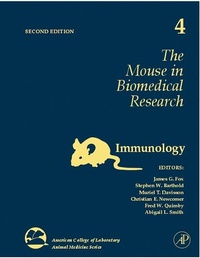
The Mouse in Biomedical Research: Volume 4
Immunology
2nd Edition
Published on 15. December 2006
Book
Hardback
392 pages
978-0-12-369458-4 (ISBN)
Description
Immunology, the third volume in the four volume set, The Mouse in Biomedical Research, is a completely new addition to this series, dedicated to mouse immunology. It is based on the vast body of knowledge which has made the mouse the model of choice when studying immunity in man. Arguably more is known about the immune system in mice than any other species except man. In large part this is due to the power of genetic engineering to delineate molecular mechanisms. In this volume we present an Overview to mouse immunology, including both the innate and adaptive immune systems, followed by 15 chapters, each dealing with a specific area of immunology in the mouse. These chapters illustrate the power of genetic engineering in dissecting each component of the immune response from the development of lymphoid tissues to signal transduction pathways in activated cells.
More details
Series
Edition
2nd edition
Language
English
Place of publication
San Diego
United States
Publishing group
Elsevier Science Publishing Co Inc
Target group
Professional and scholarly
Veterinary and medical students, graduate students, post-docs, immunologists, and researchers who utilize animals in biomedical research
Edition type
New edition
Product notice
sewn/stitched
Paper over boards
Illustrations
Illustrated; Illustrations
Dimensions
Height: 288 mm
Width: 223 mm
Thickness: 27 mm
Weight
1309 gr
ISBN-13
978-0-12-369458-4 (9780123694584)
Schweitzer Classification
Other editions
Additional editions
The Mouse in Biomedical Research
Immunology
E-Book
12/2006
2nd Edition
Academic Press
€110.00
Available for download
Persons
Prof. James G. Fox obtained his Doctor of Veterinary Medicine at Colorado State University, Fort Collins, and, as an NIH postdoctoral fellow, received a Master of Science in Medical Microbiology at Stanford University. Dr. Fox is an adjunct professor at Tufts University School of Veterinary Medicine. He is a diplomate and a past president of the American College of Laboratory Animal Medicine, as well as a past president of the Massachusetts Society for Medical Research and the American Association of Veterinary Medical Colleges. Additionally, he has served as past chairman of the AAALAC Council and the NCCR/NIH Comparative Medicine Study Section. He is also an elected fellow of the Infectious Disease Society of America and the American Gastroenterological Association. He was recruited to MIT and created the Division of Comparative Medicine, which he directed from 1974 until 2021. As a faculty member in the MIT Department of Biological Engineering, Professor Fox received numerous scientific awards and was elected to the National Academy of Medicine in 2004. Dr. Fox has been the principal investigator of an NIH postdoctoral training grant for veterinarians for 30 years and has trained 90 veterinarians for careers in biomedical research. The NIH has continuously funded him to study infectious diseases of the gastrointestinal tract, where he has studied the gastrointestinal microbiome and how it interfaces with and influences the host's immune response to gastrointestinal pathogens, particularly oncogenic Helicobacter species. He has authored over 600 papers, 84 chapters, holds 4 patents and has authored or edited 18 comparative medicine texts.
Volume editor
Division of Comparative Medicine, Department of Biological Engineering, MIT, Cambridge, MA, USA
Center for Comparative Medicine,
UC Davis School of Veterinary Medicine,
Davis CA
UC Davis School of Veterinary Medicine,
Davis CA
The Jackson Laboratory,
Bar Harbor, Maine
Bar Harbor, Maine
Research Animal Resources and Department of
Molecular and Comparative Pathobiology,
Johns Hopkins University,
Baltimore, MD
Molecular and Comparative Pathobiology,
Johns Hopkins University,
Baltimore, MD
Laboratory Animal Research Center,
The Rockefeller University,
New York, NY
The Rockefeller University,
New York, NY
School of Veterinary Medicine,
University of Pennsylvania
Philadelphia, PA
University of Pennsylvania
Philadelphia, PA
Content
1. The Molecular Basis of Lymphoid Architecture in the Mouse
2. The Biology of Toll-like Receptors in Mice
3. Genomic Organization of the Mouse Major Histocompatibility Complex
4. Some Biological Features of Dendritic Cells in the Mouse
5. Mouse Models Revealed the Mechanisms for Somatic Hypermutation and Class Switch
Recombination of Immunoglobulin Genes
6. Mouse Natural Killer Cells: Function and Activation
7. Cytokine-activated JAK-STAT Signaling in the Mouse Immune System
8. Signal Transduction Events Regulating Integrin Function and T Cell Migration in the Mouse
9. Mouse Models of Negative Selection
10. Peripheral Tolerance of T Cells in the Mouse
11. The Genetics of Mouse Models of Systemic Lupus
12. Inhibitory Receptors and Autoimmunity in the Mouse
13. Mouse Models of Immunodeficiency
14. Mouse Models to Study the Pathogenesis of Allergic Asthma
15. The Mouse Trap: How Well Do Mice Model Human Immunology?
2. The Biology of Toll-like Receptors in Mice
3. Genomic Organization of the Mouse Major Histocompatibility Complex
4. Some Biological Features of Dendritic Cells in the Mouse
5. Mouse Models Revealed the Mechanisms for Somatic Hypermutation and Class Switch
Recombination of Immunoglobulin Genes
6. Mouse Natural Killer Cells: Function and Activation
7. Cytokine-activated JAK-STAT Signaling in the Mouse Immune System
8. Signal Transduction Events Regulating Integrin Function and T Cell Migration in the Mouse
9. Mouse Models of Negative Selection
10. Peripheral Tolerance of T Cells in the Mouse
11. The Genetics of Mouse Models of Systemic Lupus
12. Inhibitory Receptors and Autoimmunity in the Mouse
13. Mouse Models of Immunodeficiency
14. Mouse Models to Study the Pathogenesis of Allergic Asthma
15. The Mouse Trap: How Well Do Mice Model Human Immunology?