

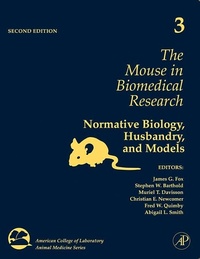
The Mouse in Biomedical Research: Volume 3
Normative Biology, Husbandry, and Models
2nd Edition
Published on 15. December 2006
Book
Hardback
816 pages
978-0-12-369457-7 (ISBN)
Description
Normative Biology, Husbandry, and Models, the third volume in the four volume set, The Mouse in Biomedical Research, encompasses 23 chapters whose contents provide a broad overview on the laboratory mouse's normative biology, husbandry, and its use as a model in biomedical research. This consists of chapters on behavior, physiology, reproductive physiology, anatomy, endocrinology, hematology, and clinical chemistry. Other chapters cover management, as well as nutrition, gnotobiotics and disease surveillance. There are also individual chapters describing the mouse as a model for the study of aging, eye research, neurodegenerative diseases, convulsive disorders, diabetes, and cardiovascular and skin diseases. Chapters on imaging techniques and the use of the mouse in assays of biological products are also included.
More details
Series
Edition
2nd edition
Language
English
Place of publication
San Diego
United States
Publishing group
Elsevier Science Publishing Co Inc
Target group
Professional and scholarly
Veterinary and medical students, senior graduate, graduate students, post-docs, and researchers who utilize animals in biomedical research
Edition type
New edition
Product notice
Unsewn / adhesive bound
Paper over boards
Illustrations
Approx. 210 illustrations; Illustrations
Dimensions
Height: 284 mm
Width: 220 mm
Thickness: 38 mm
Weight
2127 gr
ISBN-13
978-0-12-369457-7 (9780123694577)
Schweitzer Classification
Other editions
Additional editions
The Mouse in Biomedical Research
Normative Biology, Husbandry, and Models
E-Book
12/2006
2nd Edition
Academic Press
€200.00
Available for download
Persons
Prof. James G. Fox obtained his Doctor of Veterinary Medicine at Colorado State University, Fort Collins, and, as an NIH postdoctoral fellow, received a Master of Science in Medical Microbiology at Stanford University. Dr. Fox is an adjunct professor at Tufts University School of Veterinary Medicine. He is a diplomate and a past president of the American College of Laboratory Animal Medicine, as well as a past president of the Massachusetts Society for Medical Research and the American Association of Veterinary Medical Colleges. Additionally, he has served as past chairman of the AAALAC Council and the NCCR/NIH Comparative Medicine Study Section. He is also an elected fellow of the Infectious Disease Society of America and the American Gastroenterological Association. He was recruited to MIT and created the Division of Comparative Medicine, which he directed from 1974 until 2021. As a faculty member in the MIT Department of Biological Engineering, Professor Fox received numerous scientific awards and was elected to the National Academy of Medicine in 2004. Dr. Fox has been the principal investigator of an NIH postdoctoral training grant for veterinarians for 30 years and has trained 90 veterinarians for careers in biomedical research. The NIH has continuously funded him to study infectious diseases of the gastrointestinal tract, where he has studied the gastrointestinal microbiome and how it interfaces with and influences the host's immune response to gastrointestinal pathogens, particularly oncogenic Helicobacter species. He has authored over 600 papers, 84 chapters, holds 4 patents and has authored or edited 18 comparative medicine texts.
Volume editor
Division of Comparative Medicine, Department of Biological Engineering, MIT, Cambridge, MA, USA
Center for Comparative Medicine,
UC Davis School of Veterinary Medicine,
Davis CA
UC Davis School of Veterinary Medicine,
Davis CA
The Jackson Laboratory,
Bar Harbor, Maine
Bar Harbor, Maine
Research Animal Resources and Department of
Molecular and Comparative Pathobiology,
Johns Hopkins University,
Baltimore, MD
Molecular and Comparative Pathobiology,
Johns Hopkins University,
Baltimore, MD
Laboratory Animal Research Center,
The Rockefeller University,
New York, NY
The Rockefeller University,
New York, NY
School of Veterinary Medicine,
University of Pennsylvania
Philadelphia, PA
University of Pennsylvania
Philadelphia, PA
Content
1: Gross Anatomy
2: Mouse Physiology
3: Reproductive Biology of the Laboratory Mouse
4: Endocrinology: Bone as a Target Tissue for Hormonal Regulation
5: Hematology of the Laboratory Mouse
6: Clinical Chemistry of the Laboratory Mouse
Management, Techniques, and Husbandry
7: Gnotobiotics
8: Management and Design: Breeding Facilities
9: Design and Management of Research Facilities for Mice
10: Nutrition
11: Health Delivery and Quality Assurance Programs for Mice
12: Environmental and Equipment Monitoring
13: Biomethodology and Surgical Techniques
14: In-Vivo Whole-Body Imaging of the Laboratory Mouse
Use of Mice in Biomedical Research
15: Behavioral Testing
16: Cardiovascular Disease: Mouse Models of Atherosclerosis
17: Convulsive Disorders
18: Eye Research
19: Genetic Analysis of Rodent Obesity and Diabetes
20: Mouse Models in Aging Research
21: Mouse Models of Inherited Human Neurodegenerative Disease
22: Mouse Skin Ectodermal Organs
23: Quality Control Testing of Biologics
2: Mouse Physiology
3: Reproductive Biology of the Laboratory Mouse
4: Endocrinology: Bone as a Target Tissue for Hormonal Regulation
5: Hematology of the Laboratory Mouse
6: Clinical Chemistry of the Laboratory Mouse
Management, Techniques, and Husbandry
7: Gnotobiotics
8: Management and Design: Breeding Facilities
9: Design and Management of Research Facilities for Mice
10: Nutrition
11: Health Delivery and Quality Assurance Programs for Mice
12: Environmental and Equipment Monitoring
13: Biomethodology and Surgical Techniques
14: In-Vivo Whole-Body Imaging of the Laboratory Mouse
Use of Mice in Biomedical Research
15: Behavioral Testing
16: Cardiovascular Disease: Mouse Models of Atherosclerosis
17: Convulsive Disorders
18: Eye Research
19: Genetic Analysis of Rodent Obesity and Diabetes
20: Mouse Models in Aging Research
21: Mouse Models of Inherited Human Neurodegenerative Disease
22: Mouse Skin Ectodermal Organs
23: Quality Control Testing of Biologics