

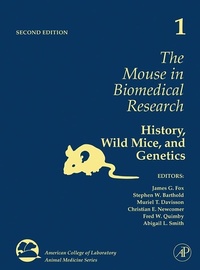
The Mouse in Biomedical Research: Volume 1
History, Wild Mice, and Genetics
2nd Edition
Published on 5. January 2007
Book
Hardback
344 pages
978-0-12-369455-3 (ISBN)
Description
History, Wild Mice, and Genetics, the first volume in the four volume set, The Mouse in Biomedical Research, provides information about the history, biology and genomics of the laboratory mouse (Mus musculus), as well as basic information on maintenance and use of mouse stocks. Mouse origins and relationships are covered in chapters on history, evolutionary taxonomy and wild mice. Genetics and genomics of the mouse are covered in chapters on genetic nomenclature, gene mapping, cytogenetics and the molecular organization of the mouse genome. Maintenance of laboratory mice is described in chapters on breeding systems for various types of strains and stocks and genetic monitoring. Use of the mouse as a model system for basic biomedical research is described in chapters on chemical mutagenesis, gene trapping, pharmacogenetics and embryo manipulation. The information in Volume 1 serves as a primer for scientists new to the field of mouse research.
More details
Series
Edition
2nd edition
Language
English
Place of publication
San Diego
United States
Publishing group
Elsevier Science Publishing Co Inc
Target group
Professional and scholarly
Researchers in laboratory medicine, genetics, immunology, infectious diseases and lab animals
Edition type
New edition
Product notice
Unsewn / adhesive bound
Paper over boards
Illustrations
Approx. 100 illustrations; Illustrations
Dimensions
Height: 285 mm
Width: 220 mm
Thickness: 23 mm
Weight
1179 gr
ISBN-13
978-0-12-369455-3 (9780123694553)
Schweitzer Classification
Other editions
Additional editions
The Mouse in Biomedical Research
History, Wild Mice, and Genetics
E-Book
12/2006
2nd Edition
Academic Press
€105.00
Available for download
Persons
Prof. James G. Fox obtained his Doctor of Veterinary Medicine at Colorado State University, Fort Collins, and, as an NIH postdoctoral fellow, received a Master of Science in Medical Microbiology at Stanford University. Dr. Fox is an adjunct professor at Tufts University School of Veterinary Medicine. He is a diplomate and a past president of the American College of Laboratory Animal Medicine, as well as a past president of the Massachusetts Society for Medical Research and the American Association of Veterinary Medical Colleges. Additionally, he has served as past chairman of the AAALAC Council and the NCCR/NIH Comparative Medicine Study Section. He is also an elected fellow of the Infectious Disease Society of America and the American Gastroenterological Association. He was recruited to MIT and created the Division of Comparative Medicine, which he directed from 1974 until 2021. As a faculty member in the MIT Department of Biological Engineering, Professor Fox received numerous scientific awards and was elected to the National Academy of Medicine in 2004. Dr. Fox has been the principal investigator of an NIH postdoctoral training grant for veterinarians for 30 years and has trained 90 veterinarians for careers in biomedical research. The NIH has continuously funded him to study infectious diseases of the gastrointestinal tract, where he has studied the gastrointestinal microbiome and how it interfaces with and influences the host's immune response to gastrointestinal pathogens, particularly oncogenic Helicobacter species. He has authored over 600 papers, 84 chapters, holds 4 patents and has authored or edited 18 comparative medicine texts.
Volume editor
Division of Comparative Medicine, Department of Biological Engineering, MIT, Cambridge, MA, USA
Center for Comparative Medicine,
UC Davis School of Veterinary Medicine,
Davis CA
UC Davis School of Veterinary Medicine,
Davis CA
The Jackson Laboratory,
Bar Harbor, Maine
Bar Harbor, Maine
Research Animal Resources and Department of
Molecular and Comparative Pathobiology,
Johns Hopkins University,
Baltimore, MD
Molecular and Comparative Pathobiology,
Johns Hopkins University,
Baltimore, MD
Laboratory Animal Research Center,
The Rockefeller University,
New York, NY
The Rockefeller University,
New York, NY
School of Veterinary Medicine,
University of Pennsylvania
Philadelphia, PA
University of Pennsylvania
Philadelphia, PA
Content
1. Building a Better Mouse: One Hundred Years of Genetics and Biology
2. Systematics of the genus Mus
3. The Secret World of Wild Mice
4. Breeding Systems: Considerations, Genetic Fundamentals, Genetic Background, and Strain Types
5. Mouse Strain and Genetic Nomenclature: an Abbreviated Guide
6. The Mouse Genome
7. Gene Mapping
8. Genetic Monitoring
9. Cytogenetics
10. Mouse Embryology: Research Techniques and a Comparison of Embryonic Development between Mouse and Man
11. Gamete and Embryo Manipulation
12. Chemical Mutagenesis in Mice
13. Gene-Specific Mutagenesis
14. Gene Transfer Studies Using Mouse Models
15. Mouse and Human Pluripotent Stem Cells
16. Drugs and the Mouse: Pharmacology, Pharmacogenetics, and Pharmacogenomics
2. Systematics of the genus Mus
3. The Secret World of Wild Mice
4. Breeding Systems: Considerations, Genetic Fundamentals, Genetic Background, and Strain Types
5. Mouse Strain and Genetic Nomenclature: an Abbreviated Guide
6. The Mouse Genome
7. Gene Mapping
8. Genetic Monitoring
9. Cytogenetics
10. Mouse Embryology: Research Techniques and a Comparison of Embryonic Development between Mouse and Man
11. Gamete and Embryo Manipulation
12. Chemical Mutagenesis in Mice
13. Gene-Specific Mutagenesis
14. Gene Transfer Studies Using Mouse Models
15. Mouse and Human Pluripotent Stem Cells
16. Drugs and the Mouse: Pharmacology, Pharmacogenetics, and Pharmacogenomics