

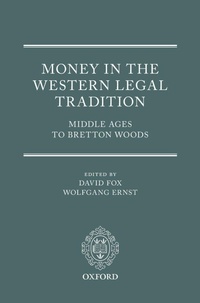
Money in the Western Legal Tradition
Middle Ages to Bretton Woods
Published on 11. February 2016
Book
Hardback
920 pages
978-0-19-870474-4 (ISBN)
Description
Monetary law is essential to the functioning of private transactions and international dealings by the state: nearly every legal transaction has a monetary aspect. Money in the Western Legal Tradition presents the first comprehensive analysis of Western monetary law, covering the civil law and Anglo-American common law legal systems from the High Middle Ages up to the middle of the 20th century. Weaving a detailed tapestry of the changing concepts of money
and private transactions throughout the ages, the contributors investigate the special contribution made by legal scholars and practitioners to our understanding of money and the laws that govern it.
Divided in five parts, the book begins with the coin currency of the Middle Ages, moving through the invention of nominalism in the early modern period to cashless payment and the rise of the banking system and paper money, then charting the progression to fiat money in the modern era. Each part commences with an overview of the monetary environment for the historical period written by an economic historian or numismatist. These are followed by chapters describing the legal doctrines of each
period in civil and common law. Each section contains examples of contemporary litigation or statute law which engages with the distinctive issues affecting the monetary law of the period. This interdisciplinary approach reveals the distinctive conception of money prevalent in each period, which either
facilitated or hampered the implementation of economic policy and the operation of private transactions.
and private transactions throughout the ages, the contributors investigate the special contribution made by legal scholars and practitioners to our understanding of money and the laws that govern it.
Divided in five parts, the book begins with the coin currency of the Middle Ages, moving through the invention of nominalism in the early modern period to cashless payment and the rise of the banking system and paper money, then charting the progression to fiat money in the modern era. Each part commences with an overview of the monetary environment for the historical period written by an economic historian or numismatist. These are followed by chapters describing the legal doctrines of each
period in civil and common law. Each section contains examples of contemporary litigation or statute law which engages with the distinctive issues affecting the monetary law of the period. This interdisciplinary approach reveals the distinctive conception of money prevalent in each period, which either
facilitated or hampered the implementation of economic policy and the operation of private transactions.
More details
Other editions
Additional editions
E-Book
01/2016
OUP eBook
€133.99
Available for download
E-Book
01/2016
OUP eBook
€144.99
Available for download
Persons
David Fox is a University Lecturer in the Faculty of Law and Fellow of St John's College, University of Cambridge. He specializes in law of property, trusts, and the legal aspects of money, and his publications include Property Rights in Money (2008).
Wolfgang Ernst is Regius Professor of Civil Law in the University of Oxford, and Fellow of All Souls College.
Wolfgang Ernst is Regius Professor of Civil Law in the University of Oxford, and Fellow of All Souls College.
Content
1 David Fox: Introduction; 2 Christine Desan: Money as a Legal Institution; Part I. Coins and the Law; Martin Allen: Currency Depreciation and Debasement in Medieval Europe; Fabian Wittreck: Money in Medieval Philosophy; Thomas Rufner: Money in the Roman Law Texts; Wolfgang Ernst: The Legists' Doctrines on Money and the Law, Eleventh to Fifteenth Centuries; Andreas Thier: Money in Medieval Canon Law; Wim Decock: The Spanish Scholastics on Money and Credit; Stefan Kotz: Gabriel Biel's Monetary Theory; Alain Wijffels: The 'Reduction' of Money in the Low Countries, c. 1489-1515; Part II. Money in the Early Modern Period: Inventing Nominalism; Michael North: Monetary Reforms in the Holy Roman Empire, Fifteenth and Sixteenth Centuries; David Fox: The Enforcement of Nominal Values of Money in Medieval and Early Modern Common Law; David Fox: The Case of Mixt Monies (1604); Harry Dondorp: The Effects of Debasements on Debts in Early Modern Jurisprudence; Clausdieter Schott: German Law Faculties and Benches of Jurymen (Schoffenstuhle) on Loans and Inflation: Legal Doctrine and Seventeenth Century Legal Practice; Anja Amend-Traut: Early Modern Monetary Policy in the Light of Contemporary Adjudication; Part III. The Emergence of Cashless Payment: Bank Money; William Roberds and Francois Velde: Early Public Banks I: Ledger Money Banks; Benjamin Geva: The Order to Pay Money in Medieval Continental Europe; James Steven Rogers: Early English Law of Checks; Benjamin Geva: 'Bank Money': The Rise, Fall, and Metamorphosis of the 'Transferable Deposit in Common Law; Stephan Meder: Giro Payments and the Beginning of the Modern Cashless Payment System; Part IV. The Emergence of Paper Money; William Roberds and Francois Velde: Early Public Banks II: Banks of Issue; Helmut Siekmann: Deposit Banking and the Use of Monetary Instruments; James Steven Rogers: Early English Law of Bank Notes; Kenneth G.C. Reid: Bank Notes and their Vindication in Eighteenth Century Scotland; Rastko Vrbaski: Multiple Currency Clauses and Currency Reform: The Austrian Coupon Cases; Part V. Fiat Money; Michael Bordo and Angela Redish: Putting the 'System' in the International Monetary System; Peter Kugler: The Bretton Woods System: Design and Operation; Francois Velde: Hyper-Inflations in the Early Twentieth Century; L. Randall Wray: From the State Theory of Money to Modern Monetary Theory; Roy Kreitner: Responses to Crisis: Re-configuring the Monetary and the Fiscal in the Great Depression; David Fox: Monetary Obligations and the Fragmentation of the Sterling Monetary Union; Jan Thiessen: The German Hyper-Inflation of the 1920s; Case Study: Swedish Government Bonds, their Gold Dollar Clause and the 1933 Roosevelt Act