

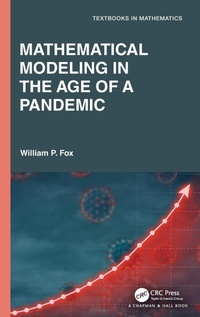
Mathematical Modeling in the Age of the Pandemic
1st Edition
Published on 10. June 2021
Book
Hardback
164 pages
978-0-367-70312-7 (ISBN)
Description
One cannot watch or read about the news these days without hearing about the models for COVID-19 or the testing that must occur to approve vaccines or treatments for the disease.
The purpose of Mathematical Modeling in the Age of a Pandemic is to shed some light on the meaning and interpretations of many of the types of models that are or might be used in the presentation of analysis. Understanding the concepts presented is essential in the entire modeling process of a pandemic.
From the virus itself and its infectious rates and deaths rates to explain the process for testing a vaccine or eventually a cure, the author builds, presents, and shows model testing.
This book is an attempt, based on available data, to add some validity to the models developed and used, showing how close to reality the models are to predicting "results" from previous pandemics such as the Spanish flu in 1918 and more recently the Hong Kong flu. Then the author applies those same models to Italy, New York City, and the United States as a whole.
Modeling is a process. It is essential to understand that there are many assumptions that go into the modeling of each type of model. The assumptions influence the interpretation of the results. Regardless of the modeling approach the results generally indicate approximately the same results. This book reveals how these interesting results are obtained.
The purpose of Mathematical Modeling in the Age of a Pandemic is to shed some light on the meaning and interpretations of many of the types of models that are or might be used in the presentation of analysis. Understanding the concepts presented is essential in the entire modeling process of a pandemic.
From the virus itself and its infectious rates and deaths rates to explain the process for testing a vaccine or eventually a cure, the author builds, presents, and shows model testing.
This book is an attempt, based on available data, to add some validity to the models developed and used, showing how close to reality the models are to predicting "results" from previous pandemics such as the Spanish flu in 1918 and more recently the Hong Kong flu. Then the author applies those same models to Italy, New York City, and the United States as a whole.
Modeling is a process. It is essential to understand that there are many assumptions that go into the modeling of each type of model. The assumptions influence the interpretation of the results. Regardless of the modeling approach the results generally indicate approximately the same results. This book reveals how these interesting results are obtained.
More details
Series
Language
English
Place of publication
Oxford
United Kingdom
Publishing group
Taylor & Francis Ltd
Target group
College/higher education
Undergraduate Advanced
Illustrations
78 s/w Abbildungen, 78 s/w Zeichnungen, 24 s/w Tabellen
24 Tables, black and white; 78 Line drawings, black and white; 78 Illustrations, black and white
Dimensions
Height: 240 mm
Width: 161 mm
Thickness: 14 mm
Weight
435 gr
ISBN-13
978-0-367-70312-7 (9780367703127)
Copyright in bibliographic data and cover images is held by Nielsen Book Services Limited or by the publishers or by their respective licensors: all rights reserved.
Schweitzer Classification
Other editions
Additional editions
William P. Fox
Mathematical Modeling in the Age of the Pandemic
Book
09/2021
1st Edition
Chapman & Hall/CRC
€107.40
Shipment within 15-20 days
William P. Fox
Mathematical Modeling in the Age of the Pandemic
E-Book
06/2021
1st Edition
Chapman & Hall/CRC
€100.99
Available for download
William P. Fox
Mathematical Modeling in the Age of the Pandemic
E-Book
06/2021
1st Edition
Chapman & Hall/CRC
€100.99
Available for download
Person
Dr. William P. Fox is an Emeritus Professor in the Department of Defense Analysis at the Naval Postgraduate School. Currently, he is a Visitng Professor of Computational Operations Research in the Department of Mathematics at the College of William and Mary. He received his BS degree from the United States Military Academy at West Point, New York, his MS in operations research from the Naval Postgraduate School, and his Ph.D. in Industrial Engineering from Clemson University. He has taught at the United States Military Academy, at Francis Marion University where he was the chair of mathematics for eight years, and twelve years at the Naval Postgraduate School. He has many publications and scholarly activities including over twenty books (6 with CRC Press), twenty-two chapters of books & technical reports, one hundred and fifty journal articles, and over one hundred and fifty conference presentations and mathematical modeling workshops.
Content
Preface
1. Modeling as a Process
2. DISCRETE DYNAMICAL SYSTEM MODELS
3. Modeling Coupled Systems of Discrete Dynamical Systems
4. Modeling with Differential Equation
5. Systems of Differential Equations
6. Probabilistic Models
7. Hypothesis Tests
8. Two Samples Hypothesis test (means and proportions)
9. Agent Based Model with NetLogo
10. Concluding Remarks and Epilogue
References
Index
1. Modeling as a Process
2. DISCRETE DYNAMICAL SYSTEM MODELS
3. Modeling Coupled Systems of Discrete Dynamical Systems
4. Modeling with Differential Equation
5. Systems of Differential Equations
6. Probabilistic Models
7. Hypothesis Tests
8. Two Samples Hypothesis test (means and proportions)
9. Agent Based Model with NetLogo
10. Concluding Remarks and Epilogue
References
Index